TB42E at a glance
Nissan's TB42E is the fuel-injected version of the TB42 straight six, best known from the Y60 Patrol. It's an old-school design: a distributor that carries both the crank and cam signals, an external igniter feeding a single coil, a cable throttle and a pair of solenoid idle air valves. None of that is a problem for a Haltech ECU, but a few details are different from the modern engines most people wire up.
| Spec | TB42E |
|---|---|
| Layout | Inline 6, cylinder 1 at the front |
| Displacement | 4169 cc (254 ci) |
| Firing order | 1-5-3-6-2-4 |
| Compression | 8.3:1 |
| Factory injector size | About 260 cc/min |
Which Haltech ECU fits
For a Y60 Patrol, the easiest path is a plug-in kit. Haltech offers plug 'n' play adaptor harness kits for the Elite 750 and Elite 2500, such as the Elite 750 Y60 TB42 kit and the Elite 2500 Y60 TB42 kit. The factory ECU sits under the carpet in the passenger footwell, so the swap is mostly a matter of pulling the carpet back and unplugging the old unit.
If the engine has been swapped into something else, or you want a clean custom loom, a universal harness with a Nexus R3 or Nexus R5 works well too. The rest of this article covers what you need to know either way.
The distributor trigger
The crank and cam signals both come from an optical sensor inside the distributor at the front of the engine. It reads a slotted disc with two rings:
- Outer ring: 360 fine slits, one per degree. This is the high-resolution position signal, and it goes to the Haltech Home input.
- Inner ring: 6 slits, one per cylinder, 120 degrees apart. Five are the same width and one is wider. This goes to the Trigger input.
The ECU finds cylinder 1 by counting how many fine slits pass during each of the six windows. The wide window has more of them, and that's the sync point.
| Signal | Distributor pin | Haltech cable and color |
|---|---|---|
| Ground | 1 | Trigger 4-core, blue |
| Switched 12V feed | 2 | Trigger 4-core, red |
| 360 slit (fine) signal | 3 | Home 4-core, yellow (Home+) |
| 6 slit (cylinder) signal | 4 | Trigger 4-core, yellow (Trigger+) |
Some Y60 Patrols have the 6x and 360x pins arranged the other way around. If the ECU never gets full trigger sync while cranking, swap Trigger+ and Home+ and try again before chasing anything else.
Running everything through one shielded cable
On a Haltech universal harness, the distributor only needs four conductors: power, ground, Trigger+ and Home+. The Trigger- wire isn't used on this optical sensor, and in the Home cable only Home+ is needed. That means you can move one pin at the ECU plug and run the whole distributor off the Trigger 4-core, then leave out (or remove) the Home cable entirely. The job is: take the unused yellow Home+ wire out of its ECU pin and insulate it, then move the green Trigger- wire into that Home+ pin position.
| ECU | Yellow wire to remove and insulate | Green wire to move |
|---|---|---|
| Elite 550 / 750 / 950 | A32 | A33 to A32 |
| Elite 1000 / 1500 / 2000 / 2500 | B2 | B5 to B2 |
| Nexus R3 / R5 | C3 | C2 to the pin the yellow wire came out of |
Double check the pin positions against your harness diagram before you start pulling terminals. Our wiring diagram library has the harness drawings, and if you're unsure about the Nexus step, ask us.
Ignition: always go through the igniter
The factory setup is a single coil fed by an external igniter, with the distributor sending spark to each cylinder. Wire Haltech Ignition Output 1 to the igniter, and let the igniter drive the coil. The ECU's ignition outputs are low-current logic signals. Connecting one straight to the factory coil will damage the ECU.
A popular upgrade is a stronger coil with a built-in igniter, like the IGN-1A coil or the LS1-style coil. Because the igniter is inside the coil, those can be driven directly from Ignition Output 1. Follow the coil's own instructions for wiring and dwell, and see our notes on dwell time.
Injectors
The stock injectors flow roughly 260 cc/min, which is fine for a stock or lightly modified engine. Enter the injector flow and dead time data carefully. Dead time covers the slice of each pulse where the injector is still opening or closing, and getting it wrong shows up as poor idle and inconsistent light-load fueling.
Wiring depends on how many injector outputs your ECU has:
- Elite 750, 950, 2000, 2500 and Nexus R3 / R5: full sequential. Injector output 1 to cylinder 1, output 2 to cylinder 2, and so on through 6.
- Elite 550, 1000, 1500: not enough injector outputs for full sequential on a six, so we don't recommend them here. If you must, run semi-sequential in pairs: output 1 to cylinders 1 and 6, output 2 to 2 and 5, output 3 to 3 and 4.
Sensors
| Sensor | Factory fit | How to connect it |
|---|---|---|
| MAP | None | Use the ECU's internal 4 bar sensor (rated to about 43 psi absolute, so roughly 29 psi of boost at sea level), or an external sensor on a spare AVI |
| Throttle position | Two plugs: a round variable one and a square idle/full switch | Only the round, variable connector is needed. The ECU works out closed and wide open from its calibration |
| Coolant temp | 2-pin sensor | One pin to a spare AVI, one to signal ground. Use the built-in "Temperature - Nissan TB42E Y60 Coolant Sensor.cal" calibration |
| Air temp | None | Add a Haltech 1/8" NPT air temp sensor, wired like the coolant sensor, with the "Temperature - GM Air Sensor.cal" calibration |
| MAF | Air flow meter | Most people remove it and tune speed density on MAP. It can still be wired up if you prefer |
Both temperature sensors are two-wire parts, so polarity doesn't matter. What does matter is the pull-up: use an AVI with a selectable 1k pull-up to 5V, or add an external 1k pull-up if the input doesn't have one. The calibrations above assume that 1k pull-up.
Idle valves
The TB42E has two air bypass valves, and only one of them needs the ECU:
- AAC valve (the larger one): this is the real idle control valve. Give one pin ignition-switched 12V and connect the other to a spare ECU output. The ECU pulses it with PWM, and more duty opens it further for more idle speed. Set it up under idle control.
- FICD valve (the smaller one): a simple on/off valve that adds air when the A/C compressor runs. It can be wired to switch with the compressor and left off the ECU entirely.
O2 sensor and why we'd add a wideband
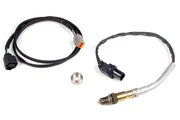
The factory sensor is a single-wire narrowband, which can go to an analog input (AVI 1 on an Elite 750, AVI 1 or 6 on an Elite 2500, or any AVI on a Nexus). A narrowband only really tells you whether you're rich or lean of stoichiometric, which isn't much use for tuning. We strongly recommend a wideband: the WB1 CAN wideband kit for Elite ECUs, or the LSU 4.9 sensor pack for Nexus units with onboard wideband control. That gives you accurate readings at every load and RPM, closed-loop fuel control across the map and lean protection. More in narrowband vs wideband.
Vehicle speed
On the Y60, the two-wire speed sensor feeds the speedometer, and the speedometer sends a cleaned-up digital signal on to the ECU. If you remove the factory cluster, for example to fit a digital dash, that signal disappears and you'll need to wire the ECU directly to the speed sensor instead.
Troubleshooting
| Symptom | Usually |
|---|---|
| Cranks, RPM shows, never syncs | Trigger+ and Home+ swapped for your model, or a wrong pin after the one-cable mod |
| No spark at all | Ignition Output 1 not going to the igniter, or igniter power missing |
| Coolant or air temp reads wildly off | Pull-up disabled on the AVI, or the wrong calibration file |
| Idle won't respond to changes | AAC valve missing its switched 12V, or wired to the FICD valve by mistake |
| No speed reading after a dash swap | The cluster was providing the signal. Wire the sensor to the ECU |
TB42 FAQ
Is there a base map for the TB42?
At the time of writing, no official base map was published. We set these up from a known-good starting file for similar engines and confirm everything on the dyno. Our base map basics article explains what a base map will and won't do for you.
Can I run the TB42 with an Elite 1500?
It will run with paired injectors, but you give up sequential injection on a six. For the small price difference we'd pick an Elite 750 or 2500 kit.
Does the TB45 or TB48 wire up the same way?
Don't assume they do. They're related engines, so check the dedicated guides before you wire anything: the TB45 and TB48 guides, or book a free consultation and we'll talk through your build.