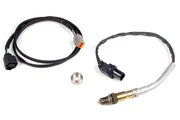
Which SR20 have you got?
Nissan built three broad families. The SR20DE is the naturally aspirated version. Every one runs a distributor, and the rocker covers are either red or bare. The SR20DET is the turbo engine most people are swapping or tuning. The SR20VE (and its smaller SR16VE sibling) has Nissan's NEO VVL variable valve lift. All of them are 1998cc (122 ci) four-cylinders firing 1-3-4-2, with cylinder 1 at the front.
Turbo engines vary by chassis, and the differences matter for wiring:
| Chassis | How to spot it | Ignition |
|---|---|---|
| S13 Silvia / 180SX | Flat red rocker cover | Direct fire |
| U13 Bluebird | Flat red cover, small intercooler sitting over the intake | Distributor |
| N14 Pulsar GTI-R | Flat red cover, big intercooler over the intake and cover, individual throttle bodies | Distributor |
| S14 200SX | Humped cover, variable cam | Direct fire with a separate igniter module |
| S15 200SX | Humped cover, variable cam | Direct fire, compact coils with built-in igniters |
Choosing a Haltech ECU
Every current Elite can run an SR20 with sequential injection and direct-fire ignition. The real question is whether you want to plug in or wire in. Plug-in installs are supported from the Elite 1000 up, and we stock Elite 1500 plug-in packages for the S13 / 180SX SR20DET, the S14 Zenki and the S15 / S14A. The Elite 550, 750 and 950 have no plug-in option, so they suit a wire-in harness.
- Cheap swap that just needs injectors, ignition and a couple of outputs: Elite 550.
- Same, but you want long-term fuel learning, internal logging or flex fuel: Elite 750 or 950.
- Plug-in install that keeps the whole car working: Elite 1000.
- Plug-in with the advanced features: Elite 1500 or Nexus S2.
- Extra injector drivers or simply more outputs: Elite 2500 or Nexus S3.
There's also the Platinum Pro plug-in, which fits the S13 Type X, S14 Series 2 and both JDM and Australian S15s (other S13s need some wiring changes). It runs every factory function and is a good budget pick if you don't need the newest features.
The CAS: how an SR20 knows where it is
Direct-fire SR20s read engine position from a cam angle sensor (CAS) driven by the camshaft, and distributor engines have the same kind of slotted disc inside the distributor. The disc gives two signals. Nissan calls them "1 degree" and "180 degree", but they're really a 360-slot track and a 4-slot track. The naming trips people up because the 360 slots are spread over one cam turn, which is 720 crank degrees.
| Signal | CAS pin | Haltech wire |
|---|---|---|
| 360-slot track | Pin 3 | Home+ (yellow, Home 4-core) |
| 4-slot track | Pin 4 | Trigger+ (yellow, Trigger 4-core) |
| Switched 12V feed | Pin 2 | 12V+ (red, Trigger 4-core) |
| Ground | Pin 1 | Signal Ground (blue, Trigger 4-core) |
Running it all through one cable
Out of the box, you need three wires from the Trigger cable and one from the Home cable. Because the CAS is a powered sensor, the Trigger- wire has nothing to do, and you can repurpose it so the Home cable isn't needed at the sensor at all. At the ECU plug, pull the Home+ yellow wire and insulate it. Then move the green Trigger- wire into the Home+ cavity it came out of.
- Elite 550, 750 and 950: yellow out of A32 (insulate it), green from A33 into A32.
- Elite 1000, 1500, 2000 and 2500: yellow out of B2 (insulate it), green from B5 into B2.
At the sensor, that green wire now carries the 360-slot signal on pin 3. Label it so the next person doesn't "fix" it. Our SR20 trigger article covers the trigger settings. Haltech's trigger screenshots for the direct-fire and distributor versions are available too: ask us and we'll send them with advice for your build.
Distributor engines
SR20 distributors come with the coil inside or outside. On the internal-coil version, pin 1 takes ignition output 1, pin 2 is power ground to the head, pins 3 and 4 are the 360-slot and 4-slot signals, pin 5 is switched 12V for the sensor, pin 6 is signal ground, pin 7 is switched 12V for the coil, and pin 8 isn't used.
Coils and igniters
S15: each coil has its own igniter. Pin IB takes the ECU ignition output, G goes to ground on the head, and + gets switched 12V.
S13 and S14: the coils are "dumb", with + for 12V, E grounded to the head, and - driven by an external igniter module. On the igniter, inputs i1 to i4 take ECU ignition outputs 1 to 4, outputs e1 to e4 go to the negative side of coils 1 to 4, and G grounds to the head.
Haltech publishes a suggested dwell table for Nissan coils. Start there and check that the coils stay only warm after a long idle.
Throttle position sensor
You'll see a 3-pin or a 6-pin sensor. The 3-pin one has signal ground on 1, signal on 2 and 5V on 3. The 6-pin sensor has two 3-pin plugs, grey and brown, wired in opposite order. Use the brown one to go directly to the Haltech, with ground on 1, signal on 2 and 5V on 3, which matches the 3-pin layout.
Sensors you'll add or change
MAP
SR20s don't have a MAP sensor. Some cars have a boost gauge sender, but it isn't connected to the ECU, so don't try to use it. The ECU's internal sensor is fine for moderate boost. Past that, fit an external one such as the 4 Bar Motorsport MAP sensor.
Air temperature
Only the GTI-R has a factory air temperature sensor. Everyone else needs to add one. With polarity-free wiring and Temperature - GM Air Sensor.cal, it's a simple job.
Coolant temperature
This is a two-wire sensor, and polarity doesn't matter. Load Temperature - Nissan S15 Coolant.cal, which Haltech built around its 1k pullup to 5V.
Knock
The factory knock sensors are polarity sensitive, and they ground themselves to the block. That's bad news for a clean signal ground. If you do keep one, pin 2 is the signal and pin 1 isn't connected in the Nissan loom. We'd rather swap in a Bosch HT-011100 and have a signal we can trust.
MAF, if you keep it
Most Haltech installs remove the MAF. If you want to keep the S15 unit, its pins are lettered on the body: A isn't used, B takes switched 12V, C is sensor ground and D is the 0-5V signal.
Idle valves
Look closely and you'll find two separate 2-pin solenoids. The larger one is the idle valve the ECU controls, and more duty means more air and a higher idle. Give it switched 12V on one pin and any spare ECU output on the other. Polarity doesn't matter. The smaller solenoid is a simple on/off air bump for when the A/C clutch engages, and it isn't wired to the ECU. The base maps include working idle settings. Our idle control article explains how to tune from there.
SR20VE and SR16VE: NEO VVL
The VE engines switch each camshaft between two lobe profiles using oil pressure, a bit like Honda's VTEC. The difference is that the intake and exhaust sides can switch independently, which smooths out the transition. Variable timing also works across the rev range. On a Haltech, each VVL solenoid runs from a DPO (digital pulsed output) using the Cam Control Switched function, which switches on RPM. Factory SR20VE switch points are 5,000 rpm for the intake and 6,500 rpm for the exhaust. The later "20V" version switches both cams together at one RPM.
Base maps
Haltech ships base maps for the Elite adaptor harnesses in the ESP software. Platinum Pro maps come with ECU Manager. They must be imported, into the ECU rather than just opened. Base Map Basics walks through what a base map will and won't do for you.
Troubleshooting
| Symptom | Usually |
|---|---|
| Cranks, no RPM signal | CAS power or ground missing, or the one-cable repin done on the wrong ECU cavities |
| Timing jumps or won't hold | 360-slot and 4-slot signals swapped, or a noisy ground |
| Noisy, unreliable knock signal | Factory knock sensor grounding through the block. Swap it for a Haltech unit |
| High, hunting idle | A/C solenoid wired to the ECU by mistake, or the idle valve output configured wrong |
SR20 FAQ
Can I use the SR20's boost gauge sensor as my MAP sensor?
No. It isn't connected to the ECU. Use the Haltech's internal MAP sensor or an external one.
Do I need the Home 4-core cable on an SR20?
Not if you do the one-cable repin above. The whole CAS then runs on the Trigger cable.
Which ECU for an S15 with a bigger turbo?
For most street and track cars, we'd go with an Elite 1500 or Nexus S2 on the plug-in harness. Step up to the 2500 or S3 if you need extra outputs for things like staged injectors or a gearbox.