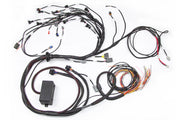
Why the RB needs a little extra thought
RB engines rev cleanly, pull harder the higher they go, and make a noise nothing else from the 1990s quite matches. That is why they are still being built into everything from Skylines to drift cars and swaps. The flip side is that most of them are now 25 to 35 years old, running parts Nissan designed for a factory ECU and a MAF, and a few of those parts need to be replaced or re-plumbed once a Haltech is in charge.
This guide covers the twin cam family: RB20DE/DET, RB25DE/DET (including NEO), and RB26DETT. The single cam RB30 is quite different, so see our RB30 engine guide for that one, and what makes RBs special if you want the backstory.
Which RB do you have?
| Engine | Size | Aspiration | Compression | Worth knowing |
|---|---|---|---|---|
| RB20DE | 1998 cc | Naturally aspirated | 10.0:1 | DOHC 24-valve |
| RB20DET | 1998 cc | Single turbo | 8.5:1 | DOHC 24-valve |
| RB25DE | 2498 cc | Naturally aspirated | 10.0:1 | DOHC 24-valve |
| RB25DET | 2498 cc | Single turbo | 8.5:1 | Has N-VTC intake cam control |
| RB25DE NEO | 2498 cc | Naturally aspirated | 10.0:1 | N-VTC |
| RB25DET NEO | 2498 cc | Single turbo | 9.0:1 | N-VTC, and a different turbo from the earlier RB25DET |
| RB26DETT (R32/R33) | 2568 cc | Twin turbo | - | Six individual throttle bodies |
| RB26DETT (R34) | 2568 cc | Twin turbo | 8.5:1 | Six throttles, red cam covers |
For reference, the RB30E and RB30ET are 2962 cc SOHC 12-valve engines with distributor ignition, which is why they get their own article.
Picking the right Haltech
- Mild builds on the factory loom and sensors: a Platinum Pro plug-in such as the R32/R33 Skyline Platinum Pro has been a popular choice. The catch is trigger support: on the Platinum Pro range, only a 12-tooth crank pattern is supported if you go to a crank trigger.
- Heavily modified engines, aftermarket triggers and sensors: this is where we recommend an Elite 2000 or 2500 plug-and-play kit, like the Elite 2500 GT-R kit or the Elite 2500 R34 GT-T / Stagea kit.
- Fresh wiring or an engine swap: the terminated RB engine harness saves a huge amount of time.
- Tight budget: an Elite 750 with a premium wire-in harness will run an RB well. You just have fewer spare inputs and outputs for extras.
Base settings we start from
These are the values we enter in ESP before the first crank. The TDC angle is the one that needs the most attention, because the factory CAS can be rotated.
| Setting | Value | Our notes |
|---|---|---|
| Firing order | 1-5-3-6-2-4 | Six cylinders, four-stroke piston engine |
| Injection mode | Sequential | Six injectors. Stock sizes were 240, 370 or 440 cc depending on model |
| Injector current | High | On the RB26, use Low once the resistor box has been taken out |
| Ignition mode | Direct Fire | Falling edge, Constant Charge dwell |
| ESP trigger pattern | Nissan RB20, RB25, RB26 | Quick Start is not available with this pattern |
| Trigger (the 6 signal) | Hall, rising edge (locked) | Six windows, each one a different width. Filter 0, strong pull-up |
| Home (the 360 signal) | Hall, rising edge (locked) | Three hundred sixty equal slots. Filter 0, strong pull-up |
| TDC angle | 109 as a base | Always confirm with a timing light, since the CAS is adjustable |
Lock the timing in software, put a light on it, and match what the software says to what the crank says. On an RB with a rotated CAS, skipping this step is how people end up with a base map that is several degrees off everywhere.
The crank angle sensor, and when to replace it
Despite the name, the Nissan CAS is driven off the front of the exhaust cam, so it turns at half engine speed. Inside is an optical disc with two rings of slots. One ring has 360 slots, giving the ECU a one-degree signal. The other ring has six slots, one per 120 degrees of crank rotation, and those slots are all different widths so the ECU can work out exactly where the engine is.
| CAS pin | Signal | Haltech wire |
|---|---|---|
| 1 | Ground | Trigger 4-core, blue (signal ground) |
| 2 | 12 V supply | Trigger 4-core, red |
| 3 | 360 slot signal | Home 4-core, yellow (Home +) |
| 4 | 6 slot signal | Trigger 4-core, yellow (Trigger +) |
The weak point is the drive. The cam belt and camshaft vibrate at high RPM, and aggressive high-lift cams make it worse, so the signal the CAS sees gets noisy right where you are making the most power. On any serious RB build we fit a crank trigger. The Elite range supports nearly every crank trigger kit on the market, Hall or reluctor, and where the kit maker offers a missing-tooth wheel we prefer it. Our trigger systems explainer covers why.
Igniters and coils: early vs late
This is the most common wiring mistake we see on RBs. There are two coil styles and they are not interchangeable at the ECU.
- Early coils (RB25 Series 1 and older) have no igniter inside. They are fired by a separate six-channel igniter mounted on the back of the coil cover. The coils must never be wired straight to the ECU. Wire the ECU's ignition outputs 1 to 6 to igniter pins 1 to 6, the igniter's pins 11 to 16 go to coils 1 to 6, and pin 17 is engine ground. Each coil has a signal pin from the igniter (-), a switched 12 V pin (+) and a ground to the head (E).
- Late coils (RB25 Series 2 and newer) have the igniter built in, so they can be wired directly: IB is the ECU ignition output, G is ground to the head, and + is switched 12 V.
Haltech makes sub-harnesses for both: the external igniter version and the internal igniter version. Dwell for the Nissan coils should come from a proper dwell chart, not guesswork.
Need this diagram? Ask us and we'll send it over with advice for your build.
Sensors, one at a time
Throttle position
Use the TPS connection on the loom side, not the plug directly on the sensor body. Getting this wrong gives you a reading that looks alive but is not the one the Haltech expects.
MAP sensor
RBs measure airflow with a MAF and have no factory MAP sensor feeding the ECU. Some models have one, but it only drives the dash boost gauge. Use the ECU's internal MAP sensor or add an external one with headroom above your boost target, such as the 5 Bar TI MAP sensor.
Air temperature
The RB26 has an air temp sensor in the front of the plenum, but it reacts slowly and heat soaks, so we replace it with a Haltech sensor like the HT-010206 mounted in the intercooler pipe ahead of the throttle. Other RBs have no air temp sensor at all and need one added, ideally in the plenum or in the cooler pipe close to the throttle. Either way the wiring has no polarity.
Coolant temperature
Two wires, no polarity. Load the calibration named Temperature - Nissan Skyline R32 R33 R34 Coolant Sensor.cal.
Oxygen sensors
Most RBs have one O2 sensor after the turbo. The RB26 has two, one per dump pipe. Older ones are Titania sensors that change resistance and swing from about 0.4 V to 1.4 V, so set the crossing voltage around 0.7 to 0.8 V if you use them. Later ones are ordinary 0 to 1 V Zirconia sensors. Neither is good enough to tune on. Fit a WB1 on single turbo engines, or a WB2 on an RB26 so you can see both banks.
MAF sensors
Every twin cam RB has a MAF, and the RB26 has two. Most people delete them with a Haltech, but you can keep them if you prefer. On the factory wiring, red is switched 12 V, purple is signal, blue is ground and brown is chassis ground.
Actuators and vehicle systems
N-VTC intake cam
RB25DET engines have Nissan's switched intake cam timing. Every Haltech ECU supports it. The solenoid lives near the fuel pressure regulator: give it switched 12 V and drive the other side from any spare output except an ignition output. Set it up in Cam Control Switched.
Idle
The main idle valve is a simple two-wire motor that any Haltech can drive. Most RBs also have a second, smaller valve that just switches on with the A/C compressor and is not connected to the ECU. See Idle Control for setup.
Boost control
The factory solenoid is a two-port valve teed into the vent side of the wastegate line, with a restrictor pill hidden in the hose (look for the paint stripe). That layout can only add a little boost and cannot be re-plumbed into anything better. If the Haltech is going to control boost, redo the plumbing for a Haltech 3-port solenoid. The factory wiring to the old valve can be reused.
ATTESA on GT-R and four-wheel-drive models
The ATTESA system has its own controller but needs a throttle signal, normally about 0.5 V at closed throttle and about 4.0 V wide open. Haltech plug-in ECUs and adaptor harnesses include the hardware to output this as a mappable 0 to 100% duty signal. On a wire-in install, add the ATTESA TPS adaptor (HT-038001).
Where is the factory ECU?
On R32, R33 and R34 Skylines it sits behind the passenger side kick panel. Factory pinouts differ between the R32 RB20DET/RB25DE, R33 RB25DET, R34 RB25DET NEO and the RB26DETT.
Need one of those pinouts? Ask us and we'll send it over with advice for your build.
RB troubleshooting
| Symptom | Usually |
|---|---|
| Misfire or timing scatter at high RPM | CAS drive vibration. Log trigger errors and plan for a crank trigger |
| Timing light disagrees with the software | TDC angle not set to match where the CAS is clocked |
| No spark on early coils wired to the ECU | Early coils need the external igniter in between |
| Barely any boost increase over spring | Factory 2-port solenoid and restrictor still in place |
| Front wheels never engage on a GT-R | ATTESA is not receiving a throttle signal |
RB FAQ
Can I keep the factory CAS?
For a mild street car, yes. Once you add big cams, more RPM or serious power, a crank trigger is the reliable fix.
Do I need to keep the MAF?
No. Most Haltech RBs run speed density on a MAP sensor, and the MAF is removed.
Not sure which kit suits your car?
Book a free 30-minute consultation and we'll go through your build with you.