TB48 at a glance
The TB48DE only ever came in the Nissan Patrol Y61, from 2001 on. It is an inline six of 4759 cc (290 ci) with a 9.0:1 compression ratio, a 1-5-3-6-2-4 firing order and number 1 cylinder at the front. It is a torquey truck engine, which is why it turns up in so many off-road and turbo builds.
ECU options
There used to be a plug-in option, the Platinum Pro Y61, but Haltech no longer sells it. Today the engine is run by wiring in an Elite ECU. Both the Elite 750 and Elite 2500 will do it. The deciding factor is usually idle: the factory idle valve is a stepper motor, and the Elite 550, 750 and 950 have no stepper outputs. If you want to keep the factory idle valve, go with a 2500.
The injector wiring also depends on the ECU. The Elite 550, 1000 and 1500 cannot fire six injectors sequentially, so on those units you pair them. The Elite 750, 950, 2000 and 2500 can run fully sequential, so injector output 1 goes to cylinder 1, output 2 to cylinder 2, and so on.
Crank and cam sensor
Unlike most engines, the TB48 reads crank and cam position from one combined unit at the front of the engine, driven by the exhaust camshaft. It produces two signals: a 6-tooth signal (one pulse every 120 degrees) and a 360-tooth signal (one pulse per degree).
| Sensor pin | Signal | Haltech connection |
|---|---|---|
| 1 (Blue) | 6x, 120 degree | Trigger +, yellow in the Trigger 4-core |
| 2 (Black/White) | 360x, 1 degree | Home +, yellow in the Home 4-core |
| 3 (Black/Red) | Power | 12 V, red in the Trigger 4-core |
| 4 (Black) | Ground | Signal ground, blue in the Trigger 4-core |
Trigger settings are covered in our TB48 trigger article.
A tidy trick: one cable instead of two
This sensor needs four wires: 12 V, signal ground, Trigger + and Home +. The grey shielded Trigger 4-core already carries three of them plus a Trigger - wire that this sensor doesn't use. The Home 4-core only needs to contribute its Home + wire. So instead of running both shielded cables to the sensor, you can repurpose the spare green Trigger - wire as Home + by moving it at the ECU connector:
| ECU | Step 1: remove and insulate the yellow wire at | Step 2: move the green wire from | to |
|---|---|---|---|
| Elite 550 / 750 / 950 | A32 | A33 | A32 |
| Elite 1000 / 1500 / 2000 / 2500 | B2 | B5 | B2 |
After that, the Trigger 4-core alone carries everything the sensor needs, and it stays inside one shield.
Ignition
The TB48 runs direct fire with a coil on each plug, and each coil has its igniter built in. That means they connect straight to the ECU with no external module.
- Pin 1: ECU ignition output
- Pin 2: ground to the cylinder head
- Pin 3: switched 12 V
Set the ignition to Constant Charge, Falling Edge. Start with a conservative dwell and check it against our dwell time guidance.
Throttle
This is where the transmission matters. Automatic TB48s use an electronic throttle that Haltech does not support, so those need converting. Manual versions use a cable throttle with a six-pin position sensor, and only three pins matter:
- Pin 1 (black): signal ground
- Pin 2 (green): throttle signal
- Pin 3 (yellow): 5 V
Pins 4 to 6 are the closed and wide-open throttle switches, which the Haltech ignores.
Manifold pressure
There is no factory MAP sensor. Use the ECU's internal MAP sensor. If your boost target is beyond its range, add an external sensor on a spare AVI, such as the 5 bar TI MAP sensor. If you'd rather keep the factory airflow meter, you can: the MAF wires as pin 1 (QA+) to an AVI, pin 2 to 5 V, pin 3 (QA-) to sensor ground, pin 4 to 12 V, with pin 5 unused. Most of our builds delete it.
Variable cam and variable intake
Both of these are simple on/off solenoids, not continuously variable systems.
- Intake cam: energizing the solenoid advances the intake cam. The factory strategy leaves it off at low rpm, switches it on through the midrange and switches it off again near the top. Set it up with switched cam control.
- VIAS intake: Nissan's Variable Induction Air Control uses a solenoid to feed vacuum to a diaphragm that opens a power valve in the intake. The stock engine typically turns it on at 2000 rpm and off again at 3600 rpm. Treat those as a starting point and confirm on the dyno.
Idle stepper motor
| Valve pin | Connect to |
|---|---|
| 6 | Stepper 1 |
| 4 | Stepper 2 |
| 3 | Stepper 3 |
| 1 | Stepper 4 |
| 2 and 5 | Switched 12 V, or leave unconnected |
Use a Low Side drive if 12 V is connected and Both if it is not. Steps are 160 and speed is 75.
Temperature sensors
The coolant sensor is not polarity sensitive: one pin to a spare AVI and the other to signal ground. Use the "Temperature - NIssan TB45.cal" calibration (the typo is Haltech's file name). The TB48 has no air temp sensor at all, so add a Haltech air temp sensor and use "Temperature - GM Air Sensor.cal". Both calibrations assume a 1k pull-up to 5 V. Pick an AVI with a switchable pull-up, or add an external 1k resistor to 5 V if yours doesn't have one.
Knock sensors
Two knock sensors sit on the intake side of the block. The Nissan units are polarity dependent (pin 1 unused, pin 2 signal) and they tie their ground to the block internally. That is bad for signal ground integrity, which you can read about in our ECU grounding guide, so we recommend replacing them with Haltech sensors such as the HT-011100.
O2 sensors
The factory sensors are heated three-wire narrowbands with no separate signal ground: blue is signal (to AVI 1 or AVI 6), and the two black wires are heater 12 V and heater ground. The heater ground should go to chassis ground, not signal ground, or to a spare injector or stepper output if you want the ECU to pulse the heater like many factory ECUs do. With 18 W heaters, keep that duty to roughly 50% or less so the output is not overloaded.
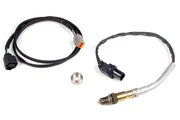
Honestly, for tuning we replace them. A WB2 dual-channel wideband kit gives you a proper wideband on each bank. The sensors come out from under the truck with a 22 mm socket or wrench.
Vehicle speed
The speed sensor is a reluctor type. In a Y61 it feeds the factory combination meter unit, which then sends a Hall style digital signal on to the ECU, and that signal can go to any spare DPI or SPI. If you wire the reluctor sensor directly, use an SPI (signal + to the SPI, signal - to signal ground), because a DPI cannot read a reluctor signal.
Injectors
Stock injectors flow about 380 cc/min. On ECUs that must pair injectors, fire them by companion cylinder: 1 with 6, 2 with 5, and 3 with 4. If your fuel system uses a fixed-pressure regulator that is not referenced to manifold pressure, which is common on returnless systems, the injector flow should be mapped against manifold pressure so the fuel model stays accurate.
Dead time is worth getting right as well. It is the part of every pulse where the injector has been told to open but isn't flowing fully yet, because the solenoid is still energizing and the pintle is still moving on the way open and on the way shut. Bad dead time data shows up as mixture errors at idle and light load.
Factory ECU location
In the Patrol, the OEM ECU is on the transmission tunnel behind the center console. Need the factory ECU pinout? Ask us and we'll send it over with advice for your build.
TB48 FAQ
Can I use an Elite 750 on a TB48?
Yes, it runs the engine sequentially, but it can't drive the factory stepper idle valve. If you want the stock idle control, choose an Elite 2500.
Does the automatic TB48 work with Haltech?
Not with its factory electronic throttle. You will need a cable throttle conversion or a supported drive-by-wire throttle. Talk to us in a free consultation before you buy parts.