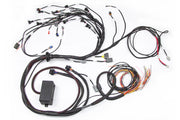
RB30 at a glance
| Spec | Value |
|---|---|
| Layout | Inline six, single overhead cam |
| Displacement | 180.8 ci (2962 cc) |
| Firing order | 1-5-3-6-2-4 |
Although it's a Nissan design, most people meet the RB30 in the Holden VL Commodore. Nissan also used it in the R31 Skyline, and a carbureted version went into the Y60 Patrol. The factory turbo engine was only ever offered in the VL.
Which RB30 do you have?
| Variant | Compression | Factory injectors | Notes |
|---|---|---|---|
| RB30E (early) | 9.0:1 | 190 cc | Naturally aspirated |
| RB30E (late) | 9.0:1 | Not specified | Picks up most of the block updates made for the turbo engine |
| RB30ET | 7.8:1 | 250 cc | Lower compression pistons, stronger rods, piston oil squirters, turbo oil and water feeds, its own cam, bigger valves and a larger oil pump |
If you're shopping for a block to turbocharge, it pays to know which RB30E you're looking at, since the late version already shares much of the turbo engine's block work.
Trigger: the optical distributor
Every RB30 fires through a distributor with an optical sensor inside. The disc has two rings of slots. The outer ring has 360 slots, one per degree. The inner ring has six, one per cylinder, and one of those six is wider than the rest. The ECU counts how many outer slots pass during each inner slot. The wide one produces a higher count, and that's how it finds cylinder 1 and syncs.
Trigger settings are covered on our RB30 trigger page.
Distributor wiring
| Dizzy pin | Signal | Haltech wire |
|---|---|---|
| 1 | Signal ground | Blue, trigger 4-core |
| 2 | Switched 12V | Red, trigger 4-core |
| 3 | 360-slot ring (home) | Yellow Home+, home 4-core |
| 4 | 6-slot ring (trigger) | Yellow Trigger+, trigger 4-core |
The single-cable trick
Wired by the book, you'd run two shielded cables to the distributor. But look at what's actually used: the trigger cable (grey shield) carries 12V, signal ground, Trigger+ and Trigger-, and the home cable (grey/black shield) only needs to contribute Home+. Trigger- isn't needed on this sensor. So if you repurpose the green Trigger- wire as the Home+ connection at the ECU plug, one 4-core cable does the whole job.
- Elite 550, 750 and 950: pull the yellow wire out of pin A32 and insulate it (it's no longer used), then move the green wire from A33 into A32.
- Elite 1000, 1500, 2000 and 2500: pull the yellow wire out of B2 and insulate it, then move the green wire from B5 into B2.
If you'd rather skip the pin shuffling, a terminated harness kit for the single-cam RB30 is built for this engine.
Ignition
The factory coil is driven by an external igniter bolted to the side of the distributor. It's simple: the ECU's ignition output goes in on pin B, the coil negative comes out on pin C, and the igniter grounds through its case to the distributor and engine. That case ground matters, so clean mounting surfaces are worth the time.
Plenty of our RB30 builds ditch the factory coil and igniter for an LS2-style coil. They make strong spark, have the igniter built in so wiring is simpler, and they're easy to find. Set dwell to suit whichever coil you end up running; if you need dwell data for your coil, ask us.
Sensors: what's there and what's missing
Throttle position
The throttle is cable-driven. Here's the catch: the TPS on manual cars isn't a real position sensor, it's just a closed-throttle switch. Automatic cars got a proper full-range sensor, and swapping one onto a manual throttle body is a common fix.
| Auto TPS wire | Signal | Haltech wire |
|---|---|---|
| Red | 5V supply | 5V+ (Orange) |
| White | Position signal | Spare AVI (AVI-10, White) |
| Black | Ground | Signal ground (Black/White) |
MAP and air temperature
The RB30 has neither. The ECU's internal MAP sensor covers NA and mild boost. For more boost, fit an external sensor on a spare AVI, such as the 5 bar TI MAP sensor. You'll also need to add an air temperature sensor to the intake tract.
Coolant temperature
It lives near the front of the intake manifold and isn't polarity sensitive. One pin goes to a spare AVI, the other to signal ground. Use an AVI with a switchable pullup and turn it on. If yours doesn't have one, add an external 1k resistor to 5V.
Knock
The factory knock sensor is an old design that tends to fail and doesn't suit a modified engine well. We swap it for a modern donut-style sensor like the genuine Bosch knock sensor. Pin 1 is the knock signal and pin 2 is signal ground.
Oxygen sensor
The stock sensor is an old titania narrowband, which is useless for tuning. Pull it and fit a WB1 wideband kit with its LSU 4.9 sensor. A 22 mm wrench or socket fits the sensor.
MAF (optional)
Most Haltech installs delete the airflow meter, but you can keep it. Only three of its six pins matter: pin 2 to signal ground, pin 3 (the airflow signal) to a spare AVI, and pin 5 to switched 12V (Grey/Red). Pins 1, 4 and 6 (chassis ground, the self-cleaning circuit and the calibration pot) aren't connected.
Vehicle speed
There's no speed sensor on the gearbox. The donor car's speedometer is cable-driven, and a small Hall effect pickup inside the speedo head provides the speed signal.
Idle valve
Idle air comes through a 2-pin bypass air control valve (Nissan calls it the AAC valve) on the back of the intake manifold. The ECU duty-controls it with one output. Pin 1 goes to a spare output and pin 2 to switched 12V; it doesn't care which way round. Cars with A/C also have a separate on/off air valve, the FICD, which opens whenever the compressor runs.
Injector data
Flow is measured with the injector held fully open. If the fuel pressure regulator isn't referenced to manifold pressure, map flow against manifold pressure so the ECU knows the real pressure drop across the injector.
- RB30ET: roughly 260 cc/min
- RB30E: roughly 185 cc/min
Dead time is the part of each pulse where the injector isn't really flowing: the delay while the coil energizes and the pintle starts moving, plus closing time, plus the partial-flow ramps at each end. Good dead time data is what makes idle and cruise fueling behave.
The factory ECU
The OEM computer sits in the passenger-side kick panel. Its pinout is only needed if you're adapting the factory loom rather than running a new harness.
Need this diagram? Ask us and we'll send it over with advice for your build.
RB30 FAQ
Can I keep the distributor with a Haltech?
Yes. The optical trigger works well, and the distributor can stay as the trigger even after you move to modern coils.
Is the RB30 related to the twin-cam RBs?
Same family, different head. Our RB engine overview and what's so special about RBs cover the wider range.