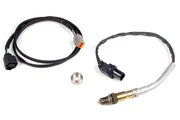
What an oxygen sensor actually does
An oxygen sensor sits in the exhaust, usually much nearer the engine than the tailpipe, and reads how much oxygen is left over after combustion. From that, the ECU works out the air-fuel ratio the engine is really running. It's the number a tuner watches on every pull and the one printed on your dyno sheet. Without a trustworthy mixture reading, fuel tuning is guesswork.
There are two kinds of sensor, and they answer very different questions.
Side by side
| Narrowband | Wideband | |
|---|---|---|
| Question it answers | "Am I richer or leaner than stoichiometric?" | "What exactly is the mixture?" |
| Useful range | About 0.99 to 1.01 lambda (roughly 14.6 to 14.8:1 on gasoline) | About 0.68 to 1.36 lambda (roughly 10:1 to 20:1 on gasoline) |
| Wires | Usually up to 4 | Usually 6, with a larger connector |
| Electronics | Read directly by a simple ECU input | Needs a dedicated controller, either a separate module or built into the ECU |
| Where you find it | Older factory systems and emissions monitoring | Tuning, modern factory systems and any serious performance build |
| Good for tuning? | No | Yes |
Why a narrowband can't tune your engine
A narrowband flips its output as the mixture crosses stoichiometric (1.00 lambda, or 14.7:1 on gasoline) and says very little beyond that. That's enough for a factory ECU cruising along. At idle and light load, it watches the sensor switch between rich and lean and nudges the fuel to hover around 14.7:1. That's closed loop O2 correction in its simplest form.
The moment the engine leaves that tiny window, the narrowband is effectively blind. At full throttle on a turbo car you may want 0.78 lambda. A narrowband reports that as "rich" and nothing more, whether you're at 0.78 or a dangerously lean 0.90 that's still richer than stoich. The factory ECU simply stops correcting until the engine returns to light load. For tuning, that's no use at all.
How a wideband works with your ECU
A wideband sensor needs active control of its internal pump cell and heater, which takes more electronics than a basic ECU input. There are two common layouts:
- External controller. A small module runs the sensor and passes the result to the ECU as a 0-5V analog signal or over CAN. Haltech's WB1 single channel and WB2 dual channel kits work this way, over CAN.
- Built-in controller. Some ECUs have wideband control on board, and the sensor plugs straight into them.
Haltech ECUs will also accept the 0-5V output of another brand's wideband controller, so you're not locked into one system. We still prefer CAN where it's available, since it avoids ground offset errors on an analog signal.
What a wideband unlocks
Closed loop everywhere, not just at stoich
With a real mixture reading across the whole operating range, the ECU can compare actual lambda against the target lambda you've set and correct the difference, whether that target is 1.00 at cruise or 0.80 at full boost.
Long term learning
If the same error keeps appearing in the same part of the map, the ECU can store a correction so it doesn't have to fight it every time. That's long term fuel trim, and it means the tune keeps refining itself as you drive. Our short and long term fuel trim article explains how the two work together.
Why would a dyno tune need correcting at all? Real roads aren't dyno cells. Air temperature, barometric pressure, fuel temperature and intercooler performance all change, and some areas of the map, like long light-throttle cruising, are hard to reproduce on a dyno. Tuning every combination by hand isn't realistic. A wideband with learning fills in the gaps.
Engine protection
You can use the wideband as a safety input. For example, you might set the ECU to go into a limp mode if the mixture goes leaner than a threshold you choose while the engine is above a certain RPM and boost. That's the kind of rule that saves an engine when a fuel pump starts to fade. See engine protection for how it's set up.
If the engine is modified in any way, fit a wideband. It's the single most useful sensor for making power safely, it keeps the tune accurate as conditions change, and it gives the ECU a way to protect the engine when something goes wrong.
Narrowband vs wideband FAQ
Can I keep my factory narrowband sensor?
You can leave it in place for emissions monitoring or a factory gauge, but don't tune from it. Put the wideband in the pre-cat position or as close to it as practical.
Can I tell them apart by looking?
Usually by the wire count and plug. A narrowband typically has up to four wires, a wideband typically six and a bulkier connector. Check the part number to be sure.
Which wideband sensor should I buy?
For most builds, a Bosch LSU 4.9 paired with a Haltech controller. For more detail on how the sensor itself works, read wideband O2 sensors explained.