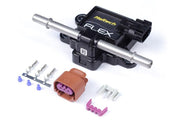
What a flex fuel sensor tells the ECU
A flex fuel composition sensor sits in the fuel line and measures two things: how much ethanol is in the fuel, and how hot the fuel is. On Nexus and Elite ECUs you can use those readings to adjust fueling, timing and boost automatically as the blend changes, to log what you're actually running, and to trigger engine protection if something goes wrong.
The Haltech Flex Fuel Composition Sensor sends both readings on a single signal wire. Ethanol percentage is carried in the frequency of the signal, and fuel temperature in the pulse width. That's why it needs a frequency-capable input.
Wiring it in
Connect the signal wire to a spare SPI. Only SPIs can read a frequency signal; an AVI won't work. On the Wiring tab, set the input like this:
| Setting | Value | Why |
|---|---|---|
| Sensor Type | Hall Effect | The sensor switches its output like a digital sensor |
| Edge | Falling | The transition the ECU times from |
| Pullup | Enabled | The signal needs pulling up to read cleanly |
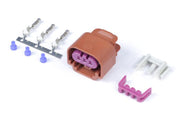
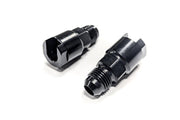
If you're building your own harness, the plug and pins kit gets you the correct connector. Many cars use GM-style spring lock fuel line fittings, and the 3/8 in spring lock to -6AN fittings make plumbing the sensor in much easier.
Calibrations
The sensor has two calibration tabs, one for fuel composition and one for temperature. Both default to the Haltech sensor, so if that's what you're running you don't need to touch them. Using a different brand? Load its calibration if it's listed, or build a custom one from the manufacturer's data.
Fault detection
The Diagnostics tab lets the ECU flag a wiring fault (a short or open circuit) by watching for readings that are out of range. All four checks are off by default. When the engine protection function is active, you can assign each one a DTC severity.
| Check | Trips when | Code |
|---|---|---|
| Raw Min | Composition frequency or voltage is too low | P0178 |
| Raw Max | Composition frequency or voltage is too high | P0179 |
| Temperature Raw Min | Temperature pulse width is too short | P0182 |
| Temperature Raw Max | Temperature pulse width is too long | P0183 |
We turn these on for any car that relies on flex fuel for its tune. If the sensor drops out, you want to know, and you want the ECU to protect the engine rather than guess. See engine protection for how severities work.
Using ethanol content in the tune
Fuel
Change Fuel Type to Flex Fuel. The ECU then works out the stoichiometric ratio from the ethanol reading and adds the fuel needed automatically. Two tables let you refine it:
- Fuel Composition Scalar: shapes how much of that automatic correction gets applied at each ethanol percentage.
- Fuel Composition Correction: starts at all zeros. Use it to fix spots where the automatic calculation doesn't match what the engine wants.
Lambda target
A separate Fuel Composition Correction table in the Lambda section moves your target lambda as ethanol changes. That's useful with closed-loop O2 control when you want a different target on E85 than on gasoline.
Ignition
Ethanol resists knock far better than gasoline, which is where much of the power comes from. The Ignition Fuel Composition Correction table holds the timing change for your highest ethanol content (typically E100), and the matching scalar table sets how much of that change applies at each blend in between.
Boost
- Duty Cycle Flex Fuel Composition Correction adjusts boost solenoid duty with ethanol content. It acts on open loop duty or on the closed loop base duty table.
- Target Pressure Flex Fuel Composition Correction (closed loop only) raises or lowers the boost target with ethanol content.
That combination is what lets a car make safe boost on 91 octane and more boost on E85 without a map switch.
Other ways to use it
- Add flex fuel composition as an axis on the Fuel Prime Pulse and Fuel Cranking tables. High ethanol blends need a lot more fuel to start, especially cold.
- Turn the Lambda Target, Fuel Base and Ignition Base tables into 4D tables with ethanol as an axis, for complete control over every blend.
- Use a generic correction table to correct for fuel temperature.
Troubleshooting
| Symptom | Usually |
|---|---|
| No reading at all | Signal wired to an AVI instead of an SPI, pull up disabled, or no power to the sensor |
| Reading jumps around | Wrong edge, or air in the fuel passing the sensor |
| Ethanol reading looks wrong | Wrong calibration selected for a non-Haltech sensor |
| Lean on E85, fine on gasoline | Fuel Type not set to Flex Fuel, or injectors out of capacity |
Flex fuel FAQ
Can I wire a flex fuel sensor to an analog input?
No. The Haltech sensor reports ethanol content as a frequency, and only SPI inputs can read that.
Do I still need to tune on both fuels?
Yes. The automatic correction gets you close, but we always tune at the low and high ends of the blend range and let the ECU blend between them. Our flex fuel tuning guide goes deeper.
Does fuel temperature matter?
Hot fuel is less dense, so the same injector pulse delivers a little less fuel. On a car with a hot fuel system, logging fuel temperature helps explain lean drift.