Two sensors, two different questions
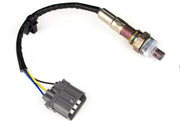
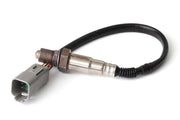
Both kinds of oxygen sensor sit in the exhaust and measure leftover oxygen, but they're built for different jobs.
A narrowband sensor is an emissions part. A catalytic converter works best when the mixture swings back and forth around stoichiometric (14.7:1 on gasoline): a little rich to load the converter up, then a little lean to let it use that up. The narrowband only needs to tell the ECU which side of 14.7:1 it's on, so that's all it does. Its output flips sharply between "rich" and "lean" with almost nothing in between.
A wideband sensor measures the actual air/fuel ratio across a broad range. Haltech's CAN wideband reads accurately from 10:1 to 20:1, which covers everything from a rich full-boost pull to a lean cruise.
Why a narrowband can't tune an engine
At full power you want the engine running well rich of 14.7:1 to keep combustion temperatures under control and protect the pistons. A narrowband in that condition just says "rich." It can't tell you whether you're at a safe 11.8:1 or dangerously close to lean. It gives the same answer for both. That's fine for idle and cruise emissions control and useless for building a fuel map.
| Narrowband | Wideband | |
|---|---|---|
| Tells you | Rich or lean of stoichiometric | The actual air/fuel ratio or lambda |
| Built for | Catalytic converter control | Tuning, diagnostics and data logging |
| Full-power tuning | No | Yes |
| Keep it when | You still run cats and need emissions control | Always, on any tuned engine |
On a street car with cats, it's common to run both: narrowbands for the emissions strategy and a wideband for tuning and monitoring. Our narrowband vs wideband article goes deeper.
Why we like a CAN wideband
An analog wideband only sends a voltage, so the ECU has no idea whether the reading is trustworthy. A Haltech CAN wideband controller also sends status information: whether the sensor has reached operating temperature, whether there's a short or other fault, and whether the sensor has been unplugged. If any of those happen, the ECU automatically drops out of closed loop O2 control and runs open loop from the base map, instead of chasing a bad reading and leaning out or richening the engine.
A wideband is only as good as its placement. Mount it far enough downstream to see mixed exhaust from all cylinders, ahead of any cat, and in the upper half of the pipe with the tip angled down so condensation drains off the element instead of sitting on it.
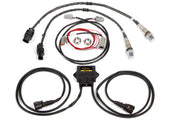
For a single sensor, the WB1 kit is our usual choice. On V engines or twin-turbo setups, the WB2 dual-channel kit reads each bank. Replacement sensors like the Bosch LSU 4.9 are available separately. Setup details are in the WB1 and WB2 guide.