What idle control is actually doing
With your foot off the pedal, the throttle blade is closed and the engine is living on whatever air sneaks past it. That's rarely the right amount in every condition. A cold engine needs more, a hot one less, and every accessory that switches on drags RPM down. Idle control gives the ECU a way to meter a controlled extra slice of air. More air means more torque and the RPM climbs. Less air, and it falls.
On a Nexus the whole thing is set up under the Idle Control function in NSP, split into three areas: the output (the hardware doing the work), the controller (how the ECU decides what to command) and a couple of extra functions.
Step 1: choose the control method
This has to match the hardware on the engine. Get it wrong and nothing else matters.
| Control Method | Hardware | How the ECU drives it |
|---|---|---|
| DBW | An electronic throttle that's already configured and working | Cracks the throttle blade open and closed to add or remove air |
| BAC Two Wire | A single bypass air solenoid | Pulses it like an injector. Zero duty is normally fully shut and full duty fully open |
| BAC Three Wire | A valve with two coils sharing one 12V feed | One coil pushes airflow up from the valve's resting midpoint, the other pulls it down. Unpowered, these valves usually flow about half |
| Ignition Only | No idle valve and no DBW | No air control. Only ignition-based idle help is left |
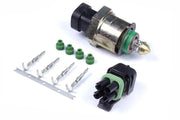
| Stepper Motor (Absolute) | A stepper idle valve such as the screw-in idle air control motor | Homes the motor at power-up, then follows the base tables. Duty here means a percentage of the stepper range |
| Stepper Motor (Relative) | A stepper idle valve | Simply steps open when RPM is low and closed when it's high. No base tables and no long term trim |
For stepper motors we almost always use Absolute. Because the ECU knows where the valve is, it can pre-position it from a table instead of hunting for the right spot every time conditions change.
Wiring for each type is covered in our idle control wiring article.
Step 2: output settings
| Setting | What it does | Our advice |
|---|---|---|
| Output Max | Caps the duty the idle controller can ever command | Set it where the valve (or throttle) stops adding RPM. There's no point letting the controller wind up past it |
| Frequency | Pulse rate for two and three wire BAC valves | Match the valve. Factory valves have a frequency they like |
| BAC Type | How the two coils of a three wire valve are driven | See below |
| DBW Max Position | How much throttle opening equals 100% idle duty in DBW mode | Just enough opening to cover your worst case, a cold engine with every load on |
| Stepper Max Speed | How fast the ECU steps the motor | Too fast and some motors skip steps, which throws off their position |
| Stepper Range | Total steps across the motor's travel | Use the motor's real range so duty percentages mean something |
| Stepper Invert | Reverses the motor's direction | Flip it if more duty makes RPM drop |
| Stepper Motor Calibration | Which end the motor homes to at power-up | See below |
Three wire BAC types
- Uni-Directional: both coils get identical duty. 25% on one means 25% on the other.
- Complementary: the coils are mirror images. As one rises the other falls, so 25% on the main pairs with 75% on the slave.
- Bi Directional: one coil covers the bottom half of the valve's travel and the other covers the top half. With no signal the valve rests at 50% open.
Stepper calibration: Normal or Reverse
At power-up an Absolute stepper drives to one end of its travel, then steps back out to the base position. Normal homes to fully closed, so if you crank before it's done, the engine starts with too little air and idles low. Reverse homes to fully open, so an early start idles high. We usually pick Reverse on engines that are hard to start or prone to stalling right after firing, since a high idle is easier to live with than a stall.
Step 3: the controller
Open or closed loop
In Open loop the ECU outputs exactly what your open loop base table says and never corrects it. In Closed loop it starts from the closed loop base table and adjusts to hold the target RPM. We tune the base table first, in open loop, until the engine idles close to target on its own. Then we switch to closed loop so the controller only has small errors to fix. A controller that has to do all the work will hunt.
Settings that decide when corrections happen
| Setting | What it does | Our advice |
|---|---|---|
| PID Scaler | Scales all three PID gain tables at once. 100% is normal | Handy for quick testing. Once you know the direction, change the real tables and put this back to 100% |
| RPM Rate Lower Limit | Blocks P and I corrections while RPM is dropping faster than this | Closer to zero waits for a steadier idle before correcting, which suits most engines |
| RPM Rate Upper Limit | Blocks P and I corrections while RPM is climbing faster than this | Same logic in the other direction |
| Decel Fuel Cut Restore | Keeps decel cut off unless RPM is at least this far above idle target | A guard so decel cut can't fight the idle. Leave margin |
| Decel Offset | Extra duty added to base when the throttle snaps shut | Enough to catch the RPM before it dips under target |
| Decel Offset Decay Time | How long that extra duty takes to fade out | Long enough that RPM settles without a dip at the end |
| Stall Offset | If RPM falls this far under target, output jumps to 100% | An emergency catch, not a tuning tool. If it fires often, fix the base table |
| Close Idle Valve On Boost | Forces 0% duty whenever there's positive boost | Turn it on when the valve isn't plumbed back into the pressurized intake ahead of the throttle. Otherwise an open valve is a boost leak |
| Max Vehicle Speed | Closed loop idle only runs below this road speed (needs a VSS) | Strongly recommended. It stops the controller treating a slow roll-down as idle |
Why the RPM rate limits matter
Think about lifting off the throttle at 3,000 RPM. RPM falls quickly toward idle. If the controller were allowed to act during that fall, it would see RPM far from target and start stacking up corrections, then overshoot when the engine finally settles. The rate limits make it wait until RPM is changing slowly, which is the only time a correction is meaningful. Move them further from zero and it jumps in sooner. Move them closer to zero and it waits for a calmer idle.
Step 4: the throttle follower (dashpot)
Old carbureted cars used a mechanical dashpot to stop the throttle slamming shut. The throttle follower does the electronic version. When you're driving, it holds some idle output in proportion to RPM and load. When you lift, that output decays away instead of vanishing, so the engine glides down to idle. Ticking the enable box brings up the Throttle Follower Target and Decay tables. It's especially helpful on big-cam engines and light flywheels that like to stall coming to a stop.
A sensible setup order
- Wire and confirm the valve moves in the right direction.
- Set the control method, output settings and Output Max.
- Tune the open loop base table across coolant temperature until the idle sits near target on its own.
- Switch to closed loop and tune the PID gains gently.
- Add loads: A/C, fans, power steering. Use idle up to pre-open the valve for each one.
- Refine with idle ignition correction, which reacts faster than air ever can.
Troubleshooting idle control
| Symptom | Usually |
|---|---|
| Idle hunts up and down | Base table too far from reality, gains too high, or RPM rate limits too far from zero |
| Dips or stalls coming to a stop | Not enough decel offset or throttle follower, or Max Vehicle Speed not set |
| More duty makes RPM fall | Stepper Invert needed, or three wire valve coils swapped |
| Idle high right after start, then normal | Reverse stepper calibration still homing when you cranked. Normal behavior |
| Loses boost with the valve on | Valve not plumbed into the pressurized side and Close Idle Valve On Boost is off |
Idle control FAQ
Can I use DBW for idle instead of a separate valve?
Yes, and it's what we do on most DBW builds. Get the throttle itself configured and calibrated first, then set DBW Max Position conservatively.
Should I use long term trim for idle?
Once the base table is close, long term trim can learn small changes over time. It isn't available with a relative stepper.
My engine has no idle valve. Can the ECU still help?
Ignition Only mode is there for exactly that case, leaving timing as the only tool. It can't add air for a cold start, so expect to set the idle stop by hand. If you're adding a valve, ask us which one suits your throttle body.