Which 1FZ do you have?
Toyota built several versions of the 1FZ, and the wiring you need depends on which one is in front of you. This guide covers the fuel-injected 1FZ-FE only. The carbureted 1FZ-F (9.0:1 compression) and the low-output LPG 1FZ-E used in forklifts aren't covered.
| Version | Ignition | Engine position sensing | Other notes |
|---|---|---|---|
| 80 series 1FZ-FE | Single coil, external igniter, distributor | Three reluctor pickups inside the distributor | Stepper motor idle valve with a cable-operated manual override. MY95 and later could have ECU-controlled dual fuel tanks, which the Elite supports |
| 100 series 1FZ-FE (MY98 on) | Waste spark, three dual-post coils with built-in igniters | Reluctor crank and cam sensors | Revised head, pistons, injectors and a longer-runner intake |
You'll find the 1FZ-FE in Toyota Land Cruisers from MY92 to MY07 and in the Lexus LX450 from MY95 to MY97. It's an inline six of 4477 cc (about 273 cubic inches) with a firing order of 1-5-3-6-2-4.
Picking a Haltech ECU
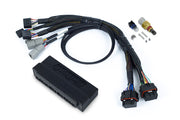
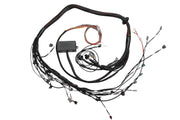
- Elite 2000 or 2500: complete support, including the stepper idle valve. For an 80 series, the Elite 2000/2500 Land Cruiser 80 series adapter harness or the Elite 2500 Land Cruiser 80 series kit is the easy path.
- Elite 750: will run the engine, but it has no stepper outputs, so there's no automatic idle control. The factory manual idle override cable can be used to set idle speed by hand, which some owners accept to save money. See the Elite 750 Land Cruiser 80 series kit.
- Nexus S3: we also stock a Nexus S3 plug-n-play adapter harness for the 1FZ-FE and a complete Nexus S3 1FZ-FE kit.
Haltech has produced base maps for the Elite adapter harness installs. They need to be imported into the ECU rather than opened as a normal file. Our base map basics article explains what a base map is and isn't.
Engine position sensors
Distributor engines (80 series)
The distributor holds three reluctor pickups. One reads a 24-tooth wheel and is labeled NE. The other two, G1 and G2, read a single-tooth wheel. The negative side of all three is joined into one common ground. Only one of the G signals is needed by the Haltech.
| Signal | Distributor pin | Connect to |
|---|---|---|
| NE, 24 teeth | 1 | Trigger + (the yellow wire of the trigger 4-core cable) |
| G1, 1 tooth | 2 | Home + (the yellow wire of the home 4-core cable) |
| G2, 1 tooth | 3 | Leave unconnected |
| G- common ground | 4 | Ground (the blue wire of the trigger 4-core cable) |
Some distributor engines are reported to also have a 36-2 crank angle sensor, called NE2. If yours has one, it's the better trigger source: connect Trigger + to it instead of the distributor's NE signal. Because the spark still goes through a distributor, rotor phasing matters on these engines. Our rotor phasing guide explains why.
Waste spark engines (100 series)
These use a 36-2 reluctor wheel on the crankshaft timing belt gear and a cam sensor reading two teeth spaced 90 degrees apart on the intake cam. Both sensors are reluctor type, so polarity matters. If you're not sure what that means for wiring, read Hall effect or reluctor.
| Sensor | Wire on the sensor side | Haltech wire |
|---|---|---|
| Crank, reluctor positive (pin 1) | Red | Yellow in the trigger 4-core |
| Crank, reluctor negative (pin 2) | Green or white | Green in the trigger 4-core |
| Crank, shield (pin 3) | White/black | Not connected |
| Cam, reluctor positive (pin 1) | Red | Yellow in the home 4-core |
| Cam, reluctor negative (pin 2) | Green or white | Green in the home 4-core |
Ignition
Distributor engines
One coil is fired by an external igniter. The Haltech only needs to drive the igniter's IGT input (pin 2, black/green) from Ignition Output 1, the yellow/black wire. The ignition fail feedback (IGF, pin 1), switched 12V (pin 3), tacho (pin 4) and coil negative (pin 5) stay with the vehicle harness and don't go to the ECU.
Waste spark engines
Each of the three coils has its own igniter and fires a pair of cylinders. The ECU signal is pin 3 on each coil, identified by wire color:
- Black, cylinders 1 and 6: Ignition Output 1
- Red, cylinders 2 and 5: Ignition Output 2
- Blue, cylinders 3 and 4: Ignition Output 3
The coil's head ground (pin 1), IGF (pin 2) and switched 12V (pin 4) don't connect to the Haltech.
Throttle, MAP and temperature sensors
The throttle body is cable operated with a position sensor. Older engines use a 4-pin TPS that includes an idle contact switch, newer ones a 3-pin sensor.
| Function | 4-pin TPS | 3-pin TPS | Haltech wire |
|---|---|---|---|
| Sensor signal | Pin 3, green/black | Pin 3, brown/white | A spare AVI (the harness guide uses AVI-10, white) |
| 5V supply | Pin 4, red/green | Pin 1, light blue/red | 5V+ (orange) |
| Ground | Pin 1, brown/black | Pin 2, red/yellow | Signal ground (black/white) |
| Idle contact | Pin 2, green/white | n/a | Not used |
MAP: early engines don't have a MAP sensor, so use the ECU's internal one. If the engine is boosted beyond what that sensor can read, fit an external sensor such as the 3 bar GM MAP sensor on a spare AVI. Later engines that do have a MAP sensor wire up like this: 5V+ orange to pin 3 (blue/red), signal ground to pin 1 (brown/white), and the signal on pin 2 (purple/blue) to a spare AVI, shown as AVI-9 yellow in the harness guide.
Coolant temperature: a two-pin sensor with no polarity. One pin goes to signal ground, the other to a spare AVI that has a selectable pullup. If you run out of pullup-capable inputs, add an external 1k ohm pullup resistor to 5V.
Air temperature: the factory sensor lives in the MAF. If you remove the MAF, add a separate air temperature sensor in the intake, as near to the MAP sensor's vacuum source as you can.
Knock, MAF and oxygen sensors
Knock: there are two single-wire resonant sensors, with the signal going to a knock input and signal ground as the reference. They work, but they're old designs that fail and read erratically once the engine is modified. We'd replace them with non-resonant donut sensors like the Haltech knock sensor.
MAF: most Haltech installs delete it, but it can be retained. Toyota used one design for MY92-94 and another from MY95. The flow signal (VG, pin 2) goes to a spare AVI, the air temperature signal (THA, pin 3) to a spare AVI with a pullup, and both grounds (E2 on pin 4, E21 on pin 5) to signal ground. Pin 1 is switched 12V from the vehicle.
Oxygen sensors: where fitted, these are 4-wire heated narrowband sensors. They can't read the mixtures you need for tuning. If you keep one, its signal (pin 3, light blue/white) goes to AVI-1 or AVI-6, pin 4 (brown/black) to signal ground, and pin 2 (yellow/red) is the switched 12V heater feed. The heater's control wire (pin 1) can go straight to chassis ground, or to a spare injector or stepper output if you want the ECU to pulse the heater like the factory ECU does. With an 18W heater, keep that duty to around 50% at most so the output isn't overloaded; 12W heaters are also common. For tuning, we strongly recommend the Haltech WB1 wideband kit, with its LSU 4.9 sensor going in place of the pre-cat sensor. They come out with a 22 mm socket or wrench. Read narrowband vs wideband for why it matters.
Idle control stepper
The idle valve is a 6-pin stepper motor. This is why the Elite 550, 750 and 950 can't control idle on this engine: they don't have stepper outputs.
| Haltech output | Valve pin | Valve coil |
|---|---|---|
| Stepper 1 (green) | 4 | Idle 1 |
| Stepper 2 (green/black) | 6 | Idle 3 |
| Stepper 3 (green/brown) | 1 (red/black) | Idle 2 |
| Stepper 4 (green/red) | 3 | Idle 4 |
| Not connected (recommended) | 2 and 5 (yellow/red) | 12V+ feeds |
With the two 12V pins left disconnected, set the drive type to Both, which is the recommended setup. If you do connect 12V, use Low Side. Set Steps to 240 and Speed to 75.
Fuel, speed and the factory ECU
- Injectors: factory flow is 280 cc/min, measured at 100% duty. If your fuel system uses a fixed regulator that isn't referenced to manifold pressure, map injector flow against manifold pressure so the fuel calculations stay accurate. Dead time data is available on request.
- Vehicle speed: the speed signal comes from the speedometer.
- Factory ECU location: low in the dash, behind the passenger-side speaker. Remember these are right-hand-drive vehicles in many markets, so "passenger side" depends on where yours was built.
Need the OEM ECU pinout or the dwell and dead time charts? Ask us and we'll send them over with advice for your build.
1FZ-FE FAQ
Can I use an Elite 750 on an 80 series?
Yes, but idle speed won't be controlled by the ECU. You'd set it with the manual override cable, and it won't compensate for A/C, cold starts or electrical load the way stepper control does.
Do I need the MAF?
No. Most Haltech installs run speed density from MAP and delete the MAF. Just remember to add a standalone air temperature sensor when you do.
Where can I compare other Toyota engines?
See our 1JZ and 2JZ and 1UZ-FE guides, or book a free consultation to plan your Land Cruiser build.