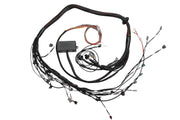
Know which JZ you have before you wire anything
Toyota built the 1JZ and 2JZ in several flavors over their production run, and the differences matter to the ECU. Ignition layout, trigger wheel, idle control and even fuel batching change between versions. Both engines are inline sixes with number 1 cylinder at the front and a firing order of 1-5-3-6-2-4. The 1JZ displaces 2492 cc and the 2JZ 2997 cc.
| Variant | Induction | Ignition | Fueling | Things to note |
|---|---|---|---|---|
| 2JZ-GTE (non VVT-i) | Sequential twin turbo, 8.5:1 | Coil per plug, direct fire | Sequential | 12-tooth crank wheel, two cam pickups |
| 2JZ-GTE VVT-i | Sequential twin turbo, 8.5:1 | Wasted spark | Sequential | Intake cam phasing; some have the ETCS-i electronic throttle |
| 2JZ-GE distributor | Naturally aspirated, 10.0:1 | Distributor | Sequential | Triggers live in the distributor; variable intake |
| 2JZ-GE VVT-i | Naturally aspirated, 10.0:1 | Wasted spark | Sequential | Intake cam phasing and variable intake |
| 1JZ-GTE | Parallel twin turbo, 8.5:1 | Coil per plug, direct fire | Semi-sequential (paired) | Injectors fired in pairs |
| 1JZ-GTE VVT-i | Single turbo, 9.0:1 | Wasted spark | Sequential | Intake cam phasing; some have ETCS-i |
Every version uses a stepper motor idle valve. All of them except the distributor 2JZ-GE read engine position from a crank sensor plus a cam sensor.
Some VVT-i engines left the factory with Toyota's ETCS-i electronic throttle. Haltech ECUs do not drive that system, so plan on converting to a cable throttle or a supported drive-by-wire throttle body before the car goes on the dyno.
Picking an ECU
The three Elites we recommend here all run the engine with sequential fuel and spark plus VVT-i, but the extras differ:
- Elite 750: full sequential fuel and spark plus VVT-i, but no stepper outputs, so the factory idle valve cannot be used.
- Elite 2000: adds support for the OEM stepper idle valve.
- Elite 2500: everything the 2000 does, plus full drive-by-wire support if you swap to a compatible electronic throttle.
For a clean install on a 2JZ, the Elite 2000/2500 2JZ terminated engine harness saves a lot of time, and Haltech supplies base maps for its Elite adapter harnesses with the ESP software. Thinking about a Nexus instead? Ask us and we will talk through the options for your JZ.
Crank and cam triggers
Crank sensor
On crank-triggered engines the reluctor wheel is part of the timing belt drive gear, and the sensor sits down near the alternator. Non VVT-i engines use 12 evenly spaced teeth. VVT-i engines switched to a 36-2 wheel, meaning 36 tooth positions with two missing to mark a reference point.
| Sensor pin | Signal | Haltech wire (Trigger 4-core) |
|---|---|---|
| 1 | Trigger + | Yellow |
| 2 | Trigger - | Green |
Cam sensor
Non VVT-i heads carry two single-tooth reluctor cam sensors on the intake side near the injectors. G1 sits roughly halfway along the head and G2 is toward the back. Haltech terminated harnesses read G2. VVT-i engines have just one cam sensor, which sees three teeth per cam revolution.
| Sensor pin | Signal | Haltech wire (Home 4-core) |
|---|---|---|
| 1 | Home + | Yellow |
| 2 | Home - | Green |
On both sensors, if you keep Toyota's factory wiring (for example with a plug-in adapter harness), pin 2 goes to signal ground instead, and you need to set the ground reference to Enabled for both Trigger and Home in the software.
A tip for non VVT-i engines: the trigger setup assumes the rear G2 sensor. If you wire the middle G1 sensor instead, the TDC offset has to move by a full 360 degrees, which takes it to 365. For full trigger settings, see our 2JZ non VVT-i trigger and 2JZ VVT-i trigger articles.
Distributor 2JZ-GE
The distributor engine keeps all of its sensing inside the distributor body. There is a 24-tooth reluctor pickup (NE) plus a single-tooth wheel read by two sensors, G1 and G2, and all three share one common return wire (G-). The ECU only needs one of the cam pickups.
| Distributor pin | Toyota function | Connect to |
|---|---|---|
| 1 (Black) | NE, 24 teeth | Trigger + (Yellow, Trigger 4-core) |
| 2 (Red) | G1, 1 tooth | Home + (Yellow, Home 4-core) |
| 3 (White) | G2, 1 tooth | Leave unconnected |
| 4 (Green) | G- common | Signal ground (Blue, Trigger 4-core) |
Because of the shared return, Trigger and Home grounds must both be enabled on this version.
Ignition: igniters, coils and dwell
None of the JZ coils have a built-in igniter, so every version needs an external igniter module. The factory unit works if you have it. If not, a Haltech HPI igniter such as the HPI6 six-channel is a good replacement.
- Non VVT-i engines run six coil-on-plug coils in direct fire.
- VVT-i engines use wasted spark: three coils sit on plugs, and each has a lead running to its partner cylinder.
- Distributor engines run a single coil through the distributor.
On the VVT-i igniter, the pin labels are printed on the case. Only the three trigger inputs connect to the ECU: T1, T2 and T3 go to ignition outputs 1, 2 and 3. The coil drives (C1 for cylinders 1 and 6, C2 for 2 and 5, C3 for 3 and 4), +B, TAC, IGF and the head ground stay with the engine side wiring. On the distributor igniter, only the IGT terminal (T, white wire) connects to the ECU, on ignition output 1.
All of the Toyota igniters used here need Constant Charge with a Falling Edge trigger. Any other setting can damage the ignition system, so check this before the first crank.
On coil-on-plug versions, keep dwell at or below 2.2 ms at 14 V. More than that can make the spark break up around 6000 rpm, and it feels exactly like hitting a rev limiter. That symptom sends a lot of people chasing fuel problems that are not there.
VVT-i cam control
Toyota's VVT-i on these engines moves the intake cam only. The same cam sensor that syncs the engine tells the ECU where the cam actually is, and a single solenoid, fed 12 V and switched by one ECU output, moves it. The ECU runs this in closed loop, adjusting the solenoid until the measured cam angle matches the target. In the cam control setup, choose the Home input as the position source. Our cam control article covers tuning the targets.
Sensors
Throttle position
These are cable throttles with a four-pin TPS. Watch out: the 2JZ-GTE and 2JZ-GE use the same connector with the pins in a different order.
| Signal | 2JZ-GTE pin | 2JZ-GE pin |
|---|---|---|
| 5 V supply (VC) | 1 | 4 |
| Throttle signal (VTA) | 2 | 3 |
| Idle switch (IDL), not used | 3 | 2 |
| Sensor ground (E2) | 4 | 1 |
MAP sensor
The factory manifold-mounted MAP sensor wires as pin 1 brown to signal ground, pin 2 yellow/green to the signal input, and pin 3 blue/red to 5 V. The calibration file is "MAP - Toyota Supra JZA80 2JZGTE 079800-3250.cal". The catch is range: it only reads to 126 kPa, which runs out quickly on a boosted car. The ECU's internal sensor reads to 200 kPa of boost. Past that, fit a higher-range external sensor such as the 5 bar TI MAP sensor.
Coolant and air temperature
The coolant sensor lives under the number 1 intake runner and the air temp sensor is on the plenum. Neither is polarity sensitive. Use "Temperature - Toyota JZX100 Coolant Sensor.cal" for coolant and "Temperature - GM Air Sensor.cal" for air temp, with the input's 1k pull-up to 5 V enabled.
Knock sensors
There are two single-wire resonant knock sensors, one for the front three cylinders and one for the rear three. They are tuned to the stock engine and get unreliable once it is modified. We swap them for flat "donut" non-resonant sensors like the Bosch HT-011100, which can be tuned to suit the build.
O2 sensors
The factory narrowband sensors are not good enough for tuning. Fit a WB1 wideband kit and put its LSU 4.9 sensor in the pre-cat position. A 22 mm socket or wrench removes the old one.
Vehicle speed
Depending on the car you will find either a three-pin Hall sensor (pin 1 yellow to 12 V, pin 2 red to signal ground, pin 3 blue/red to a spare SPI) or a two-pin reluctor (signal + to a spare SPI, signal - to signal ground). Start around 2450 pulses per km and correct it against GPS.
Idle stepper motor
| Valve pin | Connect to |
|---|---|
| B | Stepper 1 |
| F | Stepper 2 |
| E | Stepper 3 |
| A | Stepper 4 |
| C and D | Switched 12 V, or leave unconnected |
If you feed 12 V to C and D, set the drive type to Low Side. If you leave them open, use Both. Set steps to 240 and speed to 75.
Injectors and turbos
Stock injector flow is about 330 cc/min on the 1JZ, 370 cc/min on the JDM 2JZ and 440 cc/min on the USDM 2JZ. The 1JZ-GTE batches its injectors in pairs (1 with 4, 3 with 5, 2 with 6), while every other version is fully sequential. The 2JZ-GTE's sequential twin turbo system is ECU controlled, and a Haltech can run it.
Where the factory ECU lives
On a JZA80 Supra, the OEM ECU is on the passenger side floor near the firewall, under the carpet and a cover. Need the factory ECU pinout? Ask us and we'll send it over with advice for your build.
2JZ and 1JZ FAQ
Can I keep the factory MAP sensor on a turbo JZ?
Only if you never plan to exceed about 126 kPa. On any boosted build we use the ECU's internal sensor or an external MAP sensor with headroom above your highest target.
Why does my JZ feel like it hits a limiter at 6000 rpm?
Check dwell first. More than 2.2 ms at 14 V on the coil-on-plug engines can cause spark breakup that mimics a limiter.
Do I have to change the knock sensors?
Not to run the engine, but for dependable knock control on a modified motor we strongly recommend non-resonant sensors. If you want help planning the build, book a free 30-minute consultation.