The FJ20ET at a glance
This guide is for the turbocharged FJ20ET only. The naturally aspirated FJ20E and the FJ24 are different enough that the details below won't all apply. Every Haltech Elite model can run this engine.
| Spec | FJ20ET |
|---|---|
| Cylinders | Inline four |
| Capacity | 1990 cc |
| Firing order | 1-3-4-2 |
| Compression | 8.0:1 on the original non-intercooled engine, 8.5:1 on the intercooled Turbo C |
| Factory injectors | 370 cc/min |
Factory fitments were the DR30 Skyline 2000RS Turbo and the S12 Gazelle/Silvia RS-X. The DR30 version has a longer intake and a twin scroll turbo manifold, while the S12 got a shorter intake and a log manifold. These days you're just as likely to find one in another chassis. They were a very popular Datsun 1600 (510) swap through the 1990s and 2000s.
Trigger: the distributor
Crank and cam information comes from a distributor mounted under the intake plenum. Inside is a slotted disc read by a dual optical pickup, which behaves like a Hall effect sensor as far as the ECU is concerned. One track has four slots at 90 degree spacing, with one slot wider than the others. The other track has 360 slots, one every 2 degrees. That combination is enough for fully sequential injection and direct fire ignition.
| Distributor wire | Job | Haltech wire |
|---|---|---|
| Red | Switched 12V feed | Red in the Trigger 4-core |
| Green | Trigger signal | Yellow in the Trigger 4-core |
| Black | Sensor ground | Blue in the Trigger 4-core |
| White | Home signal | Yellow in the Home 4-core |
Running everything through one shielded cable
Hall and optical sensors don't use the Trigger negative wire, which leaves a spare conductor in the Trigger 4-core. By moving that wire at the ECU connector so it lands on the Home positive pin, the one cable carries 12V, ground, Trigger and Home. That's one cable to the distributor instead of two, and it's a much tidier install. Once it's done, remember the green wire labeled Trigger negative is actually carrying Home.
| Step | Elite 550 / 750 / 950 (main connector) | Elite 1000 / 1500 / 2000 / 2500 (26-pin connector) |
|---|---|---|
| 1 | Unplug the connector from the ECU | Unplug the 26-pin connector from the ECU |
| 2 | Press the large white tab until it clicks and the two small locking tabs pop up | Same as the smaller Elites |
| 3 | Pull the yellow Home+ wire out of pin 32, insulate it and tie it back | Pull the yellow Home+ wire out of pin 2 and insulate it |
| 4 | Move the green Trigger- wire from pin 33 to pin 32 | Move the green Trigger- wire from pin 5 to pin 2 |
| 5 | Push both small tabs back down until they click | Same as the smaller Elites |
When you seat the relocated pin, push until the metal terminal is clearly visible from the mating side and sits level with its neighbors. A half-seated pin is a classic cause of intermittent sync loss. The Elite trigger wiring guide has more on the shielded cables.
Ignition
The FJ20ET uses an old oil-filled coil with a separate igniter. The igniter can be driven straight from a Haltech ignition output: pin B takes the ECU signal and pin C goes to the coil negative. It works, but it wasn't designed for a lot of spark energy.
That's why most of the Haltech installs we see on this engine ditch the factory coil and igniter for a modern smart coil. GM LS2-style coils are the usual pick: they make plenty of energy, have the igniter built in so wiring is simple, and they're easy to find. Haltech published dwell data for the factory coil, which we can send on request, but if you change coils, use dwell figures for the coil you actually fit.
Sensors: what to keep, what to replace
| Sensor | Factory part | Our advice |
|---|---|---|
| Throttle position | Idle switch only, no position signal | Must be replaced. A Haltech ECU needs a real position sensor |
| MAP | None fitted | Use the ECU's internal sensor, or an external sensor on a spare AVI for higher boost |
| Coolant temp | Two-wire thermistor | Keep it |
| Air temp | Built into the MAF | If you delete the MAF, fit a separate sensor near the MAP vacuum source |
| Knock | Older resonant type | Replace with a non-resonant donut sensor |
| O2 | Single-wire narrowband | Add a wideband for tuning |
| Speed | Signal from the speedometer | Pick it up from the speedo output |
Temperature sensors
Both temperature sensors are simple two-wire thermistors with no polarity. One wire goes to a spare AVI, the other to signal ground. Use an AVI that has a selectable pull-up and turn it on. If yours doesn't, add a 1k resistor from the signal wire to 5V. For air temp, the Haltech HT-010206 air temp sensor is a good fit. Mount it in the intake as close as you can to where the MAP sensor takes its vacuum, so both are reading the same air.
Knock sensor
Resonant knock sensors were tuned to a single frequency for the stock engine. On a modified engine they are unreliable and can report knock that isn't there, or miss knock that is. We fit a non-resonant donut sensor like the Haltech genuine Bosch knock sensor whenever we want useful knock data.
MAF (optional)
Most people remove it, but if you keep it: pin 3 is 5V (orange), pin 5 is signal ground (black/white), pin 6 is the MAF signal to a spare AVI, and pin 7 is the air temperature signal to a spare AVI with the pull-up enabled. Pins 1, 2 and 4 aren't used.
Idle
Idle air is handled by a two-pin cold start valve that is simply switched on or off. It can be driven from a spare output as a switched device, but it won't give you proportional idle control.
Wideband: don't skip it
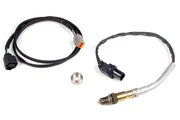
The factory single-wire narrowband can help hold lambda 1.0 at light load, but it tells you nothing useful under boost. A Haltech WB1 kit is the first thing we'd add. Its LSU 4.9 sensor can go in place of the factory sensor, using a 22 mm socket or wrench.
Injectors
The stock injectors flow 370 cc/min at wide open. That flow figure assumes fuel pressure rises with boost. If your system has a fixed pressure that isn't manifold referenced, flow has to be mapped against manifold pressure for accurate fueling. Dead time, the part of each pulse where the injector isn't really flowing while it opens and closes, also needs to be right, or idle and light-load fueling will never behave.
FJ20ET FAQ
Can I keep the FJ20ET distributor with a Haltech?
Yes. Its 360-slot and four-slot tracks give the ECU everything it needs for sequential fuel and direct fire spark.
Why won't my factory TPS work?
It's only a closed-throttle switch. A Haltech needs a variable position signal, so fit a throttle body or sensor with a proper potentiometer.
Building another Nissan? See our SR20, CA18 and RB engine guides, or contact us for help planning your install.