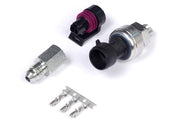
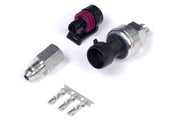
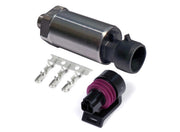
What this sensor measures
A wastegate pressure sensor reads the pressure acting on top of the wastegate diaphragm, the side that helps hold the valve shut. You'll also hear it called dome pressure or hat pressure. With CO2 boost control, this is the value the ECU controls. It raises or lowers dome pressure, and boost follows. That's why a CO2 setup like the CO2 boost control dual solenoid kit needs this sensor, while a normal solenoid setup controlling manifold pressure doesn't.
Calibration
The main node holds the sensor calibration. If you bought a Haltech sensor, press Load from File and pick its calibration instead of entering points by hand. Save to File stores the calibration so you can reuse it on another map. Suitable sensors include the 150 PSI TI sensor, the 250 PSI TI sensor and the 150 PSI motorsport sensor. Choose a range with comfortable headroom over the highest dome pressure you'll run.
Display settings
| Setting | What it does |
|---|---|
| Warning Maximum | Pressure where wastegate pressure gauges, bars and numbers switch to warning |
| Display Minimum | Where those displays start |
| Display Maximum | Where those displays end |
Diagnostics and wiring
You can enable high and low voltage DTCs and give each a severity, which links it to an engine protection level. On a CO2 car that's worth doing: if the dome pressure signal fails, the ECU is controlling boost blind.
Pressure sensors go to an analog input, and any spare AVI works. Leave the pullup disabled.
With the engine off and the dome vented, the sensor should read near atmospheric. Then apply a little CO2 pressure and check the reading against a mechanical gauge. For the control side, see boost control and CO2 boost control wiring.