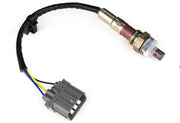
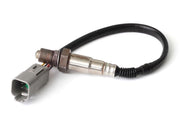
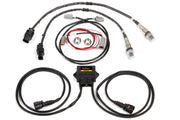
Why a wideband
A narrowband sensor only switches between "rich" and "lean" around the stoichiometric point, so it can't tell you whether you're at a safe mixture under boost. A wideband reads accurately across the whole range an engine uses, from lean cruise to rich full load. The Nexus can use that reading for monitoring and protection, and as the feedback for closed-loop O2 control. For background, see Wideband O2 Sensors Explained.
How the section is organized
The top-level Wideband O2 page is where you say how many sensors the car has, where each one sits (for example one per bank) and what kind of input each uses. For every sensor you enable, NSP adds its own sensor page to the navigation tree, and that page holds the settings for that sensor alone. The section also has these pages:
- Wiring: assigns each enabled sensor to a physical input or a CAN connection. If the input or controller can handle more than one sensor type, you also choose the type here, so make sure it matches the sensor actually fitted.
- Diagnostics: the fault code thresholds for the sensor signal. With an on-board or CAN wideband controller, like the WB2 dual-channel kit, the minimum and maximum voltage DTCs are switched off, because there's no analog voltage to check.
- Engine Protection: the lean-condition safety net, covered below.
Lean protection, explained
When enabled, the ECU watches the wideband while the engine is working hard. If the mixture goes leaner than you've allowed for long enough, it raises a DTC, which your Engine Protection strategy can act on.
| Setting | What it does | Our advice |
|---|---|---|
| Wideband Maximum | A table of the leanest reading allowed. It can be mapped in 3D against any channel | Map it against load so the limit tightens where the engine is most at risk |
| Minimum RPM | Monitoring only runs above this speed | Keep it above idle and decel so normal lean events don't trip it |
| Precondition | Chooses MAP, TPS or both as the load gate | MAP on boosted engines, TPS or both on naturally aspirated ones |
| Minimum MAP / Minimum TPS | The load that must be exceeded before monitoring starts | Set it where you're clearly under real load |
| Delay Time | How long it must stay too lean before the DTC fires | Long enough to ignore a single noisy sample, short enough to act before damage |
| DTC Severity | How seriously the fault is treated | Match it to the response you've set up in Engine Protection |
Protection that has never been triggered is protection you're only hoping works. On the dyno, temporarily lower the Wideband Maximum into your normal operating range and confirm the DTC fires and the engine responds the way you expect. Then set it back.
FAQ
Do I need a separate sensor for each bank?
On a V engine, it's worth it. One bank can go lean on its own because of an injector or an intake leak, and a single sensor in a merged pipe can hide that.
Can I keep my narrowbands too?
Yes. They're configured separately under Narrowband O2.