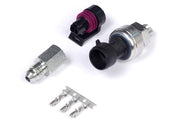
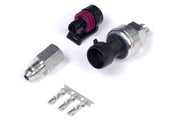
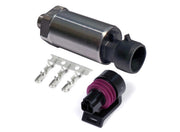
Why fit a fuel pressure sensor?
Your injectors are rated at a particular pressure difference across them. If fuel pressure sags, or manifold pressure rises without fuel pressure following, the injectors flow less than the ECU expects, and the engine leans out. A sensor gives the Nexus three useful abilities:
- Logging, so you can see a tired pump or a struggling regulator long before it causes damage.
- Injector pressure differential modeling. The ECU compares fuel pressure with manifold pressure, allows for how your fuel pressure is referenced (the Fuel Pressure Input Type), and works out the real pressure across the injector. That lets it predict flow accurately at any rail pressure and any boost level.
- Engine protection when pressure drops below what the engine needs.
These are powered sensors with three wires: 5V supply, signal back to the ECU, and signal ground. They normally mount on the fuel rail or the regulator so they read what the injectors actually see.
Choosing a sensor
Haltech's 150 psi TI sensor suits most port-injected builds. Go for the 250 psi version on high-boost or high-pressure fuel systems, or the 150 psi motorsport sensor if you want the motorsport-grade part. Pick a range comfortably above your highest expected pressure so you have resolution and headroom.
Setting it up in NSP
| Section | What it does | Our advice |
|---|---|---|
| Wiring | Assigns the input. It uses an analog input, and any free AVI will do | Turn the pull-up off |
| Configuration | Holds the sensor calibration. Haltech sensors can be loaded with Load from File, and Save to File stores a custom one | Load the file for your exact part number, then compare with a mechanical gauge |
| Display | Minimum and maximum for number and gauge displays | Just wider than your normal operating range |
| Diagnostics | High and low voltage DTCs, each with a severity that triggers engine protection | Enable both, so a broken wire or failed sensor is flagged |
Fuel Pressure Operating Safety
The last option in Diagnostics switches on the fuel pressure safety system. It works alongside the Fuel Tuning settings and watches the differential fuel pressure: the real pressure across the injector, calculated from fuel pressure, manifold pressure and input type. Turning it on adds a Differential Fuel Pressure Minimum table, which sets the minimum differential the safety system checks against.
| Setting | What it does | Our advice |
|---|---|---|
| DTC Delay | How long low pressure must persist before protection kicks in | Long enough to ignore brief dips, short enough to catch a real failure |
| Minimum RPM | Safety stays inactive below this speed | Above idle and cranking, where pressure naturally moves around |
| Precondition | Requires a MAP load, a TPS opening, or both before the check runs | We usually use MAP on boosted engines, since that's where low pressure hurts |
| Minimum MAP / TPS | Threshold for the chosen precondition | Set it where the engine starts making meaningful load |
| DTC Severity | Which engine protection level fires when the system trips | Match it to how dangerous a lean condition would be on your build |
Protection response is set in engine protection, so review that when you choose a severity.
Worked example
A turbo car with a boost-referenced 1:1 regulator should hold a steady differential pressure. We'd set the minimum table a margin below that, require some boost as the precondition, and apply a short delay. Now if the pump falls behind on a long pull, the ECU steps in within a moment instead of letting the engine run lean to redline.
Troubleshooting
| Symptom | Usually |
|---|---|
| Reading pinned at max or zero | Open circuit or short: check 5V, ground and signal. Pull-up left on can also skew it |
| Reads differently from a mechanical gauge | Wrong calibration file for the sensor range |
| Protection triggers at idle | Minimum RPM or precondition set too low |
| Protection never triggers when pressure drops | Safety not enabled, precondition not met, or delay too long |
For a broader look at the sensor side, see fuel pressure sensor and diagnosis, and pair this with manifold pressure setup, since the differential calculation depends on both.