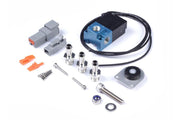
How electronic boost control works
A wastegate opens when the pressure on its diaphragm beats the spring holding it shut. Left alone, that means boost stops climbing at roughly the spring's rating. A boost control solenoid sits in the line between the pressure source and the wastegate and bleeds some of that signal away. The ECU pulses the solenoid, and the percentage of time it spends open is the duty cycle. More duty hides more pressure from the wastegate, so it stays shut longer and the turbo makes more boost.
Everything in the Boost Control setup comes back to one question: how should the ECU decide what duty to command?
Open loop or closed loop?
| Open loop | Closed loop (NSP default) | |
|---|---|---|
| You tune | Duty directly, in a table | A boost target, plus a base duty table |
| The ECU does | Outputs exactly the duty you gave it | Trims duty up or down to hit the target |
| Strengths | Simple, predictable, easy to diagnose | Holds boost through weather, altitude and fuel changes |
| Watch out for | Boost drifts as conditions change | Needs a good base duty table or it hunts |
| We use it for | First start-ups, fault finding, some drag setups | Almost every street and road-race car |
Even in closed loop, the closed loop base duty table does most of the work. The controller only has to correct a small error, which is what keeps boost smooth. If you're starting from scratch, tune in open loop first, then copy those duties across as your closed loop base.
Which pressure should it control?
- Manifold pressure: the right answer for nearly everyone. The ECU targets the boost your engine actually sees, measured by the MAP sensor. Make sure your MAP sensor has headroom above your highest target.
- Wastegate pressure: controls the pressure fed to the wastegate itself instead of the manifold. It's mostly used on drag cars and CO2 setups, like the CO2 dual solenoid kit. It needs a dedicated wastegate pressure sensor, and because the ECU is no longer watching manifold boost, your targets have to be set with care.
- Boost pressure: uses a separately configured boost pressure sensor as the control input, for setups where the manifold reading isn't the one you want to chase.
The core settings, and where we start
| Setting | What it controls | Our starting point |
|---|---|---|
| Output frequency | How fast the solenoid is pulsed | Match the solenoid. Haltech's 3-port solenoid runs at 33 Hz |
| Minimum duty | The lowest duty the ECU will command | Just below where the solenoid starts to respond |
| Maximum duty | The highest duty the ECU will command | Just above where more duty stops adding boost |
| Control point offset | How close to target boost must get before closed loop corrections start | Roughly a quarter of your target, then refine from logs |
| Max derivative | How fast boost can still be rising while corrections are allowed | Low enough that the controller waits for boost to settle |
| Overboost offset | How far over target before duty is dropped to 0% | A few psi, well inside what the engine can survive |
| Closed loop min TPS | Throttle opening required before corrections are allowed | High enough that part throttle can't "wind up" the controller |
Min and max duty are worth a minute of logging. Most solenoids have a dead zone at the bottom and a point near the top where boost stops rising. Keeping the controller inside the useful range stops it from wasting time, and output, in places that do nothing.
When closed loop actually takes over
Closed loop doesn't correct the whole time you're on boost. It waits until three things are true:
- Boost is within the control point offset of the target.
- Boost has stopped climbing faster than the max derivative.
- Throttle is past the closed loop min TPS.
Here's a worked example. Say you're targeting 140 kPa (about 20 psi) with a control point offset of 35 kPa (about 5 psi). Below 105 kPa (about 15 psi) the ECU just runs the base duty table, and closed loop corrections start once boost passes 105 kPa and has calmed down.
Getting that offset right is a balance. Set it too small and the controller joins in late, so boost can overshoot before it reacts. Set it too large and it starts correcting while boost is still surging, which shows up as wavy, inconsistent boost in your logs.
The min TPS setting solves a problem you'll recognize if you've ever cruised on part throttle. At 40% throttle the engine may not be able to reach target, so a controller with no guard keeps adding duty. Stab the throttle to 100% and all that stored-up duty turns into a spike. Requiring real throttle before corrections are allowed prevents it.
Spool assist
With spool assist on, the ECU holds 100% duty from the moment boost goes positive until boost reaches the target minus the control point offset. Using the numbers above, that's full duty from 0 to about 15 psi. The wastegate stays shut, and the turbo builds boost as quickly as it can. The trade-off is that on some setups, especially with changing throttle input, spool assist can push boost past target before closed loop catches it. If you see spikes, try it off and let the base duty table handle spool.
Overboost offset drops boost duty to zero when boost exceeds the target by the amount you set. It's a last line of defense, not a boost limiter. Pair it with a proper overboost cut so the engine is protected even if a hose splits or the solenoid sticks.
Extra features worth knowing
Arm switch
Makes boost control depend on a switch. With the switch off, the car runs on wastegate spring pressure, which is handy as a low-boost or valet mode.
Boost trim
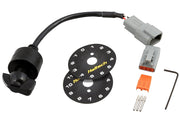
Lets the driver pull boost back from a dash-mounted knob like the 12-position rotary trim module. In closed loop, the trim max sets the most target pressure the knob can remove. In open loop, it's the most duty (as a percentage) the knob can take away.
Scramble boost
A timed boost increase triggered by a button, great for passing or the last pull down the straight. You set:
- Target offset: extra boost added to the target (closed loop).
- Base offset: extra duty added (open loop). In closed loop, leave this at 0 and build the extra duty into your closed loop base table instead.
- Hold time: how long it stays active after you release the button.
- Max time: the longest a single scramble can last.
- Rest time: the cooldown before it can be used again.
Troubleshooting boost control
| Symptom | Usually |
|---|---|
| Spikes past target, then settles | Control point offset too small, spool assist too aggressive, or base duty too high |
| Never quite reaches target | Max duty too low, base duty too low, a boost leak, or the wastegate spring/actuator can't be held shut |
| Boost waves up and down | Control point offset too large or max derivative too high, so corrections start before boost is stable |
| Spike when going from part to full throttle | Closed loop min TPS set too low |
| No response at all | Check the solenoid wiring, output assignment and frequency first |
Once it's behaving, long term trim can learn small differences over time, and boost corrections let you adjust the target for gear, speed or temperature.
Boost control FAQ
Do I need closed loop boost control on a street car?
You don't need it, but it's what we recommend. It holds the same boost on a cold morning and a hot afternoon, and it corrects for small changes like a fresh air filter without a retune.
Can I run more boost than my wastegate spring?
Yes, that's the point of a boost control solenoid. How far above spring pressure you can reliably go depends on the wastegate, the actuator and the plumbing. Very high multiples of spring pressure are where CO2 or dual-port setups come in.
Why does my boost overshoot in closed loop?
Usually the base duty table is doing too much, spool assist is on, or the controller starts too late. Log boost, target and duty together and look at what happens in the second before the spike.