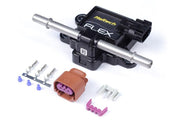
How the sensor works
A flex fuel composition sensor sits in the fuel line and reports two things: the ethanol percentage and the fuel temperature. The ECU can use those for flex fuel tuning, so fuel and timing follow whatever blend is in the tank, as well as for logging and engine protection.
Clever part: both values come down one signal wire. The Haltech flex fuel sensor sends a square wave whose frequency represents ethanol content and whose pulse width represents fuel temperature. That's why it has to go to a digital frequency input and can't go to an analog one.
Wiring
- Power: switched 12 V.
- Ground: chassis ground.
- Signal: a free SPI (digital input).
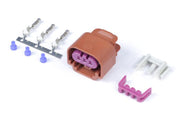
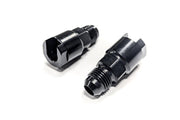
If you're building your own lead, the plug and pins kit has the connector. For plumbing into GM-style spring-lock lines, these 3/8" GM spring-lock fittings make it straightforward.
Software setup
| Setting | Set to | Why |
|---|---|---|
| Input | Any free SPI | Only a frequency input can decode both values |
| Edge Select | Rising | Matches how the sensor's signal is measured |
| Sensor Type | Hall Effect | It's a square-wave digital output, not a magnetic pickup |
| Pull Up | Enabled | The sensor pulls the line low, so the ECU has to provide the high side |
| SPI Glitch Filter | Leave at default unless you see noise | Time in microseconds a transition must last to count. Anything shorter is thrown away as a glitch |
Once the input is set, the Fuel Temperature and Flex Fuel Composition channels both take their data from it. Their own wiring settings are locked, because they share the one input. You still set up calibrations, display ranges and diagnostics on each of those nodes.
Too much glitch filtering can start rejecting real pulses and make the readings jump. If ethanol content looks erratic, check grounds and routing first, and only then adjust the filter in small steps.
What next
With ethanol content reading correctly, you can build fuel and ignition blending around it. Our flex fuel tuning guide walks through that, and how flex fuel control works explains the theory.