What the sensor does
Pump E85 is rarely exactly 85% ethanol, and a tank of mixed fuel can land anywhere. A flex fuel composition sensor measures the blend and reports it to the ECU, which uses it three ways:
- Tuning: blending fuel, timing and other tables between gasoline and ethanol values. See how flex fuel control works.
- Logging: so you know what the engine was actually running on.
- Protection: flagging a failed sensor through engine protection.
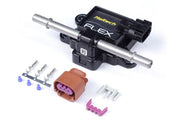
The Haltech Flex Fuel Composition Sensor reports ethanol content as a digital frequency. Most flex sensors on the market, including the common GM-style units, work the same way. Many sensors also report fuel temperature, which is set up separately as flex fuel composition temperature.
Wiring and input setup
On the Wiring node, choose the input type that matches your sensor:
| Setting | What it does | Our advice |
|---|---|---|
| Digital Frequency | For sensors that output a frequency | Use this for the Haltech sensor and most others |
| Edge Select | Which edge of the signal is counted | Rising for the Haltech sensor |
| Sensor Type | Signal style | Hall Effect |
| Pull Up | Internal pull-up on the input | Enabled for the Haltech sensor |
| Analogue Voltage | For sensors or converters with a 0 to 5V output | Only if your sensor genuinely outputs voltage |
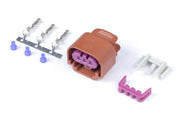
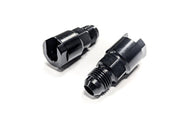
If you are building your own connector, the plug and pins kit saves hunting for the right parts, and the 3/8 GM spring lock fittings make plumbing the sensor into your fuel line easier.
Calibration
You can load a calibration or type one in. For most common sensors, the default is already right: 50 Hz reads as 0% ethanol and 150 Hz as 100%, with a straight line between. Only change it if your sensor's documentation says it uses a different range.
Sampling thresholds: the setting people miss
The sensor needs fuel flowing through it to read accurately. Many installs put it in the return line, and at high RPM and load a hard-working fuel system can return very little fuel. With almost no flow across the sensor, the reading can wander just when the ECU is relying on it most.
Enable the sampling threshold and enter an RPM and a load value. Above either limit, the ECU stops taking new readings and holds the last good value. Below them, it samples normally. Ethanol content doesn't change mid-pull anyway, so holding the value costs you nothing and keeps fueling steady.
If you see the ethanol reading move during a wide-open-throttle run in your logs, that is a strong sign you need sampling thresholds, or better placement of the sensor.
Display, diagnostics and glitch filter
- Display: Warning Minimum and Warning Maximum set when gauges and bars for this channel switch to their warning colors. For example, you might warn below the ethanol content your tune was built for.
- Diagnostics: turn on high and low frequency DTCs. Each one can have a severity that triggers an engine protection level, so a failed or unplugged sensor can pull power instead of leaving you on the wrong fuel map.
- SPI Glitch Filter: digital sensors only. A pulse must stay in its new state for this many microseconds to count. Shorter blips are treated as noise and ignored. Leave it alone unless you see noisy readings.
Troubleshooting
| Symptom | Usually |
|---|---|
| Reads 0% or nothing | Wrong input type, pull-up off, or no power to the sensor |
| Jumps around at high load | Low flow over the sensor. Enable sampling thresholds |
| Reading doesn't match a test kit | Check calibration against the sensor's specs, and allow time for fresh fuel to reach the sensor |
FAQ
Where should I mount the sensor?
Anywhere it sees steady fuel flow. Return-line mounting is common and fine, provided you use sampling thresholds.
Do I need a flex fuel tune if I always run E85?
We still recommend the sensor. E85 varies season to season, and the sensor lets the ECU adjust. Our flex fuel tuning guide covers the tuning side.