Why ethanol needs its own fueling
Ethanol is popular with performance builds for good reasons: very high knock resistance, a strong charge-cooling effect, and a price at the pump that race gas can't touch. The catch is that ethanol carries less energy per gallon than gasoline, so the engine needs a lot more of it for the same air. At full E100 the injectors have to deliver roughly 35% more fuel than they would on straight gasoline.
Back when everything was carbureted, switching fuels meant rejetting, and switching back meant rejetting again. On a pump E85 car that's a real problem, because the actual ethanol content at the pump varies with the season and the station, and most people end up mixing whatever's left in the tank with whatever they just bought. Fill a half tank of gasoline with E100 and you're driving on roughly E50, not either of the fuels you tuned for.
A flex fuel sensor solves this. It sits in the fuel system, measures the ethanol percentage of whatever is flowing through it, and reports that to the ECU. The ECU then scales fueling (and anything else you choose) to suit the blend. Think of it as the ECU rejetting itself continuously, every time the fuel changes.
What you need
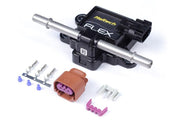
- A composition sensor. The Haltech Flex Fuel Composition Sensor (HT-011000) reports both ethanol content and fuel temperature on one signal wire.
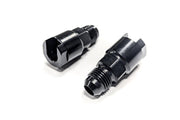
- Fittings to put it in the line. The GM spring lock to -6AN fittings suit the common sensor style.
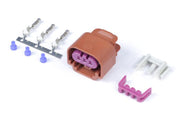
- A connector if you're building your own loom: the plug and pins kit.
- A spare digital (pulsed) input on the ECU. The sensor outputs a frequency, so it can't go on an analog input.
Where to plumb the sensor
For most return-style fuel systems we put the sensor in the return line, between the regulator and the tank. It's usually the easiest spot to reach, the fuel is moving through it whenever the pump runs, and it isn't adding restriction on the pressure side feeding the rail.
There's one catch, and it matters on big power cars. At high load, a pump that's close to its limit may send almost nothing back down the return. With little or no flow, the sensor can see a partly empty or stagnant line and start reporting nonsense. We'll cover the fix for that in the sampling threshold section below.
Electrically, the sensor needs three connections: switched +12V, sensor ground, and the signal wire to a pulsed input. Follow the wiring sheet that comes with the sensor for pin identification. If you're not sure which inputs on your ECU are free, our Haltech wiring diagrams page is the place to check.
Software setup (Elite and ESP)
The steps below follow Haltech's Elite software, ESP. If you run a Nexus with NSP, the menus are organized differently, so use the NSP-specific articles for the exact screens.
- Open Setup then Main Setup and go to the Functions tab. Typing "flex" in the search box at the bottom gets you there fastest.
- Enable Flex Fuel/Composition Sensor. This is the option for sensors like Haltech's that report temperature as well as ethanol percentage.
- Pick the input you wired it to. ESP offers the SPIs here.
- Set the edge to Rising. That's required to read both ethanol content and fuel temperature.
- Load calibrations using the folder icon:
Fuel Composition Digital – Haltechfor ethanol content andTemperature_Digitalfuelcomposition – Haltechfor temperature.
Before touching any tables, go for a short drive and watch the ethanol reading. It should be steady, and it should make sense for what's in the tank. If it jumps around at idle, look at wiring and grounds before blaming the sensor. The flex fuel composition sensor article covers the input itself in more detail.
Sampling threshold: dealing with an empty return line
Ethanol content doesn't change while you drive. It only changes when you refuel, and once fresh fuel has mixed through the tank and lines, it stays put. Haltech uses that fact. The sampling threshold lets you tell the ECU to stop updating the ethanol reading above a certain load and RPM, and simply hold the last good value.
On a car where the return line runs nearly dry at full power, this keeps a bad reading from ever reaching the fuel calculation. Set the threshold below the point where your logs show the return flow dropping away, and the ECU samples during cruise and idle, where the reading is trustworthy.
Fueling for the blend
In Main Setup, on the Fuel tab, change the fuel type to Flex Fuel. From then on, the ECU uses the sensor reading to work out how much extra fuel the current blend needs to reach your target air/fuel ratio. That calculation is based on fuel chemistry, so in theory you're done.
In practice, logs from the wideband usually show the result is off by a couple of percent. The main reason is ethanol's cooling effect on the intake charge: it changes how much air actually ends up in the cylinder, which pure chemistry doesn't account for. That's also why ethanol resists knock so well, so it's a trade we're happy to make.
To tidy up the difference, selecting Flex Fuel adds a Fuel Scalar table. It lets you trim how much of the calculated extra fuel is actually delivered at each ethanol percentage. Haltech's base values came from testing on a range of turbo engines and are a sensible start for most forced induction builds. We still verify them against the wideband at a couple of different blends before calling a car finished. See fuel composition scalar for the table itself.
Using ethanol to make more power
Running the same tune on E85 as on gasoline leaves a lot on the table. Once the ECU knows the blend, you can let timing and boost climb with it.
Timing that follows ethanol content
On the Ignition tab in Main Setup, turn on Fuel Composition Correction. Two tables appear:
- Flex Fuel Correction: how much timing to add over your base map, by load and RPM, when the fuel is at full ethanol (in practice, your highest real blend).
- Flex Fuel Scalar: what percentage of that extra timing to apply at each ethanol content.
This is the clever part. You tune the base map on gasoline and the correction table on your highest blend, then shape the scalar so everything in between blends smoothly. You don't need a separate full map for every 10% of ethanol.
Here's how it plays out. Say a cell has 18 degrees in the base map and 5 degrees in the correction table. If the scalar says 60% at the current ethanol reading, the ECU adds 3 degrees, for 21 total. At full ethanol with the scalar at 100%, you get all 23. More on this in ignition fuel composition correction and ignition fuel composition scalar.
Boost that follows ethanol content
Open the Boost Control function (F4 gets you there), go to its Corrections tab, and enable Flex Fuel Compensation. A Flex Fuel table then shows up under the boost corrections, with ethanol percentage on its axis. Whatever it holds is added to your normal boost target. You can think of it either way: more boost when E85 is in the tank, or a built-in safety step down when you're stuck with pump gas. The boost corrections article explains how it stacks with the others.
Everything else
Because Haltech tables can use almost any channel on an axis, ethanol percentage can drive other corrections too. Cold starting is the big one. Ethanol doesn't vaporize as readily as gasoline when it's cold, so high blends need more fuel to fire and run in the first minutes. Adding ethanol content as an axis on the fuel prime pulse and cranking tables fixes the classic hard-starting E85 car.
Only add ethanol-based timing and boost once fueling is right across the range of blends you'll actually run. A car tuned on 85% that fills up with a winter blend at 70% needs the scalars to pull things back correctly. Log a tank of each if you can.
Troubleshooting
| Symptom | Usually |
|---|---|
| Ethanol reading drops or jumps at full throttle | Return line running short of fuel; set a sampling threshold |
| No reading, or a fixed value | Wrong input selected, wrong edge, calibration not loaded, or a wiring fault |
| Temperature reads but ethanol doesn't (or the reverse) | Edge not set to Rising, or only one calibration loaded |
| Lean or rich only on high blends | Fuel Scalar needs adjusting at those ethanol percentages |
| Hard cold starts on E85 | Prime and cranking fuel not scaled by ethanol content |
Flex fuel FAQ
Can I just tune for E85 and skip the sensor?
You can, but you'll be tuned for one blend that the pump won't always give you. Seasonal blends can run well below 85%, and a car tuned rich for one blend can go lean on another. The sensor removes the guesswork.
Does the sensor have to go in the return line?
It's the most common spot, not the only one. What matters is steady flow through the sensor when the ECU is sampling. If you're unsure for your fuel system layout, book a free consultation and we'll talk it through.
Do my injectors need to be bigger for E85?
Often, yes. With roughly a third more fuel needed at high blends, injectors and pumps sized for gasoline can run out. Check duty cycle in your logs on the highest blend you plan to run. The flex fuel tuning guide goes further into the tuning side.