What a TPS does and how it's built
The throttle position sensor tells the ECU how far the throttle is open. That one number gets used everywhere: as the load input on some tunes, to recognize idle, to spot deceleration, and to add fuel and timing when you stab the pedal.
A conventional TPS is a potentiometer. Inside is a resistive track with the ECU's 5V supply at one end and signal ground at the other. A sliding contact, the wiper, rides along the track as the throttle turns, and whatever voltage it picks up is sent back to the ECU as the signal. Across its travel a typical sensor spans roughly 200 ohms to 4k ohms, which works out to around 0.5V closed and around 4.0V wide open.
Once you picture it that way, identifying the pins is straightforward logic.
What you need
- A multimeter that reads resistance in the k-ohm range
- Some way to turn the sensor through its travel (on the throttle body or by hand)
- A marker to label the pins 1, 2 and 3 so you can keep track
Step 1: find the signal pin
The trick is to find the two pins that are not the signal. The ends of the track are fixed, so the resistance between them never changes, no matter where the throttle is.
- Put the meter on resistance.
- Probe any two pins and sweep the throttle from closed to open.
- If the reading changes, the wiper is one of those two pins. Try a different pair.
- When you find a pair that stays steady through the whole sweep, those are the 5V and ground ends of the track.
- The pin you didn't use is the signal.
Step 2: tell 5V from ground
With the signal pin known, you can work out which end is which. Hold the throttle fully closed and measure from the signal pin to each of the other two pins.
At closed throttle the output should be low, around 0.5V, which means the wiper is sitting near the ground end of the track. So the pin with the lower resistance to signal at closed throttle is ground, and the higher-resistance pin is 5V. Open the throttle fully and the readings should swap around, which is a good cross-check.
If you want to be certain, power it up: with 5V and ground connected, the signal voltage should rise as the throttle opens.
Swapping 5V and ground doesn't damage anything. The signal simply runs in reverse, falling as the throttle opens. A Haltech ECU can calibrate either direction, so it will still work, though we prefer the conventional rising signal because it's what everyone expects to see in a log.
Step 3: calibrate in ESP
Calibrate any time the TPS is new to the ECU, the throttle stop has been adjusted, or the sensor has been moved. You need to be connected and online with the Elite.
- Open Main Setup, then Functions, then Throttle Position Sensor, and select the Calibration tab.
- Press Start.
- With the throttle fully closed, press Calibrate to capture the 0% voltage.
- Open the throttle all the way and press Calibrate again for 100%.
- Check the two recorded voltages make sense (roughly the 0.5V and 4.0V range above), then press OK.
If you're on a drive by wire setup, use the DBW calibration process instead; see DBW calibration.
Troubleshooting
| Symptom | Usually |
|---|---|
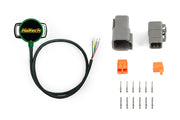
| No pair of pins gives a steady reading | It may be a dual-output or contactless sensor rather than a simple potentiometer |
| TPS reads 100% at idle | 5V and ground reversed and not recalibrated |
| Reading jumps or drops out at one spot | Worn track under the wiper; replace the sensor |
| Calibration voltages look very close together | Wrong pin used as the signal, or the sensor isn't turning fully |
TPS wiring FAQ
Can I test a TPS without removing it?
Yes. Unplug it and probe the sensor's pins while someone works the throttle, or turn the throttle linkage by hand.
What if I need a replacement TPS?
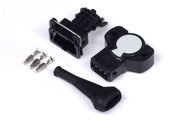
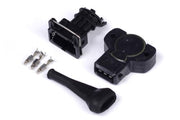
Haltech makes clockwise and counterclockwise 8 mm D-shaft sensors, plus a contactless dual channel version with no wiper to wear out.
For more sensor know-how, see our guides on using an SPI for temperature sensors and Hall effect vs reluctor sensors.