Why put oil pressure on the ECU?
A factory oil light usually comes from a simple pressure switch that only trips when pressure is almost gone. By then, bearings may already be marked. A proper analog sensor gives the ECU an actual number, so you can log it, spot trends such as pressure falling off when the oil is hot, and set a threshold that fits your engine. On supported Elite ECUs you can go further and have the ECU limit the engine automatically when pressure drops below safe levels.
Choosing and mounting the sensor
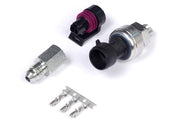
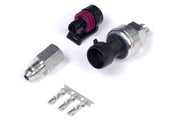
Our go-to is the Haltech 150 psi TI pressure sensor. It's built to handle oil and fuel and covers normal engine oil pressure with plenty of range. If you want more headroom, there's a 250 psi version. Other sensors can work too, as long as you have the correct wiring and calibration data for them.
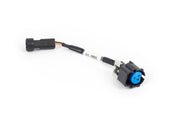
The one mistake we see over and over is screwing the sensor directly into the block. Engine vibration kills these sensors. Mount it on the chassis or a bracket that's isolated from the engine, and run a braided hose from the oil gallery port to the sensor. The pressure sensor extension kit makes that simple. On a Gen IV LS running a Nexus Rebel harness, the Gen IV oil pressure sensor adaptor harness is built for that combination, so check it against your harness before you start cutting wires.
Configuring the input
Pick your input in the software first, then run the wires. Any spare AVI or SPI can read the sensor, and the software only shows you inputs that suit it, so doing it in this order avoids wiring to a pin you can't use.
- Click the gear icon to open Main Setup, then go to Functions.
- Choose Add/Remove Functions, find Oil Pressure Sensor (the search box helps), move it to the active side and click OK.
- Click the Oil Pressure Sensor function and use Edit Connection to choose a spare input.
- Make sure Pull Up is Disabled. The sensor is powered and outputs its own signal, and a pull-up will distort the reading.
- Load or enter the calibration for your sensor and click OK.
Before you rely on it, compare the reading with a mechanical gauge at idle and at a steady higher rpm. They should agree closely. If they don't, the calibration or pull-up setting is the usual culprit.
Setting up low oil pressure detection
Engine protection is shown here on the Elite 1500 and 2500. Setting it up is a two-stage job: first the ECU needs to know what counts as low oil pressure, then it needs to know what to do about it.
Turn on the diagnostic
In the Oil Pressure Sensor function, open the Diagnostic tab and tick the Operating condition. Then choose a DTC severity level. We treat low oil pressure as the most serious fault an engine can have, so we give it Level 3.
Once that's done, a new Oil System group appears among your tables on the left of the screen. That's where you define when protection is allowed to act and what pressure is too low.
DTC Settings: when it's allowed to trigger
| Setting | What it does | Our advice |
|---|---|---|
| RPM threshold | Protection can only trigger above this engine speed | Set it above cranking and first-start speeds. Too low, and it can trip on a cold start before oil has had time to circulate |
| DTC Delay | How long pressure must stay low before the fault is flagged | Long enough to ignore a momentary blip, short enough to act before bearings suffer. Start short and confirm in logs |
| Load / throttle condition | How much load or throttle must be present before it can trigger | A small value keeps it from tripping while you coast with the throttle closed |
Oil Pressure Minimum table
This table holds the pressure below which protection kicks in, usually mapped against rpm. Oil pressure naturally rises with engine speed, so the minimum should too. Use your engine builder's specification or your own logs from a healthy engine at full temperature, and leave a sensible margin below normal readings so it doesn't trip every time the oil is hot. Every engine is different, so there's no universal table to copy.
Choosing the response
Add Engine Protection from Main Setup under Functions, then enable the severity levels. Level 3 is the one tied to your oil pressure fault. For that level you can combine:
- A slightly richer air/fuel target.
- A boost correction of -100%, which shuts boost control off.
- Ignition retard to cut cylinder pressure.
- A low rpm limit enforced with fuel cut.
- A maximum throttle position, if the car is drive-by-wire.
It's tempting to shut the engine off the instant oil pressure drops. Think about where that could happen: on a freeway, in traffic, mid-corner. Losing power steering, brake assist and speed without warning can hurt people. We set a low rpm limit instead, enough to crawl to the shoulder safely, and let the driver shut it down once they're stopped.
Active Condition: how it clears
The Active Condition setting decides how the car recovers from protection:
- Current DTCs Only: cycling the ignition off and on clears the protection state.
- Current and past DTCs: someone has to connect a laptop and clear the code before the engine will run normally again.
For oil pressure we usually lean toward requiring a laptop on race cars, so nobody can restart and carry on without looking into it. On a street car, the ignition-cycle option may be more practical. It's your call, but make sure whoever drives the car knows how it behaves. More detail on the response side is in our Engine Protection article.
Troubleshooting
| Symptom | Usually |
|---|---|
| Protection trips right after start-up | RPM threshold too low or DTC delay too short |
| Protection trips on hot laps only | Minimum table too close to normal hot pressure, or a real oil starvation or temperature problem worth investigating |
| Reading doesn't match a mechanical gauge | Wrong calibration or pull-up left enabled |
| Reading goes erratic or drops out | Wiring, or a sensor damaged by vibration from being block-mounted |
| Engine won't rev after a fault, even after key cycle | Active Condition set to require the code to be cleared with a laptop |
Oil pressure FAQ
Can I use the factory oil pressure switch instead?
A switch only tells the ECU on or off at one pressure. A sensor gives a real value, so you can set rpm-based thresholds and log what happened. If a switch is all you have, see Oil Pressure Switch.
Does the same process work for fuel pressure?
Yes, the setup is very similar. See fuel pressure sensor and diagnosis.
Do I need Engine Protection just to log oil pressure?
No. The sensor function alone gives you a logged and displayed value. Engine Protection is the extra layer that lets the ECU act on it. Need help picking thresholds for your build? Get in touch.