Which Haltech ECU for an LT1?
Any LT1 can run on an Elite 950, but you'll give up idle control because the factory idle valve is a stepper motor and the smaller Elites don't have stepper drivers. An Elite 2000 or Elite 2500 runs everything, including the idle valve. For a street car that has to idle nicely with the A/C on, we'd go straight to one of the bigger units.
LT1 basics
| Spec | LT1 Gen II |
|---|---|
| Layout | V8 |
| Displacement | 349.8 ci (5733 cc) |
| Firing order | 1-8-4-3-6-5-7-2 |
| Cylinder numbering | Viewed from the front: 1, 3, 5, 7 on the right-hand bank; 2, 4, 6, 8 on the left |
How the model years differ
- 1992-93: 10.4:1 compression, 5700 rpm factory limit, speed-density with a MAP sensor, and batch-fired injection on two injector drivers. Heads can be aluminum or cast iron, and blocks come as two-bolt or four-bolt main.
- 1994-95: switched to a MAF sensor instead of MAP, went to sequential injection and added vacuum venting for the Optispark.
- 1996-97: OBD-II, and some cars gained rear O2 sensors and an extra catalytic converter.
Good news for early cars: the injectors themselves don't care how the factory fired them, so every LT1 can run fully sequential on a Haltech.
The Optispark trigger
The Optispark sits on the front of the engine under the water pump and hides an optical trigger. Two light sensors read a slotted disc. The outer track has 360 slots, and the inner track has eight: four equal small slots plus four with differing widths, and that difference is how the ECU identifies cylinders. If you've set up a Nissan optical distributor, it's the same idea, and the Elite supports it.
| Optispark pin | Signal | Connect to |
|---|---|---|
| A | 8-slot low resolution | Trigger input |
| B | 360-slot high resolution | Home input |
| C | +12V ignition switched | Any switched 12V supply |
| D | Signal ground | ECU signal ground |
Optisparks have a reputation for hating moisture, so check the vent hoses and the cap before blaming the ECU for a trigger fault.
Coil and igniter
The LT1 coil is fired by an external igniter module, so the ECU never drives the coil directly. Only one wire goes to the Haltech: igniter pin B (ignition control) lands on Ignition Output 1, which is yellow/black on Haltech's harness. Pin A (coil negative), pin C (ground to the cylinder head) and pin D (switched 12V) stay as the factory had them.
Sensors
| Sensor | Wiring | Haltech calibration / notes |
|---|---|---|
| Throttle position | A: 5V, B: signal ground, C: signal | Calibrate closed and wide-open in the software |
| MAP (1 bar) | A: signal ground, B: signal, C: 5V | MAP - GM 1 Bar.cal. Atmospheric only, no boost reading |
| Coolant temp | EV1 connector, either polarity | Temperature - Holden VP V8 Coolant Sensor.cal, 1k pull-up |
| Air temp | Delphi connector, either polarity | Temperature - Holden VP V8 Air Sensor.cal, 1k pull-up |
| MAF (optional) | A: signal to a spare AVI, B: signal ground, C: switched 12V | Most people delete it and run speed-density |
| Vehicle speed | A: VSS low to signal ground, B: VSS high to a spare SPI | Reluctor type |
A couple of practical notes. The air temp sensor's Delphi plug is assembled by threading the wire through the housing, crimping the terminal, then drawing it back until it locks, so do it in that order. And if you plan to add boost, the factory 1 bar MAP has to go. A 3 bar GM MAP sensor is the usual swap.
Stepper idle valve
The idle valve is a four-wire stepper: pin A to Stepper 4, B to Stepper 3, C to Stepper 2 and D to Stepper 1. Start with drive type Both, 240 steps and a speed of 75. It works on the Elite 1000, 1500, 2000 and 2500, not the 550, 750 or 950.
O2 sensors
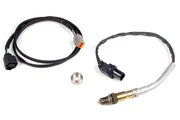
The factory narrowband sensors can tell rich from lean at light load, but they're useless for tuning. We fit a Haltech WB2 and put its two LSU 4.9 sensors where the pre-cat sensors were, one per bank. You'll need a 22 mm wrench or O2 socket.
Injector data
Stock LT1 injectors flow about 24.9 lb/hr (260 cc/min), measured held fully open. If your fuel system uses a fixed-pressure regulator that isn't referenced to manifold pressure, map flow against manifold pressure so the ECU accounts for the changing pressure drop across the injector. Dead time also needs to be correct: it's the portion of each commanded pulse where the injector isn't yet flowing fully, covering opening, closing and the ramps in between. Wrong dead times show up as poor idle and inconsistent light-load fueling.
Transmission and factory ECU
Many LT1s were paired with a 4L60E automatic. Check with us on current Elite support for your transmission before you plan the swap. The factory PCM lives in the engine bay on the driver's side, near the windshield, which is useful to know when you're tracing the factory loom.
Doing an LT1 swap or conversion? See our LS1 and LS2/LS3 engine notes if you're comparing platforms, or contact us for factory pinout diagrams and advice for your build.