Two generations under one name
The EFI Holden V8 came in the VN to VT Series 1 Commodore, and it splits into two groups that matter a lot for engine management:
- VN to early VS: multipoint injection that is really batch fire. The factory ECU has just two injector drivers (pins D15 and D16) and they're joined in the loom, so all eight injectors fire together no matter what.
- VS Series 3 and VT Series 1: a revised ECU, loom and distributor, plus a MAF sensor, giving true sequential injection. The ECU has eight injector drivers and the distributor carries a Hall effect trigger with 8 teeth and a separate 1-tooth home signal. These engines have covers marked Sequential Injection, which is the quickest way to tell.
The same basic setup applies to both 4987 cc (304 ci) and stroked 5737 cc (355 ci) versions.
Which Haltech ECU to use
| Car | Options | Our take |
|---|---|---|
| VN to VS, factory loom intact | The Platinum Sport GM plug-in | Fine for mild builds that already have one |
| VN to VS, serious build | Elite 2000 or 2500 on a new loom | What we recommend. Every factory function on the early cars is supported |
| VS Series 3 and VT Series 1 | Piggyback-style install | Needed if you want every factory dash function to keep working |
If you're weighing up a rewire, the Elite range is where we'd start, and we can quote a loom to suit. Our guide to wiring in an ECU covers the options.
Base settings
These are the values we'd enter in an Elite ECU as the starting point. Treat injector data as stock-only and update it the moment you change injectors.
| Setting | Value | Notes |
|---|---|---|
| Cylinders | 8 | 4-stroke piston engine |
| Capacity | 4987 cc (304) or 5737 cc (355) | Match your engine |
| Firing order | 1-2-7-8-4-5-6-3 | Odd cylinders (1, 3, 5, 7) are on the right-hand bank |
| Injection mode | Sequential | Needs eight injector outputs wired individually |
| Injector size | 220 cc, high current setting | Stock injectors |
| Ignition mode | Distributor, falling edge | Constant charge dwell |
| Trigger / home teeth | 8 / 1 | ESP pattern: Holden V8 Commodore VT |
| Trigger and home sensors | Hall, falling edge | Filter level 0, pull-up enabled on both |
| TDC angle | About 690° with a movable distributor, about 600° with an ICE distributor (no OEM bypass module) | About 60° when the factory DFI module is kept in bypass. Always confirm with a timing light |
| Quick start | Disabled |
Why the big jump in TDC angle without the factory module? The home edge arrives at about 30° BTDC on cylinder 1, which is after cylinder 1's trigger edge. The ECU therefore counts seven cylinders further, or 630°, which moves the offset from around 60° to around 690°. Either way, confirm it with a timing light before any load goes on the engine.
The DFI ignition: what makes this engine different
The factory ignition module is clever. With no ECU connected, it will still spark every cylinder on its own by firing off the rising edge of the distributor signal, which is set up to land at 10° BTDC. When an ECU is present, it sends a 5V signal to the module's bypass input. The module then passes the distributor signal to the ECU and waits for a timed spark signal back, like any conventional ECU-controlled ignition.
That gives you a neat way to phase the distributor. Disable the bypass output, then turn the distributor body until your timing light shows 10° BTDC. Re-enable bypass and set your TDC offset, which normally ends up close to 60°.
Wiring to the DFI module
| Haltech connection | VN to VS module pin | VT module pin |
|---|---|---|
| Trigger + (yellow) | B5, distributor reference in (white/violet) | D12, reference high (violet) |
| Signal ground (blue) | B3, reference earth (black/red) | D11, reference low (black/red) |
| Ignition output 1 | D4, EST output (white) | D10, EST out (white) |
| DPO1, 5V pull-up, high state | D5, bypass control | D9, bypass control (teal/black) |
| Home + (yellow) | Not used | D3, cam sensor (black) |
Upgraded ignition on a Platinum Sport GM
The Sport GM expects the factory distributor and DFI module. If those have been replaced with an aftermarket system, such as an MSD or ICE ignition, the ECU needs custom firmware. Haltech released two versions, both turning on the trigger pull-up. One keeps a falling-edge ignition output for inductive coils with a DFI delete (LS1 coils, IGN-1A, dumb igniters, ICE). The other switches to a rising-edge output for CDI boxes like the MSD 6AL. Contact us and we'll help you get the right one loaded.
Direct distributor wiring (no DFI module)
VN to VS distributor
The blue connector is marked +, 0 and -.
| Haltech wire | Goes to pin | Factory color at that pin |
|---|---|---|
| Signal ground (blue) | - | Grey/red |
| Trigger + (yellow) | 0 | Light blue/white |
| 12V+ (red) | + | White/black |
VT distributor
| Haltech wire | VT distributor wire |
|---|---|
| Signal ground (blue) | Black |
| Home + (yellow) | Blue |
| Trigger + (yellow) | Green |
| 12V+ (red) | Red |
One-cable shortcut: Haltech's trigger lead is a grey 4-core shielded cable with 12V+, signal ground, trigger + and trigger -. The home lead is a second 4-core, and you only need its home + wire. Since trigger - isn't needed with this Hall distributor, you can move that green wire to the home + ECU pin and run everything through the single trigger cable:
- Elite 550, 750 and 950: pull the yellow wire out of A32 and insulate it, then move the green wire from A33 into A32.
- Elite 1000, 1500, 2000 and 2500: pull the yellow wire out of B2 and insulate it, then move the green wire from B5 into B2.
Sensors
| Sensor | Pins / wiring | Calibration and notes |
|---|---|---|
| TPS | A 5V+, B signal ground, C signal | Calibrate closed and wide open in software |
| MAP | A signal ground, B signal, C 5V+ | MAP - GM 1 Bar.cal. It is a 1 bar sensor, so it can't read boost. Supercharged or turbo builds need a higher-range sensor, such as a 3 bar MAP sensor |
| Coolant temp | Common EV1 plug, not polarity sensitive | Temperature - Holden VP V8 Coolant Sensor.cal, built for a 1k pull-up to 5V |
| Air temp | Delphi plug, not polarity sensitive | Temperature - Holden VP V8 Air Sensor.cal, 1k pull-up to 5V. Thread the wire through the plug before crimping, then pull the pin back to lock it |
| Narrowband O2 (early cars) | Black = signal to AVI 1 or AVI 6, grey = sensor ground | Unheated, single sensor on the left-hand header. People often mistake the black wire for ground; it's the signal |
| MAF (VS III / VT) | A brown/white signal to a spare AVI, B black/red to sensor ground, C purple to switched 12V+ | Usually removed when a Haltech goes in |
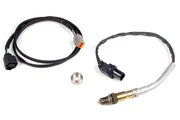
That old O2 sensor has no heater and is poor by modern standards. We'd replace it with a proper wideband kit such as the WB1 CAN wideband controller before any tuning starts.
Idle stepper motor
The factory idle valve is a stepper motor. Connect A to stepper 4, B to stepper 3, C to stepper 2 and D to stepper 1. It's supported on the Sport GM and on Elite 1000 and above, but not on the Elite 550, 750 or 950. See stepper outputs for how those drivers work.
Factory ECU location and transmissions
On VN to VP cars, the factory ECU sits behind the passenger-side kick panel. If you need the VT mounting location, ask us and we will send photos.
- TH700: the only thing the ECU controls is torque converter lockup, a ground-switched output on factory pin A7 (grey/red). Any spare low-side output can do this job.
- 4L80E: needs the ECU to handle shifting as well as lockup. That's a bigger job; our 4L80E controller build shows one approach.
Troubleshooting
| Symptom | Usually |
|---|---|
| Timing on the light doesn't match the software | TDC angle wrong for your setup: around 60° with DFI bypass, around 690° without the module |
| Timing fixed at about 10° and won't change | The DFI module isn't in bypass. Check the bypass output and its 5V pull-up |
| No RPM signal cranking | Pull-up disabled on trigger or home, or the Hall sensor is missing 12V |
| Engine runs but MAP stops rising on boost | Still using the factory 1 bar sensor |
FAQ
Can I run sequential injection on a VN?
Not with the factory ECU or loom, since the two drivers are tied together. With a new loom, an Elite and a distributor that gives a home signal, yes.
Do I need to keep the DFI module?
No. You can wire the distributor directly and drive coils yourself, but remember the TDC angle changes and the Sport GM needs special firmware.
Is the LS the better starting point?
For a fresh build, often yes. Our LS1 engine guide covers that route.