Which Alloytec do you have?
GM built several versions of this 3.6 liter, 24-valve V6, and only the port-injected ones suit a Haltech Elite. Check the engine code before you buy anything.
| Code | Key details | Haltech Elite support |
|---|---|---|
| LE0 | 10.2:1 compression, variable cam timing on the intake cams only, drive by wire, 175 kW (about 235 hp) | Supported |
| LY7 | Adds variable timing to the exhaust cams, 190 kW (about 255 hp) | Supported |
| LLT | Spark ignition direct injection, 11.3:1 | Not supported |
| LFX | Lighter LLT derivative with flex fuel capability, 11.5:1 | Not supported |
| LWR | Dedicated LPG vapor injection, 12.2:1, unique pistons, valves, heads, injectors and intake | Not supported |
You'll mostly find these engines in the Holden Commodore from VZ through VF. Their output, parts prices and availability also made them a popular control engine in some race series.
Choosing the ECU
If you keep the factory drive by wire throttle, you need an Elite 2500. If you convert to a cable throttle, an Elite 2000 is enough. Either way, plan on the Elite running the engine only: the factory CAN and serial networks that link the dash, ABS and body control module are not supported, so budget for how those systems will behave once the OEM ECU is gone.
Engine basics
| Item | Value |
|---|---|
| Layout | V6, 6 cylinders |
| Displacement | 217.5 ci (3564 cc) |
| Firing order | 1-2-3-4-5-6 |
The firing order is simply sequential, which makes checking coil and injector order easy. Confirm the cylinder numbering on your engine against a factory service manual before you pin the injector and coil outputs.
Crank and cam triggers
The crank wheel is a 60-2 pattern: sixty tooth positions with two missing to mark a reference point. The cam wheels carry four teeth, two narrow and two wide. Depending on the model, the crank sensor is either a two-wire reluctor or a three-wire Hall effect sensor, and the trigger settings differ between them, so identify yours first.
| Function | 2-pin reluctor sensor | 3-pin Hall sensor | Haltech trigger 4-core wire |
|---|---|---|---|
| Signal | Pin 2 (white), reluctor + | Pin 2 | Yellow |
| Reluctor negative | Pin 1 (black) | n/a | Green |
| Signal ground | n/a | Pin 1 | Blue |
| Sensor supply | n/a | Pin 3 | Orange (5V+) |
Cam sensors
All the cam sensors are Hall effect units at the front of the engine, and they share one pinout: pin 1 ground, pin 2 signal, pin 3 5V supply.
- Bank 1 intake cam: this is the home (sync) signal. Pin 2 goes to the yellow wire in the Home 4-core, pin 1 to the blue wire, and pin 3 to orange 5V+.
- Every other cam sensor: pin 2 to any spare SPI, pin 1 to signal ground (black/white), pin 3 to 5V+ (orange). These feed cam position back to the ECU for variable cam control.
Need the trigger setup screens for either crank sensor type? Ask us and we'll send them over with advice for your build.
Ignition coils
The factory coils have the igniter built in, so they can be driven straight from the Elite's ignition outputs with no external igniter module.
| Coil pin | Connect to |
|---|---|
| 1 | Haltech ignition output for that cylinder |
| 2 | Switched 12V |
| 3 and 4 | Ground at the cylinder head |
Drive by wire throttle and pedal
These engines use one electronic throttle body. Both 6-pin and 8-pin versions have been reported, so count the pins before you start. The table lines the two up by function.
| Function | 8-pin body | 6-pin body | Haltech wire |
|---|---|---|---|
| Motor drive 1 | A | A | DBW1 (brown/black) |
| Motor drive 2 | C | B | DBW2 (brown/red) |
| Throttle position 1 | G | D | AVI-2 (orange/black) |
| Throttle position 2 | F | F | AVI-3 (orange/red) |
| 5V supply | E and H | E | 5V+ (orange) |
| Sensor ground | B and D | C | Signal ground (black/white) |
The accelerator pedal has two independent tracks, each with its own supply and ground. Pins 1 and 2 are the two 5V feeds (both to orange 5V+), pins 4 and 5 are the two grounds (both to black/white signal ground), pin 6 is pedal signal 1 to AVI-5 (orange/green) and pin 3 is pedal signal 2 to AVI-4 (orange/yellow). For the software side, see our Elite drive by wire guide.
Idle speed is handled by the DBW throttle itself, so there is no separate idle valve to wire.
Variable cam timing
The Elite supports the continuously variable cam timing on these engines, whether yours has two phased cams (LE0) or four (LY7). Each cam solenoid needs one ECU output and one switched 12V feed. Any spare output will do except ignition outputs. The cam position feedback comes from the cam sensors covered above. Our cam control guide covers the setup.
Sensors
Manifold pressure
No factory MAP sensor is fitted. The Elite's internal MAP sensor works for naturally aspirated and mild boost use. For more boost, fit an external sensor such as the 5 bar TI MAP sensor on a spare AVI.
Coolant and air temperature
Both are two-wire thermistors, and polarity doesn't matter: one pin to a spare AVI, the other to signal ground. Use an AVI with a switchable pull-up and turn it on. If the AVI doesn't have one, add a 1k resistor from the signal to 5V.
The factory air temperature sensor lives inside the MAF. If you remove the MAF, install a replacement such as the Haltech HT-010206 air temp sensor, placed as close as you can to where the MAP sensor takes its reading.
Knock sensors
Two non-resonant knock sensors come fitted, and they work with the Elite 1000, 1500, 2000 and 2500. Pin 1 is the knock signal and pin 2 goes to signal ground.
MAF sensor (optional)
Most people delete it, but you can keep it. MAF signal (pin A) to a spare AVI, pin B to switched 12V, pin C to signal ground, air temp signal (pin D) to a spare AVI such as AVI-7 (grey), and pin E to signal ground.
Oxygen sensors
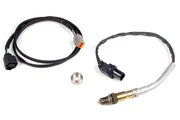
The factory narrowband sensors can hold lambda 1.0 at light load, but you can't tune under power with them. We strongly recommend a WB2 dual channel wideband kit, one sensor per bank, with the supplied LSU 4.9 sensors going in the pre-cat locations. They come out with a 22 mm wrench.
Vehicle speed
- Aisin AY6 manual: Hall effect speed sensor. Factory service data suggests roughly 4000 pulses per mile as a starting calibration, then calibrate against GPS.
- Tremec T56: reluctor speed sensor. Pin 1 (signal +) to any spare SPI, pin 2 (signal -) to signal ground.
Injector data
The ECU needs accurate flow and dead time figures. Flow is measured with the injector held fully open. If your fuel pressure isn't referenced to manifold pressure, as with many returnless systems, the effective flow changes with boost and vacuum, so map flow against manifold pressure. Dead time covers the delay while the injector opens and closes plus the part-flow period during those movements. Our dead time article explains why it matters.
Factory ECU
The factory ECU varies between Commodore generations such as VZ and VE. If you need the OEM ECU location or pinout for a plug-in conversion, ask us and we'll send it over with advice for your build.
Alloytec FAQ
Can I run an LLT or LFX on a Haltech Elite?
No. Those are direct injection engines and aren't supported on the Elite. Stick with an LE0 or LY7, or talk to us about your plan.
Will my Commodore dash still work?
The Elite doesn't talk to the factory CAN or serial networks, so dash gauges and other modules may not work as they did. Plan for this before the swap.
Is this related to the GM LS swaps?
Only in the sense that both came out of the same cars. If you're doing a V8 conversion instead, see our Gen IV LS guide or the Holden V8 guide.