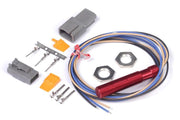
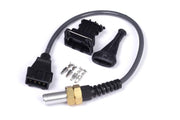
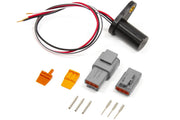
How this sensor works
The HT-010610 single channel Hall effect sensor switches when a suitable iron or steel tooth passes its face. Its output is a current sinking (open collector) type: it pulls the signal line to ground when triggered but can't drive it high on its own. That's why it needs a pull up resistor to create a usable square wave. It doesn't care about orientation, so you can mount it at any angle to the target.
Wiring
| Sensor wire | Job | Connect to |
|---|---|---|
| Brown | Supply | 12 V |
| Black | Output | Trigger+, Home+, or a spare SPI, depending on what it's measuring |
| Blue | Ground | Haltech signal ground (black/white) |
Choosing the pull up
If your ECU input doesn't provide a suitable internal pull up, fit an external resistor between the signal and the supply voltage. Haltech recommends:
| Pull up to | 5 V | 9 V | 12 V | 15 V | 24 V |
|---|---|---|---|---|---|
| Resistor | 1 kΩ | 1.8 kΩ | 2.4 kΩ | 3 kΩ | 3 kΩ |
Key specifications
- Supply voltage: 5 to 24 VDC. It tolerates up to 30 VDC and 24 VDC reverse polarity.
- Current draw: 3 mA typical, 6 mA maximum. Output can sink up to 20 mA.
- Maximum frequency: 15 kHz, plenty for crank triggers and most speed pickups.
- Temperature: -40 to 257 °F (-40 to 125 °C), operating and storage.
- Toughness: IP67 sealed, rated for 50 g shock and 15 g sinusoidal vibration from 40 Hz to 2 kHz.
Designing a trigger target
The target matters as much as the sensor. Low carbon cold rolled steel gives the best results. As a starting point, aim for at least:
| Feature | Minimum |
|---|---|
| Tooth height | 0.20" (5.0 mm) |
| Tooth width | 0.10" (2.5 mm) |
| Gap between teeth | 0.40" (10.0 mm) |
| Target thickness | 0.25" (6.35 mm) |
| Air gap to sensor | 0.06" (1.5 mm) |
Smaller teeth can work, but test on your setup before relying on them. Tooth shape and spacing both affect signal quality, so check the signal with a trigger scope before the first start.
Need a dual channel or higher frequency option? Compare the S3 dual channel sensor and the GT101 style sensor, and read Hall effect or reluctor? if you're choosing a trigger type.