The 4G63 at a glance
This guide covers the DOHC turbo 4G63 only. It's an inline four with 1998 cc (121.9 ci) of displacement and a firing order of 1-3-4-2. The basics stayed the same for well over a decade, but the sensors, ignition and ECU connectors moved around between generations, so the first job on any 4G63 build is to pin down exactly which version you have. Our look at what makes the 4G63 special covers the history. Below is the practical side.
Which 4G63 do you have?
| Model | Compression | Changes that matter for the ECU swap |
|---|---|---|
| Galant VR4 / Eclipse 1G | 7.8:1 | Engine sits on the left side of the bay, dual-post waste spark coils, some cars have the twin-runner "Cyclone" intake |
| RVR | As EVO 1-3 | Basically the EVO 1-3 package with a smaller turbo |
| EVO 1 and 2 | 8.5:1 | Factory limit of 7500 rpm |
| EVO 3 | 9.0:1 | Bigger turbo |
| EVO 4 and 5 | 8.8:1 | Engine turned around to the right side, trigger moved to the crank, coil-on-plug ignition, metal head gasket, revised intake, factory anti-lag provision on the exhaust manifold |
| EVO 6 / 6.5 | - | 7600 rpm limit, cooling upgrades, Inconel turbine on GSR and titanium on RS. The 6.5 is the Tommi Makinen Edition |
| EVO 7 | - | New intake manifold, hollow cams, intercooler water spray |
| EVO 7.5 GTA | - | Five-speed INVECS-II automatic, smaller turbo, no anti-lag and no water spray |
| EVO 8 / 8MR | - | First US-market EVO, stronger rods and pistons, new water pump and exhaust manifold. The MR gets a six-speed |
| EVO 9 | - | MIVEC variable intake cam, different extended-tip plugs, two-piece rings, mag-alloy compressor wheel on RS and GT |
Trigger and home sensors
Every turbo 4G63 gives the ECU the same basic pattern: a 4x trigger signal and a 2x home signal. What changed is where that signal comes from. If trigger terms are new to you, start with our trigger systems explainer, and see the 4G63 trigger page for the pattern itself.
Early engines: cam angle sensor (CAS)
Up to the EVO 3, one sensor at the back of the head, above the flywheel, produces both signals. EVOs use an optical disc inside it, while some other 4G engines use a slotted chopper wheel, but the ECU sees the same output either way.
| CAS pin | Signal | Goes to on the Haltech |
|---|---|---|
| 1 | 2x cam (home) | Home + (yellow, Home 4-core) |
| 2 | 4x crank (trigger) | Trigger + (yellow, Trigger 4-core) |
| 3 | Supply | 12V+ (red, Trigger 4-core) |
| 4 | Ground | Signal ground (blue, Trigger 4-core) |
The one-cable trick. Because the CAS doesn't use Trigger-, you can run everything through the grey Trigger 4-core and leave the Home cable out entirely. The green Trigger- wire gets moved into the Home+ position at the ECU plug, and the original yellow Home+ wire is removed and insulated:
- Elite 550 / 750 / 950: pull yellow from A32 and insulate it, then move green from A33 into A32.
- Elite 1000 / 1500 / 2000 / 2500: pull yellow from B2 and insulate it, then move green from B5 into B2.
EVO 4 onward: separate crank and cam sensors
From the EVO 4 the trigger moved to a Hall effect sensor on the crank, with a Hall effect cam sensor on the exhaust cam. The signal the ECU sees is the same as the CAS engines, just with better timing accuracy because the belt is out of the picture. The EVO 9 is the exception: its pattern is inverted, so you choose a different trigger pattern in the software, but the rest of the settings carry over.
| Pin | Crank sensor (Trigger 4-core) | Cam sensor (Home 4-core) |
|---|---|---|
| 1 | Signal ground (blue) | Signal ground (blue) |
| 2 | Trigger + (yellow) | Home + (yellow) |
| 3 | 12V+ (red) | 12V+ (red) |
It's easy for an engine builder to fit the cam trigger plate facing the wrong way when changing camshafts. If that happens, the TDC offset ends up 360 degrees out. If a freshly built engine won't fire with a known-good map, check this before anything else.
Ignition
All turbo 4G63s run waste spark, so you need two ignition outputs.
- Early cars use dual-post coils driven by a separate igniter module. The pins are labeled on the igniter: IB1 and IB2 take Ignition Output 1 and 2 from the Haltech, VB is switched 12V, GND goes to the head, and OC1/OC2 and TAC stay as factory.
- Later cars have coil-on-plug units with igniters built in. Each coil also fires its partner cylinder through a short plug lead. Each coil has three pins: pin 1 switched 12V from a relay, pin 2 ground to the head, pin 3 the ECU ignition output.
On an EVO 6.5, the pins for ignition 1+4 (23) and 2+3 (10) are swapped compared to the EVO 6, so don't assume an EVO 6 pinout is correct. Set dwell to suit the coils you're running; our dwell time page explains why it matters.
Sensors
Throttle position
Cable throttle with a four-pin TPS: pin 1 is 5V+, pin 2 is the signal to an AVI, pin 3 is unused, and pin 4 is signal ground.
MAP
There's no factory MAP sensor to use. The EVO 9 has one, but it isn't used for engine control. The ECU's internal MAP sensor works for mild builds. For more boost, fit an external sensor on a spare AVI, such as the 5 bar TI MAP sensor.
Coolant temperature
A two-pin sensor with no polarity: one pin to a spare AVI, the other to signal ground. Pick an AVI that has a switchable pull-up. If none are free, wire a 1k ohm pull-up to 5V yourself.
Air temperature and MAF
The factory air temp sensor lives inside the MAF. Most Haltech installs delete the MAF, so fit a new air temp sensor in the plenum or as close to the throttle body as you can. If you keep the MAF, remember it's a frequency output. It must go to a DPI or SPI, not an AVI. Its pins are 5V+ (1), baro signal to an AVI (2), MAF signal to a DPI or SPI (3), 12V+ (4), signal ground (5), air temp to an AVI (6) and reset (7, unused).
Knock
The factory resonant knock sensor is an older design. They fail often and only suit fairly stock engines. On a built engine we fit a flat, doughnut-style broadband sensor like the Haltech knock sensor.
Oxygen sensors
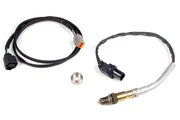
The factory narrowband sensors are for emissions only and are no use for tuning. We fit a WB1 wideband kit and put its LSU 4.9 sensor in the pre-cat position. They come out with a 22 mm socket or wrench.
Vehicle speed
The Hall effect speed sensor has 12V switched on pin 1, signal ground on pin 2 and signal on pin 3 to a DPI or SPI. A calibration of roughly 2600 pulses per km gets you close. Fine-tune it against GPS.
Actuators
Idle valve (stepper motor)
The idle valve is a stepper motor, so it needs four ECU outputs. On a dual-connector Elite (1000/1500/2000/2500), use the stepper outputs. On Nexus, use half-bridge outputs. An Elite 550/750/950 can drive it from DPOs, but that uses up outputs you'll probably want for something else, so we don't recommend it.
| Nexus output | Elite output | Idle valve pin |
|---|---|---|
| HBO 1 | Stepper 1A | 4 |
| HBO 2 | Stepper 1B | 6 |
| HBO 3 | Stepper 1C | 1 |
| HBO 4 | Stepper 1D | 3 |
Pins 2 and 5 are the valve's 12V switched supply. Leave them as factory on Elite and Nexus, and set the output Drive Type to Low Side in the software. Use a range of 120 steps and a speed of 100 steps per second. On older Haltech units such as the Platinum Sport 1000 or 2000, the stepper outputs always drive both high and low, so pins 2 and 5 must be cut and insulated. See our stepper output page for more.
MIVEC (EVO 9 only)
Only the EVO 9 has variable cam timing, and only on the intake cam. The intake cam sensor wires up the same way as the exhaust cam sensor above. The MIVEC solenoid needs one ECU output (any spare output other than an ignition output) and switched 12V on its other pin.
Injectors
| Model | Factory injector flow |
|---|---|
| VR4 | 450cc |
| EVO 1-4 | 510cc |
| EVO 5-9 | 555cc |
These figures are the flow at 100% duty, with the injector held fully open. You also need accurate dead times. Those cover the time the injector spends getting open and closed, when it isn't flowing its full rate. If you've upgraded injectors, use the dead time data for the new ones, not the factory numbers.
Finding the factory ECU
- EVO 1-6: behind the passenger kick panel.
- EVO 7-9: standing vertically behind the right side of the glovebox. A small access panel under the right side of the glovebox lets you reach the connector.
The EVO 8MR and EVO 9 ECUs use a different connector with three rows of pins, so the pinout is different from earlier cars. We have factory pinouts for every generation. If you need one, ask us and we'll send it over with advice for your build.
Plug-and-play options
If the chassis is still factory-wired, a plug-in adapter harness saves a lot of work. Haltech base maps are built for use with these harnesses and ship with the software. Popular options include the Elite 1000/1500 EVO 1-3 harness, the EVO 4-8 five-speed harness, the Elite 2000/2500 EVO 8MR and 9 harness and, for Nexus, the Nexus S3 EVO 4-8 adapter harness.
4G63 FAQ
Can I keep the factory MAF with a Haltech?
Yes, but most people don't. If you keep it, wire its output to a DPI or SPI because it's a frequency signal. Most builds switch to speed density with a proper MAP sensor.
Do the EVO 4-8 and EVO 9 use the same trigger settings?
Almost. The EVO 9's signal is inverted, so you pick a different trigger pattern, but the other trigger settings stay the same.
What's the most common 4G63 start-up problem you see?
Trigger and home wiring mix-ups, and cam trigger plates fitted backwards after a cam change. If you're stuck, book a free 30-minute consultation and we'll go through it with you.