The Barra turbo at a glance
Ford's Barra is the 4.0-liter inline six from the BA, BF and FG Falcons. This guide covers the factory turbo versions only; the naturally aspirated engines are a different story. Even stock, the turbo Barra is well equipped, with a Garrett GT3540 turbo that's big by OEM standards, and variable cam timing on both cams. People routinely push them far past factory power.
| Spec | Value |
|---|---|
| Layout | Inline 6 |
| Displacement | 243.1 ci (3984 cc) |
| Firing order | 1-5-3-6-2-4 |
| Crank trigger | 36-1 reluctor |
| Cam triggers | One reluctor per cam, 3+1 (4 tooth) pattern |
| Knock sensors | 2 |
Which Barra do you have?
| Variant | What sets it apart |
|---|---|
| BA 240T | 8.7:1 compression, 240cc injectors, red rocker cover. Both cams share one timing table |
| BF 245T | Revised cams, two knock sensors, separate inlet and exhaust cam tables. From June 2006 (BF Mk2) the rods are stronger |
| BA/BF FPV 270T | More boost, bigger intercooler, new intake, blue rocker cover |
| FG 270T | 8.8:1 pistons, new intake manifold, smaller turbo, new intercooler |
| FG FPV 310T | Bigger turbo and intercooler, 8.47:1 pistons, 430cc/min injectors |
| FG-X 325T | FG 270T base with the 310T's turbo and intercooler, carbon intake, 8.8:1 |
Weak points to plan around
- BA valve springs. Valve float can show up at as little as 10 psi (about 70 kPa) of boost, which usually limits a stock-spring BA to around 250 kW (roughly 335 hp) at the wheels. BF springs are better.
- BF Mk2 rods are good for about 450 kW (roughly 600 hp) at the wheels, which is why later BFs are popular build bases.
- Oil pump gears can crack. It doesn't track with power level; some last forever and some don't.
- The 4-speed BTR automatic doesn't like big power. The ZF 6HP is the much tougher option.
- Factory coils have a reputation for failing.
Haltech options for the Barra
There are two routes. The Elite PRO Plug-in for the Barra plugs into the factory loom, handles the CAN-connected dash, ABS, body control and the ZF automatic on every model, and has the igniters and wideband controller built in. See the Barra plug-in quick start guide for install notes.
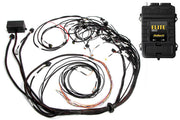
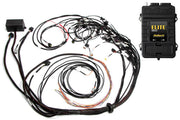
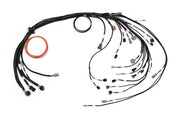
The other route is a universal ECU on a terminated harness: the Elite 2500 kit for BA/BF, the Elite 2500 kit for FG, or the Nexus R3 Barra terminated harness. The Elite 2500 covers most of the dash and ABS CAN functions, but it won't run the ZF automatic. If you're keeping the ZF, that choice matters.
Trigger and cam sensors
The crank sensor is a two-wire reluctor near the front of the crankshaft reading a 36-1 wheel. Each cam has its own two-wire reluctor toward the back of the head, reading a 3+1 pattern.
| Sensor | Sensor pin 1 (reluctor +) | Sensor pin 2 (reluctor -) |
|---|---|---|
| Crank | Trigger 4-core, yellow | Trigger 4-core, green |
| Inlet cam | Home 4-core, yellow | Home 4-core, green |
| Exhaust cam | A spare SPI | Signal ground |
One Ford wiring detail catches people. In the factory loom, both cam sensors' negative wires are joined and run to signal ground. The table above assumes you're wiring the sensors directly to the Haltech. If you keep the Ford wiring instead, both negatives stay on signal ground and you need to enable Home Ground in ESP.
Ignition: the coils need an igniter
The Barra's factory coils don't have igniters inside them, and the stock ECU does that job. The Elite PRO Plug-in has igniters built in too, so it drives the factory coils directly.
- Universal ECU with factory coils (Nexus R3, Nexus S3 or Elite 2500): add an external igniter. The HPI6 six-channel igniter is the one we use. For wiring, see the HPI documentation on our downloads page.
- OEM or Plug-in ECU with smart coils (coils with their own igniter): you need a signal converter so the ECU's internal igniter is bypassed.
The factory coil plug is two pins: pin 1 is the trigger signal and pin 2 is switched +12V. Dwell values come in the base maps that ship with ESP. If you're unsure which setup you have, internal igniter or not explains how to tell.
Variable cam timing: why the tables look odd
Both cams have continuously variable timing with up to 60 degrees of travel. The exhaust cam behaves the way you'd expect. The inlet cam doesn't. Its rest position is full advance, and adding solenoid duty retards it. The result is an inlet cam table that looks like a normal one shifted 60 degrees in the retard direction.
On top of that, Ford's zero point sits where Haltech would say 10 degrees retarded (-10). So if you compare a Haltech Barra map with one from another tuning platform, the cam numbers won't match even when the physical cam position is the same. That's expected, not an error.
Other sensors and systems
| System | Notes for the Haltech install |
|---|---|
| Throttle | Single drive-by-wire throttle body, which also handles idle control. BA/BF and FG wire differently |
| MAP and air temp | Combined T-MAP sensor (air temp is built in). BA/BF and FG differ |
| Engine temp | A cylinder head temperature sensor instead of a coolant sensor. Set it up like a coolant sensor. Non-polarized: one pin to a spare AVI, the other to signal ground. Use an AVI with a switchable pull-up, or add a 1k pull-up to 5V |
| Knock | Two sensors: pin 1 is the knock signal, pin 2 is signal ground |
| Vehicle speed | All four wheel speeds come from the ABS module over CAN |
| Alternator | ECU-controlled charging voltage via a duty signal |
| A/C | Uses an A/C pressure switch input to the ECU |
Oxygen sensors
From the factory the Barra only has narrowband sensors, one before the cat and one after. The front one is fine for idle and cruise emissions duties but not for tuning, and Haltech doesn't use the rear one at all. If you do use the factory front sensor, its signal (black) goes to AVI 1 or AVI 6, grey to signal ground, one white to switched +12V and the other white to chassis ground or a spare output, not signal ground.
For tuning you want a wideband. The Plug-in ECU includes a Bosch LSU 4.9 sensor and has the controller onboard. With an Elite 2500, fit a WB1 CAN wideband kit and put its sensor where the pre-cat sensor was. A 22 mm wrench or sensor socket gets the old one out.
Injectors
Injector flow and dead time data are in the ESP base maps. Flow is rated with the injector held fully open. On a returnless or fixed-pressure system where the regulator isn't referenced to manifold pressure, the pressure across the injector changes with boost, so injector flow has to be mapped against manifold pressure for the fueling to be right. Dead time covers the delay while the injector opens and closes, including the part-open moments where it isn't flowing at full rate.
Factory ECU and base maps
The stock ECU sits on the passenger-side strut tower. Haltech has base maps for the common models in the ESP package, which is where we start every Barra. Need the OEM ECU pinouts or the throttle and sensor wiring diagrams for your model? Ask us and we'll send them over with advice for your build.
Barra FAQ
Can a Haltech run the ZF automatic in my Barra?
The Elite PRO Plug-in supports the ZF on all models. The Elite 2500 terminated setup does not, so plan your ECU choice around the transmission.
Why does my inlet cam table look wrong compared to other Barra tunes?
The inlet cam retards with duty, and Ford's zero is Haltech's -10 degrees. Both shift the numbers without changing where the cam physically ends up.
Do I have to replace the factory coils?
No, but a universal ECU needs an external igniter to drive them, and they're a known failure item. If you do switch to smart coils (coils with built-in igniters) on the Plug-in ECU, remember it needs a signal converter to bypass its internal igniters. Book a free consultation if you want help choosing.