The engine at a glance
| Spec | Boss 5.4L |
|---|---|
| Layout | V8, Ford Modular family |
| Displacement | 5408 cc (about 330 ci) |
| Firing order | 1, 3, 7, 2, 6, 5, 4, 8 |
| Crank trigger | 36-1 wheel inside the timing cover, reluctor sensor |
| Cam trigger | Single tooth, reluctor sensor |
| Throttle | Single drive-by-wire throttle body, which also handles idle |
| Factory injectors | 440 cc/min |
Many of the car's systems talk over CAN, including the dash, ABS and body control. The Elite 2500 has CAN support for some of these models, which matters because vehicle speed comes from the ABS module over CAN rather than a wired sensor.
Which Boss do you have?
- Boss 260: DOHC with 4 valves per cylinder, 9.5:1 compression, 6000 rpm limit.
- Boss 290 (FG XR8): compression rises to 10.5:1. The bottom end gets a balanced crank plus revised pistons, rods, bearings and a thicker gudgeon (wrist) pin. Up top there are more cam lift, stainless valves, improved gaskets and head bolts. Fuel gets bigger rails and injectors, and a second knock sensor is added.
- Boss 302 (FPV BF): the 290 package with new cams and 10.8:1 compression.
- Boss 315 (FPV FG): new cams, 11.0:1, a twin plate throttle body and a 6500 rpm limit.
- Boss 302 (FPV FG): the 315 with the limit back at 6000 rpm.
The 3-valve Barra 220 and 230 V8s with intake cam timing are a different beast and aren't covered here.
Crank and cam sensors
Both are 2-pin reluctor sensors. The crank sensor sits on the left of the crank pulley and reads the 36-1 wheel. The cam sensor is on the front of the right-hand head (viewed from the front of the engine) and sees one tooth per cam turn, which is all the ECU needs for full sequential.
| Sensor pin | Function | Haltech 4-core wire |
|---|---|---|
| 1 | Reluctor + | Yellow (Trigger for crank, Home for cam) |
| 2 | Reluctor - | Green |
Set reluctor as the sensor type on both inputs, then confirm sync and timing before you tune anything. Our Elite trigger setup guide covers the settings.
Coils and igniters
These coils have no igniter built in. The factory ECU drives them through internal igniters, so a Haltech ECU without them needs an external module. Each coil has two pins: pin 1 is the signal and pin 2 is switched 12V. With an Elite 2500 we recommend an HPI8 igniter, one channel per coil. You can bring dwell values across from the Barra base map as a starting point.
Other sensors
| Item | How we wire it |
|---|---|
| T-MAP | Factory sensor combines MAP and air temperature, with a different connector layout on BA-BF and FG. You can use the Elite's internal MAP sensor instead; for higher boost, fit an external MAP sensor such as the 5 bar TI MAP sensor on a spare AVI |
| Coolant temp (cylinder head) | Pin 1 to any spare AVI, pin 2 to signal ground. Not polarity sensitive. Use an AVI with a selectable pull up, or add an external 1k pull up to 5V |
| Knock | One or two sensors depending on model; the Elite 2500 handles both. Pin 1 knock signal, pin 2 signal ground |
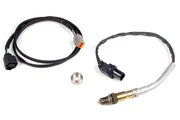
| O2 | Factory sensors are narrowband. Fit a WB2 dual channel wideband kit with its LSU 4.9 sensors in the pre-cat bungs (22 mm wrench) |
| Vehicle speed | Comes from the ABS module over CAN |
| Idle | Handled by the DBW throttle; there's no separate idle valve |
Drive-by-wire throttle
The throttle body and pedal wiring differs between BA-BF and FG cars, so identify your model before pinning anything. Our Elite drive-by-wire setup guide covers the software side.
Need the throttle, pedal, T-MAP or factory ECU pinout diagrams for your model? Ask us and we'll send them over with advice for your build.
Injector data
Flow is rated with the injector held fully open. If your fuel system uses a fixed regulator that isn't referenced to manifold pressure, which is common on returnless setups, map injector flow against manifold pressure so fueling stays accurate under boost and vacuum.
Dead time is the part of each commanded pulse where the injector isn't delivering full flow: the time to energize and start opening, the time to close, and the ramp in between. Accurate dead time is what keeps idle and light load fueling stable when battery voltage moves around.
Where is the factory ECU?
On the passenger side strut top in the engine bay. For other Ford platforms, see our Barra turbo and Coyote 5.0L guides.