Which NZ engine do you have?
This guide covers the conventional NZ engines. The hybrid, Atkinson cycle versions are a different animal and aren't covered here.
| Engine | Displacement | Notes |
|---|---|---|
| 1NZ-FE | 1.5L (1497cc) | 10.5:1 compression, VVT-i on the intake cam, 6400 rpm factory limit |
| 1NZ-FTE | 1.5L | Factory turbo version, still 10.5:1 |
| 2NZ-FE | 1.3L (1299cc) | Smaller-displacement version of the 1NZ-FE |
All are inline fours with a 1-3-4-2 firing order.
In the donor car, several modules talk to each other over CAN, including the dash, ABS and body control. Vehicle speed, for example, reaches the factory ECU over CAN from the cluster. If you're keeping the original car's dash and systems, plan for what they'll expect from the engine ECU before you start.
Crank and cam sensors
The crank trigger is a 36-2 pattern built into the timing chain sprocket on the crank. The cam trigger is a 3-tooth target at the flywheel end of the intake cam, read by a sensor at the back of the head. Both sensors are two-wire reluctors.
| Sensor pin | Crank sensor goes to | Cam sensor goes to |
|---|---|---|
| 1 (positive) | Yellow wire, Trigger 4-core cable | Yellow wire, Home 4-core cable |
| 2 (negative) | Green wire, Trigger 4-core cable | Green wire, Home 4-core cable |
The shared ground gotcha
Toyota's harness ties the cam sensor's negative to the crank sensor's negative. If you're keeping the factory engine loom, don't use the green Trigger- and Home- wires. Run the shared negative to the blue signal ground instead, then turn on the Trigger and Home ground options in the software. Wired this way, both sensors reference the same ground and you avoid a floating signal.
New to reluctors? Our reluctor sensor explainer covers how they work and why polarity matters.
Ignition: the famous NZ coils
Each cylinder gets a coil with its own built-in igniter, so they connect straight to the ECU's ignition outputs. These coils are popular enough that people fit them to other engines for coil-on-plug conversions, where they're simply called "NZ coils."
In the ignition setup, choose Direct Fire as the mode, Constant Charge for dwell, and a Falling edge.
Double-check the edge setting before the first crank. Once it's running, confirm timing with a timing light.
Throttle
Cable throttle (early engines)
The throttle position sensor has three wires: red/white on pin 1 to 5V+, brown on pin 2 to signal ground, and yellow/red on pin 3 to a spare analog input (AVI-10 works).
Drive-by-wire (later engines)
Later engines use one electronic throttle body with two position sensors, so you'll need an ECU with drive-by-wire control, such as the Elite 1500 or 2500 on the Elite range.
| Haltech connection | Throttle pin |
|---|---|
| DBW2 (motor) | 1 |
| DBW1 (motor) | 2 |
| Signal ground | 3 |
| AVI-3 (TPS2 signal) | 4 |
| 5V+ | 5 |
| AVI-2 (TPS1 signal) | 6 |
The accelerator pedal's two sensors also connect to the ECU. See drive-by-wire throttle wiring for how the pedal and throttle pair up and calibrate.
Idle control
DBW engines idle on the throttle blade. Cable engines use a three-pin bypass air valve, and even though it has three wires, you set it up as a 2-wire BAC driven by a single ECU output:
- Pin 1 (open signal): a spare ECU output
- Pin 2 (power): 12V switched
- Pin 3 (close signal): grounded to the engine
Variable cam timing (VVT-i)
The intake cam uses Toyota's continuously variable VVT-i, with up to 60 degrees of movement. The ECU reads cam position from the 3-tooth target and drives the oil control solenoid to hit a target angle. Setup lives in cam control wiring and the cam control tables.
Sensors
| Sensor | How to connect it |
|---|---|
| MAP | None fitted from the factory. Use the ECU's internal MAP sensor, or an external sensor on a spare AVI for higher boost |
| Coolant temp | Pin 1 to a spare AVI with a selectable pull-up, pin 2 to signal ground. Not polarity sensitive. No pull-up available? Add an external 1k resistor to 5V |
| Air temp | Built into the MAF housing (below) |
| Knock | White (pin 1) to signal ground, black (pin 2) to the knock input |
| Vehicle speed | Pink signal to a spare DPI or SPI, white/black to signal ground, black is 12V switched |
MAF sensor
Factory fueling is MAF based, and the MAF housing contains the air temp sensor. Most Haltech installs switch to speed density and remove the MAF, but you can keep it:
- Pin 1: 12V switched
- Pin 2: MAF ground to signal ground
- Pin 3: MAF signal to any spare AVI
- Pin 4: air temp signal to a spare AVI with pull-up (AVI 7)
- Pin 5: air temp ground to signal ground
O2 sensors: go wideband
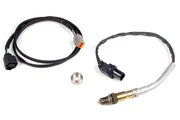
The factory narrowband sensors only tell you whether the engine is rich or lean of lambda 1.0. That's fine for emissions cruising, useless for tuning under load. We fit a Haltech WB1 CAN wideband kit and put its LSU 4.9 sensor where the pre-cat sensor was. A 22mm wrench or O2 socket gets the old one out. Read more in narrowband vs wideband O2 sensors.
Injector data
Two numbers make or break the fuel model:
- Flow is measured with the injector held fully open. On a returnless system with a fixed regulator that doesn't reference manifold pressure, the pressure across the injector changes as boost or vacuum changes, so you need flow mapped against manifold pressure.
- Dead time is the part of each commanded pulse where fuel isn't flowing at full rate: the time it takes the solenoid to energize and lift, the time to close, and the partly open moments in between. It changes with battery voltage and needs to be right for idle and light load to behave.
Troubleshooting
| Symptom | Usually |
|---|---|
| Trigger errors or no sync on the factory loom | Green Trigger-/Home- wires used on the shared ground, or trigger/home grounds not enabled |
| Erratic timing reading | Reluctor polarity reversed; swap that sensor's two wires |
| Coolant temp stuck or wrong | Input has no pull-up |
| Idle won't settle on a cable engine | BAC set up as 3-wire instead of 2-wire |
FAQ
Can I tune a 1NZ with the factory O2 sensors?
No. They're narrowband and only useful around lambda 1.0. Fit a wideband.
Do I need an external MAP sensor?
Not for a naturally aspirated engine; the internal one is fine. For higher boost levels, use an external sensor on a spare AVI, rated above your boost target.
Want the OEM ECU pinout or wiring diagrams?
Ask us and we'll send them over with advice for your build. You can also compare notes with our 2JZ/1JZ and 4AG guides.