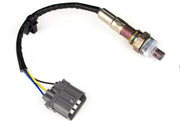
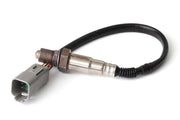
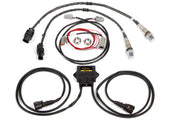
Why a wideband, and why CAN
A narrowband O2 sensor is only really accurate right around stoichiometric. A wideband reads across a much wider span of air/fuel ratio, from rich full-boost mixtures to lean cruise, which is why it's the reference we tune to. On an Elite you can use it two ways: as a monitored channel for logging and gauges, or as the feedback signal for closed loop O2 control.
You can't wire a wideband sensor straight to an Elite ECU. It needs an external controller that runs the sensor heater and pump cell. The one exception is the Elite Pro Plug-in for the Ford Falcon, which has a wideband controller built in.
For everything else we recommend a Haltech CAN controller such as the WB1 single channel or WB2 dual channel kit. The big advantage is that the controller tells the ECU what state the sensor is in: warming up, faulted, disconnected and so on. An analog wideband just sends a voltage, and the ECU has no way to know if that voltage is a real reading or a dead sensor. Knowing the difference is what makes closed loop fueling and lean protection safe to rely on.
Setting it up in ESP
Open the Wideband O2 Sensor function and work through the tabs.
Wiring tab
| Setting | What it does | Our advice |
|---|---|---|
| Position | Tells the ECU where the sensor sits in the exhaust: Overall, a bank (once two or more banks are set up), a cylinder, or Unassigned | One sensor after the merge is Overall. On a V engine with a sensor per side, assign each to its bank so O2 control trims the right injectors |
| Input type: On Board/CAN Wideband Controller | Reads lambda and sensor status digitally from a Haltech CAN kit or the onboard controller | Use this whenever you can |
| Input type: Analogue Voltage | Reads a voltage from another brand's wideband controller | Fine for monitoring, but you lose sensor status reporting |
| Connections | Chooses which CAN sensor channel becomes Wideband 1, 2 and so on, or which input wire an analog signal lands on | For analog, use a shielded AVI such as AVI1 or AVI6 |
If you go analog on a shielded input, take care when terminating it. The braided shield must not touch the center signal conductor, or the reading will be garbage.
Calibration tab
This tab only appears with Analogue Voltage selected, because a CAN controller already sends lambda directly. ESP ships with a set of calibrations you can load with the open-folder button, and you can save your own with the disk button. If your controller isn't listed, build a custom calibration from the voltage-to-lambda data the manufacturer publishes, and double check it against a known reading before you trust it.
Diagnostics and lean protection
The Diagnostics tab is where the wideband becomes an engine protection device and not just a gauge. Each check can raise a trouble code, and if Engine Protection is enabled you can attach a severity of Level 1, 2 or 3 to it (or None if you only want the code logged).
| Check | Code | Triggers when |
|---|---|---|
| Raw Min (analog only) | P0131 | The input voltage falls under your limit, which usually means a short or broken wire |
| Raw Max (analog only) | P0132 | The input voltage goes over your limit |
| Operating Max | P1276 | The engine runs leaner than your limit, under load, for longer than you allow |
| Sensor Failure | The controller reports a sensor error or failure |
Building a lean protection rule
Operating Max is disabled out of the box. When you turn it on, every one of its conditions has to be true together before the code sets:
- Maximum: the air/fuel ratio has to be leaner than this.
- Delay Time: it has to stay that lean for at least this long.
- Minimum RPM: engine speed has to be above this.
- Precondition: whether load is judged by MAP, TPS or both, with Minimum MAP and Minimum TPS setting the thresholds.
Here's how we think about it. You don't care if the engine goes lean on a closed throttle overrun, because it isn't making power. You care a lot if it goes lean at full boost. So set the load precondition so the check only watches real load, set the lean limit a sensible margin richer than anything that would hurt the engine, and give it a short delay so one noisy sample can't trigger it. Then verify on the dyno or in logs that it never trips during normal, healthy pulls. Start conservative and tighten it once you trust the data.
Too short and a single lean blip on a gear change cuts power mid-run. Too long and the engine spends real time lean before anything happens. Log a few pulls and look at how long normal transients actually last before you pick a number.
Reading wideband status codes
When a Haltech CAN controller (or the onboard Falcon controller) isn't giving a valid reading, the wideband channel in ESP shows a status message instead of lambda. In a datalog, that status is recorded as a small negative number, which is easy to miss if you're only glancing at a graph. Any negative value in a lambda channel is a status, not a mixture.
| Status shown | Log value | What's going on |
|---|---|---|
| Error | -0.01 | A WBC1/WBC2 fault, or an external LSU 4.9 controller that wasn't found at power-up |
| Battery Voltage Low | -0.02 | Supply voltage is under what an external LSU 4.9 controller needs |
| Battery Voltage High | -0.03 | Supply voltage is over what an external LSU 4.9 controller can handle |
| Sensor Short Circuit | -0.04 | A short inside the sensor or its wiring |
| Sensor Open Circuit | -0.05 | A break in the circuit, for example the sensor unplugged from its controller |
| Sensor Cold | -0.06 | Still warming up, normal just after startup |
| Free Air | -0.07 | The sensor is seeing atmosphere |
| Heater Short Circuit | -0.08 | A short in the heater circuit |
| Condensation Phase | -0.09 | Running the heater gently on a cold start (see below) |
| Controller Inactive | -0.10 | Onboard controller: engine off for 30 seconds, so the heater shuts down until it starts. External LSU 4.9 controller: the heater has a fault and can't operate |
| Time Out | -0.11 | External LSU 4.9 controllers only: CAN communication has dropped |
What Condensation Phase protects against
When a cold engine first fires, water vapor in the exhaust condenses on the cold pipe and gets blown down the system as droplets. If a fully hot sensor element gets hit by one of those droplets, the sudden temperature change can crack it. That's thermal shock, and it's a common way to kill a wideband. The controller avoids it by holding the heater at reduced power for a while after a cold start, which is why you won't see a reading instantly on a cold morning.
If CAN communication to an external controller drops, short term fuel trims are held at 0% until it comes back. The engine won't chase a missing signal, but it also isn't being corrected, so treat any Time Out in a log as something to fix before the next run.
Troubleshooting
| Symptom | Usually |
|---|---|
| Lambda channel stuck at a negative number | It's a status code. Match it to the table above |
| Reads fine at idle, goes to Time Out while driving | A loose CAN connection or chafed CAN wiring |
| Free Air with the engine running | An exhaust leak near the sensor, or the sensor isn't actually in the pipe |
| Analog reading jumps around | Unshielded input, shield touching the signal wire, or a ground offset between the controller and ECU |
| Analog reading steady but wrong | Wrong calibration loaded for that controller |
| Sensors keep dying | Mounted too close to the turbo or too flat, where condensation collects, or run with the heater on before the engine starts |
Wideband FAQ
Do I need a CAN wideband, or will my existing analog gauge work?
An analog controller will work for monitoring and even O2 control. We still prefer CAN because the ECU can tell a bad sensor from a bad mixture, which matters as soon as you let the wideband trim fuel or protect the engine.
Which sensor should I buy?
Match it to your controller. Haltech CAN kits come in Bosch LSU 4.9 and NTK versions, and replacement sensors such as the NTK wideband sensor are available separately. Older setups may use the Bosch LSU 4.2.
Why does my wideband take a while to read on a cold start?
That's the sensor warming up and the condensation protection doing its job. If it never leaves Sensor Cold, check heater power and wiring.
For more background, see our wideband O2 sensors explained article, or the WB1 and WB2 controller guide.