How fuel moves through a return-style system
On a typical port-injected engine, an electric pump in or near the tank pushes fuel forward to the fuel rail, where the injectors sit. At the end of the rail, the regulator decides how much fuel goes back to the tank through the return line. Letting more fuel return drops rail pressure; letting less return raises it. That's the regulator's whole job: keep pressure where you want it by controlling the return flow.
The detail that matters is which pressure it controls. What sets injector flow isn't the pressure in the fuel line on its own. It's the difference between the fuel pushing in behind the injector and the manifold pressure sitting at its nozzle.
Why flow rate depends on pressure
Injector flow ratings are always quoted at a specific pressure. Most engines use a base pressure around 3 bar, roughly 43.5 psi, often rounded to 45 psi. Change that pressure and the flow changes too. The injector usually sold as a "Bosch 1000", for example, flows about 1035 cc/min at 45 psi and about 1085 cc/min at 50 psi.
That matters because a Haltech ECU, like most modern ECUs, works out how much air the engine is taking in and then adds fuel to hit the target air/fuel ratio. To turn "this much fuel" into an injector pulse, it needs the true flow rate. Give it the wrong one and every calculation, and every correction built on top of it, is off. The tune then fights you.
What boost and vacuum do to the numbers
Picture a regulator holding a fixed 45 psi in the line with no manifold reference. Now add 10 psi of boost. That boost pushes back against the injector nozzle, so the net push across the injector is only 35 psi. The injector now flows less than the ECU thinks, and the engine runs lean exactly where you least want it to.
At idle the opposite happens. Manifold vacuum effectively pulls on the nozzle, so the net pressure is higher than 45 psi and the injector flows more than expected.
How a manifold-referenced regulator fixes it
A referenced regulator has a hose to the intake manifold. It adds manifold pressure to the rail pressure one for one, so the difference across the injector stays constant:
| Condition | Manifold | Fuel line | Across the injector |
|---|---|---|---|
| Base setting, hose off | 0 psi | 45 psi | 45 psi |
| 10 psi boost, referenced | +10 psi | 55 psi | 45 psi |
| 10 psi boost, not referenced | +10 psi | 45 psi | 35 psi |
| Idle vacuum, referenced | Below 0 psi | Lower than 45 psi | 45 psi |
The line pressure moves, but the injector always sees the same 45 psi push, so it always flows what the ECU expects.
Set base fuel pressure with the pump running and the regulator's vacuum hose pulled off (and plugged on the manifold side). With the hose connected at idle, vacuum lowers the reading and you'll set it too high.
Let the ECU see it too
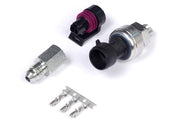
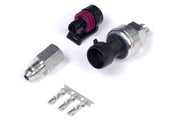
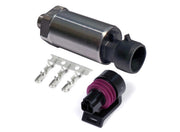
A regulator does the heavy lifting, but it isn't perfect, and pumps can fall behind at high load. A fuel pressure sensor such as the 150 psi TI sensor, the 250 psi version or the stainless 150 psi motorsport sensor lets the ECU measure the real differential pressure. You can then map injector flow against differential pressure, so if pressure sags or runs high, the ECU still knows what the injectors are flowing. Our fuel pressure sensor and protection article shows how to set up the warnings too.
Pair all of this with accurate injector dead times and the fuel side of the tune becomes far easier to get right.
Common questions
Does a returnless fuel system work the same way?
Not quite. Many returnless systems hold a fixed line pressure without a manifold reference, which means differential pressure changes with boost and vacuum. That's exactly the case where a fuel pressure sensor and pressure-based flow correction in the ECU earn their keep.
My car leans out at the top of a boost run. Is it the regulator?
It can be: a split reference hose, a sticking regulator, or a pump that can't keep up. Log fuel pressure against manifold pressure. If the gap between them shrinks as boost climbs, the fuel system isn't keeping up.