Do you need bigger injectors?
An injector is a solenoid valve: the ECU energizes it, it opens, and fuel flows for as long as it stays open. Make more power and the engine burns more air, so it needs more fuel to hold a safe air-fuel ratio. On a programmable ECU you add fuel through the fuel map, which lengthens every pulse and raises injector duty cycle, the share of each engine cycle the injector spends open.
Our rule is the same one Haltech uses: at peak power, stay at or below about 80% duty. Past that the injector has little time left to close and reopen, fueling gets less predictable, and you have no margin for hot fuel or a tired pump. If your logs show duty climbing past 80% near redline, it's time to go bigger.
Fuel type matters just as much. E85 carries less energy per gallon, so an engine on E85 needs roughly 40% more injector capacity than the same engine on gasoline. If you're planning a flex fuel or ethanol build, size for E85 from the start.
A quick sizing example
The classic back-of-envelope formula divides the fuel the engine needs by the number of injectors and your duty limit. Fuel demand is horsepower times brake specific fuel consumption (BSFC), in pounds per hour. As a rough guide, naturally aspirated gasoline engines sit near 0.5 and boosted ones nearer 0.6.
Say you have a turbo four-cylinder aiming for 450 hp on gasoline: 450 x 0.6 = 270 lb/hr of fuel. Spread over 4 injectors at 80% duty, that's about 84 lb/hr each, or close to 890 cc/min (1 lb/hr is roughly 10.5 cc/min). A 980cc injector covers it with some room to spare. Switch that same build to E85 and you need about 40% more, which puts you past the 980cc and into 1462cc territory. Treat this as a starting point. Fuel pressure, pump capacity and the real BSFC of your engine all move the answer.
The kits
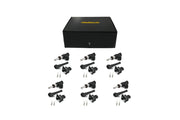
Each kit includes flow matched injectors plus a Bosch EV1 connector and pin set for every injector.
What flow matching means
No two injectors off a production line flow exactly the same. Flow matching measures each one and sorts them into groups with nearly identical flow, so every cylinder in your engine gets the same fuel for the same pulse. Haltech marks each injector with a colored dot showing its group: blue, red or yellow.
Why it matters in practice:
- Every cylinder runs close to the same air-fuel ratio, so one lean cylinder doesn't set the limit for the whole engine.
- Tuning is more precise, because the data loaded in the software matches the injectors you actually have.
- Power delivery is more even across the rev range.
Each dot color has its own dead time and flow data. That's why it's important to select the right color in the software, and to replace a single failed injector with one of the same color.
Loading the injector data in NSP
NSP, which is used for both Elite and Nexus ECUs, has the data for these injectors built in from version 1.42 onward. To apply it:
- In the navigation tree on the left, expand Fuel Tuning and click Stage 1.
- Click Select Stage 1 Injectors in the main window.
- Pick the Bosch injector that matches your size and dot color, then click OK.
NSP then writes the Injector Dead Time and Injector Flow Rate tables for you. They can be shown and edited if you want to look at them. Dead time is the part of each pulse where the injector is opening or closing and not flowing fully, and it matters most at idle and light cruise. Our injector dead time article explains why.
Need the raw dead time and flow tables for each color? Ask us and we'll send them with advice for your build.
Injector adapters
Your fuel rail and manifold bores may not match the Bosch body. Haltech's adapters change the top or bottom so the injector seats properly and seals:
- 10.5mm: 1/2 to full length, Nissan RB26DETT GT-R
- 11mm: 1/2 to full length, 3/4 to full length
- 14mm: 3/4 to full length, 1/2 to 3/4 length, 1/2 to full length, base
- Nissan: Nissan base
Measure the rail bore and the height available before ordering. A seal that's squeezed at an angle or barely engaged is a fuel leak waiting to happen.
Wiring the injectors
Every injector needs two wires: 12V switched power and its own injector output from the ECU. Pick a convention and stick to it on every injector, for example pin 1 always power and pin 2 always the ECU output. It makes fault finding much quicker later. The kits use the Bosch EV1 (Jetronic) push-on connector with a rubber boot.
You'll need a wire stripper and a proper crimper, such as the Haltech dual crimper set. Our process:
- Cut the power and output wires to length and feed both through the rubber boot first. It's easy to forget and hard to fit afterward.
- Strip the ends and crimp each terminal in two stages: the conductor crimp onto bare wire, then the insulation crimp onto the jacket for support.
- Push the terminals into the connector until they lock, then give each a light tug.
- Slide the boot over the connector for strain relief and weather protection.
Troubleshooting
| Symptom | Usually |
|---|---|
| One cylinder won't fire | Terminal not locked in the connector, power and output swapped on one injector, or wrong output assigned |
| Rough idle after swapping injectors | Wrong injector or dot color selected in Stage 1, so dead time is off |
| Fuel smell or wet seal | Wrong adapter length or damaged O-ring |
| Lean at high RPM with duty over 80% | Injectors too small for the power level or fuel type |
FAQ
Can I mix dot colors in one engine?
Keep one color per engine. The point of the matched set is that every injector behaves the same, and the software data is loaded per color.
Do bigger injectors hurt idle?
Larger injectors run very short pulses at idle, which is exactly where dead time accuracy counts. With the correct data loaded from NSP, both sizes can idle well. Just don't oversize wildly for the power you're really making.
What else should I upgrade with the injectors?
Your pump and regulator need to keep up. Read why you need a fuel pressure regulator and consider monitoring fuel pressure, especially on boosted or nitrous builds.