The car
If you've never come across one, the Stagea is Nissan's wagon cousin of the Skyline, sharing a lot of its running gear. This one is a C34 owned by Ben, better known to MCM viewers as "Mechanical Stig." It earned the Double Unicorn name from the custom badge in its grille.
From the outside you'd hardly notice anything. There are a few cosmetic changes, but nothing that hints at what's under the hood. That's the charm of a sleeper wagon, and it's also why the engine bay comes as such a surprise.
The engine: no RB in sight
Where you'd expect an RB straight six, there's a Nissan VH41: a 4.1-liter, quad-cam V8, fitted with a turbocharger. The VH41 is a wide engine for a bay designed around an inline six, so a lot of the build is about packaging.
- Throttle body: the stock throttle was replaced with a GM electronic (drive-by-wire) throttle body, and it moved to the opposite end of the plenum to free up room for the turbo plumbing.
- Turbo: a Garrett unit squeezed into the space, with a GFB EX50 external wastegate fed straight off the exhaust housing.
- Driveline: the engine keeps its original front diff and bolts to an R33 GTR gearbox through a custom flywheel and a twin-plate clutch.
Moving a throttle body to the other side of the plenum is the kind of detail that looks simple in a photo and takes days in real life. It's also a good reminder that a DBW throttle doesn't care where it lives, as long as the ECU can drive it. That makes Elite DBW control a handy tool on swaps with tight packaging.
The numbers
On a modest 14 psi of boost, the setup puts out 480 hp at the wheels, through all four of them. For a wagon weighing in close to 4,400 lb (2 tonnes), that's enough for 12-second quarter-mile passes, and it's still a daily driver. That's the part we like best: big, usable power from a relatively low boost level, in a car that still does the grocery run.
The Haltech side
Rather than build a new engine loom, Ben kept the factory harness and re-pinned it to plug directly into a Haltech Elite 2500. That's a smart choice on a car like this. The factory loom is already routed, clipped and protected, and re-pinning it keeps the install tidy and serviceable.
A few details are worth calling out:
- ATTESA stays: the Elite works alongside Nissan's ATTESA all-wheel-drive computer, so the factory AWD control is kept rather than replaced. Swaps that lose the factory systems usually lose something the owner misses later.
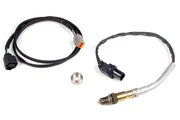
- Flex fuel: a Haltech flex fuel sensor lets the car run different fuel blends, with the ECU adjusting to what's actually in the tank. See our flex fuel explainer for how that works.
- IQ3 dash: the most obvious change inside is a Haltech IQ3 dash on the instrument cluster. For everyday driving it's set up to show oil pressure, water temperature, gear position, AFR and ethanol content.
That dash layout is a good lesson on its own. It isn't crammed with every channel. It shows the handful of numbers that tell you whether the engine is healthy and what fuel you're on. Our article on setting up an IQ3 Street dash covers the basics.
What we take from builds like this
We see a lot of engine swaps come through the shop, and the ones that end up as reliable daily drivers share a few habits with this Stagea:
- Modest boost, done well. 14 psi with a good tune and good fuel makes strong, repeatable power without living on the edge.
- Keep the factory systems that matter. AWD control, gauges and safety systems are easier to keep working than to replace.
- Clean wiring. Re-using and re-pinning a known-good factory loom beats a rushed new one.
- Useful data in front of the driver. Oil pressure, coolant temperature and mixture are the numbers that save engines.
If you're planning a swap and want to know which Haltech ECU suits it, have a read of which ECU is right for you.
More Mighty Car Mods builds
The same crew has put Haltech in some very different cars. Check out Miss Daisy, the Subaru-powered VW Beetle, and their Mini, revisited in VTEC Magic. Want to talk about your own swap? Book a free 30-minute consultation.