The car and the goal
Restomod builds have become one of the most common reasons people come to us for EFI. This '69 Mustang, built by an owner from the restomod trade and wired by a specialist wiring shop, is a textbook example of doing it right. The original 302ci two-barrel carbureted V8 came out, and a 5.0 liter Coyote from a late-model Mustang GT went in. Same displacement on paper (the Coyote is also a 302 in cubic inches), but a completely different engine.
The owner wasn't building a race car. The brief was a Mustang that could be driven every day: reliable, easy to live with, and with smooth, predictable power across the rev range.
Why the Coyote needs a proper ECU
The Coyote has dual overhead cams and four valves per cylinder, and each of the four camshafts has its own variable timing control. The ECU can advance or retard intake and exhaust cam timing independently, and that's a big part of why the engine is both strong and efficient. It also means a simple fuel-only controller won't do. You need an ECU with enough outputs and the strategy to run all four cams properly. Our Coyote engine guide covers the specifics.
The Haltech package
| Part | Its job in this build |
|---|---|
| Elite 2500 ECU | Runs fuel, ignition, all four cams and the comfort features |
| Coyote terminated harness | Pre-built engine loom with every plug labeled |
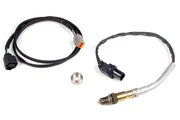
| WB2 dual channel CAN wideband | Air-fuel ratio on each bank |
| HPI8 high power igniter | Drives the eight ignition channels |
If you're planning something similar, the Elite 2500 and Coyote harness come together as a kit. Coyotes use different cam solenoid connectors depending on year, so pick the right one: the early cam solenoid kit or the late cam solenoid kit.
Why a terminated harness makes sense
The installer's main takeaway was how much the terminated harness simplified the job. Every connector is already on the loom and labeled, so you can drape it over the engine and see immediately where each branch goes. On a swap like this, that saves a lot of time compared with building a loom from scratch, and it cuts down on wiring mistakes. Our 6 ways to wire in your ECU article compares the options.
Modern comforts, classic car
Because the Elite 2500 has the inputs and outputs to spare, the owner kept all the modern conveniences: air conditioning, power steering and a proper cold start. It drives like a new car while looking like a '69.
On the dyno it made 265 kW, or about 355 hp, at the rear wheels. That's plenty for daily use and weekend cruising, and it arrives smoothly rather than all at once, which was the point.
Thinking about your own swap?
A Coyote, LS or modern Hemi can transform a classic, but the ECU and wiring decisions make or break the result. Book a free consultation and we'll help you choose parts, or read which ECU is right for you first.