The idea: a Beetle nobody suspects
A sleeper only works if it looks harmless, and few cars look more harmless than an early Beetle. Marty and Moog from Mighty Car Mods started with a 1974 car nicknamed Miss Daisy and set themselves a big target: roughly ten times the original engine's power. They got there and went past it.
Inside, the cabin stays almost bare. There's no pile of gauges, just a single multi-purpose gauge in the small dash, which keeps the stock look intact.
Swapping flat four for flat four
On paper the swap looks natural. Both the original and the replacement are horizontally opposed four cylinders. That's where the resemblance stops:
| Original VW engine | Subaru EJ25 replacement | |
|---|---|---|
| Displacement | 1600 cc | 2500 cc |
| Cooling | Air-cooled | Water-cooled |
| Induction | Naturally aspirated | Turbocharged |
| Valvetrain | Old-school pushrod design | Quad cam, 16 valves |
The fit-up was done by Mike Kristen of Custom Bugs and Buses, a VW specialist. Nice details include a custom catch can wearing VW hubcap emblems on its sides. The turbo itself is tucked in so well among the plumbing that you have to look for it. With the engine in the back, the exhaust run from the turbo is very short, which is efficient and sounds great.
If you're considering an EJ for your own project, our EJ25 engine article covers the details that matter for tuning.
Solving the cooling problem
A water-cooled engine in a car designed for an air-cooled one needs somewhere to reject heat. The build handles it in two places.
Engine radiator
The main radiator sits right behind the firewall, with the overflow tank beside it. A cone-shaped gap between the radiator and firewall lets air moving under the car flow through it.
Water-to-air intercooling
A front-mounted air-to-air intercooler would give the game away, so the build uses water-to-air. The heat exchanger for the intercooler circuit is laid flat behind the front bumper, fed by a set of holes drilled into the bumper panel. Coolant is pumped back to the intercooler core at the rear, keeping intake air temperature down without anything visible from outside. If you're weighing the options, our how intercoolers work article explains the trade-offs.
The electronics
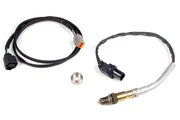
A Haltech Elite ECU lives under the rear seat next to a WB1 CAN wideband controller. The Elite handles more than fuel and spark:
- Variable cam control
- Boost control, with targets by speed and gear
- The water-to-air intercooler system
- Drive-by-wire throttle
Because the Beetle's dash has no temperature or pressure gauges, the ECU's engine protection strategy was set up to watch for overheating, overboost and lean conditions. We think that's one of the smartest parts of the build.
What we'd take from Miss Daisy for your swap
Minimal dashes look great, but they hide problems. When a build doesn't have room for gauges, we set up engine protection on coolant temperature, oil pressure, boost and lambda so the ECU can pull power before damage happens.
- Plan cooling early. Radiator placement, airflow paths and intercooler type decide the whole layout. Sort them before you make brackets.
- Use a wideband from day one. A WB1 kit on CAN gives you lambda for tuning, logging and protection.
- Let one ECU run the extras. Cam control, boost, DBW and intercooler pumps are all easier to tune and log from one place.
- Short turbo plumbing helps. Packaging the turbo close to the engine improves response.
Mighty Car Mods have done a few Haltech-powered builds. Read about their nine-second Barra Cresta and the VTEC-swapped Mini. Planning a sleeper of your own? Book a free 30-minute consultation and we'll help choose the ECU and harness.