Why TPS matters so much
The throttle position sensor tells the ECU how far the throttle blade is open. On some engines, especially individual throttle bodies, it's the main load input for fuel and spark. Even on a MAP-based tune it drives idle control, decel fuel cut, transient throttle enrichment and plenty of other functions. A TPS that reads 3% at a closed throttle, or never quite reaches 100%, will quietly upset all of them.
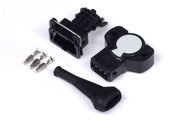
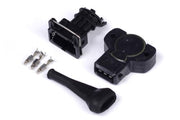
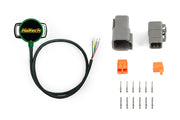
A typical TPS is a three-wire powered sensor: a 5V supply from the ECU, a signal wire back to the ECU, and a signal ground. Haltech sensors like the grey clockwise and black counter-clockwise 8 mm D-shaft sensors follow this layout. Pick the rotation that matches the way your throttle shaft turns. The contactless dual-channel version carries two signals, so check its own wiring before you assign inputs.
Wiring the input
The TPS is an analog sensor, so on the Wiring node you can assign it to any free analog voltage input (AVI). Leave the input's pull-up disabled. The sensor has its own 5V supply and drives the signal itself; a pull-up would only bias the reading. If you're not sure which wire on an unknown sensor is which, our guide to finding the correct TPS wiring walks through it with a multimeter.
Calibrating the sensor
Calibration teaches the ECU which voltage means fully closed and which means wide open. Do it whenever you fit a new sensor, remove and refit the existing one, or its position changes at all, even slightly after loosening the screws.
Using the wizard
- Press Start in the TPS calibration wizard.
- With your foot off the pedal and the throttle fully shut, let the wizard capture the closed voltage.
- Open the throttle all the way, by hand at the throttle body if needed, and let it capture the wide open voltage.
Read each on-screen prompt before you move on. Then check the result: with the engine off, TPS should read 0% at rest and 100% at full throttle, and move smoothly in between.
Entering it manually
Below the wizard there's a graph where you can type in the 0% and 100% voltages directly. We use this when we already know the numbers, or to make a small correction without redoing the whole process.
Get someone to press the pedal to the floor while you watch. Worn cables or a floor mat can stop the throttle from reaching full travel, and the calibration will only be as good as the travel you gave it.
Filter settings
| Setting | What it does | Our advice |
|---|---|---|
| Filter | Smooths the TPS value. It's a time constant: how long the reading takes to move 63% of the way to a new value. Default 2 ms | Leave it at default unless the signal is genuinely noisy. More filtering hides noise but delays the ECU's response |
| Derivative Filter | Smooths TPS-Derivative, the rate-of-change channel used by functions like transient throttle | Too much dulls throttle response; too little makes the channel jumpy and can set off transient throttle when you haven't moved the pedal |
If you do find yourself raising the filter, ask why the signal is noisy first. A worn sensor track, a poor ground or a signal wire run alongside coil wires will all show up as a jittery TPS, and filtering only masks the fault.
Diagnostics
The Diagnostics node lets you enable DTCs for the TPS voltage going too high or too low, which is how the ECU spots an open or shorted sensor. You set a severity for each, and that severity feeds an engine protection level. We always turn these on. A failed TPS on a car that uses it for load can cause serious fueling errors, and it's far better for the ECU to protect the engine than to keep going on a bad reading.
Troubleshooting
| Symptom | Usually |
|---|---|
| TPS above 0% at closed throttle | Sensor moved or replaced without recalibrating |
| Never reaches 100% | Throttle not fully opened during calibration, or pedal travel restricted |
| Reading jumps around at steady throttle | Worn sensor, poor ground or noise on the signal wire |
| Random fuel enrichment at steady throttle | Derivative filter too light, so noise looks like pedal movement |
| Reading goes backwards | Wrong rotation sensor for the shaft |
FAQ
Do I need to recalibrate after adjusting the idle stop screw?
Yes. Moving the stop changes the closed-throttle position, so the old 0% voltage no longer matches.
Is TPS the same as pedal position on drive-by-wire?
No. On a DBW setup, pedal position is what the driver asks for and TPS is where the throttle blade actually is. Both need calibrating.
Setting up the rest of your sensors? See manifold pressure and wideband O2.