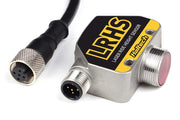
Why log ride height?
A ride height sensor measures the distance from the body to the ground at the front or rear of the car. Logged against speed, braking and throttle, that one number exposes a lot: aero load squashing the suspension, a wing or splitter flexing, bodywork moving, springs sagging, the chassis twisting, and the car pitching or squatting when load arrives suddenly. It's also the input behind functions like wheelie control with a laser ride height sensor.
Haltech's own laser ride height sensor is the easy option, but ESP can work with other sensors too, as long as you have their calibration data.
Setup, tab by tab
The front and rear sensors are separate functions with identical settings, so repeat these steps for each one you fit.
Wiring tab: choose the input
| Input type | When to use it | Pull-up option |
|---|---|---|
| AVI (Analog Voltage Input) | The preferred choice | 1k resistor to 5 V |
| SPI (Synchronized Pulsed Input) | Only when you've run out of AVIs | Weak 10k resistor to 5 V. Set Sensor Type to Hall Effect for analog signals |
On the pull-up: leave it disabled for any sensor that has its own power supply, such as an active laser unit. It's mainly for two-wire sensors that need the ECU to supply the bias. If the sensor is shared with another ECU, for example in a piggyback install, the other ECU normally already provides the pull-up, so keep it off here too.
Calibration tab: tell ESP what the voltage means
This is where you load or save the voltage-to-height calibration. ESP ships with several ready-made calibrations. Use the open (folder) icon at the top left to load one, or the disk icon beside it to save your own. If your sensor isn't included, build a custom calibration from the manufacturer's data sheet and save it so you can reuse it on the next car.
Display tab: warning limits
Set Warning Minimum and Warning Maximum. When the reading goes outside that band, ride height items in ESP flash red. We set these just outside the range the car should ever reach, so a flash means something is wrong rather than just a big bump.
Diagnostics tab: catch wiring faults
These limits look at the raw sensor voltage and flag readings that can only come from a fault:
- Raw Min: when enabled, sets code
C1800if voltage drops below your value, which points to a short or an open circuit. - Raw Max: when enabled, sets code
C1801if voltage rises above your value.
Both are disabled by default. If you run the Engine Protection function, you can also give each code a DTC severity level.
Log the sensor through its full travel with the car on stands, note the lowest and highest voltages, and put the raw limits a little outside them. That way a damaged wire trips a code, but real suspension movement never does.
Troubleshooting
| Symptom | Usually |
|---|---|
| Reading pinned at one value | Sensor unpowered, wrong input selected, or pull-up enabled on a powered sensor |
| Height moves the right way but the numbers are off | Wrong calibration loaded, or zero point not matched to your mounting |
| C1800 or C1801 logged | Open or shorted wiring, or raw limits set too tight |
| Warnings flash on every bump | Warning limits inside the car's normal range |
FAQ
Do I need both front and rear sensors?
One sensor tells you about that end of the car. Two let you see pitch, which is what you want for aero and braking work.
Where's the Nexus version?
This guide covers Elite and ESP. For NSP, see the ride height article. For other Elite sensor setups, browse the knowledge base.