Why a wheelie costs you time
Every bit of engine output spent lifting the nose is output that isn't pushing the car down the track. A car that stands up at the hit is also a car that's hard to keep straight, and when the front comes back down hard it can bend suspension parts or crack a chassis. That's why drivers and crews generally like wheelies a lot less than spectators do.
What makes a car lift
Drag cars are the usual offenders because they combine big power with huge traction on a prepped surface. At launch, the rear tires push the car forward while the body tries to rotate around the rear axle. That rotation shifts weight rearward, and here's the problem: as the nose rises, there's less weight left on the front to resist it, so it takes even less force to keep it climbing. It feeds on itself.
How far it goes depends on a mix of factors:
- How much power the engine is making at each point in the rev range
- Vehicle weight, and where the center of gravity sits
- Vehicle speed
- Suspension setup
- Wheelie bars, if the car has them, and how they're adjusted
Two ways to keep the nose down
Wheelie bars are the mechanical answer. They bolt to the back of the car and are set at a height that limits how far the front can rise. They work well, but some classes don't allow them, and they can't respond to anything; they just catch the car.
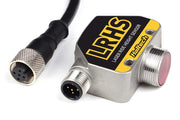
Electronic wheelie control is the other answer. A Haltech laser ride height sensor measures the distance from the front of the car to the track surface, and the ECU uses that measurement to manage power as the front end lifts.
How the ECU controls it
The sensor gives the ECU a live front ride height reading. You set how much lift you're willing to accept, then build fuel and ignition cut strategies against front-end lift and road speed. When the nose climbs past what you allowed, the ECU starts cutting ignition, fuel, or both, and the car stops rotating. Once the front is back down on the track, the ECU returns to the normal fuel and ignition settings.
Returning to full power instantly can just start the whole cycle again. The fix is the timer in the torque management setup, which holds the reduced power for a set time after the front touches down. That gives the car a moment to settle, build speed and put some weight back on the front tires before full power comes back.
In practice, we start with a gentle strategy and a generous lift allowance, make a pass, and read the log. The ride height trace next to engine speed and road speed shows exactly when and how far the car lifted. Tighten things up a step at a time from there. Haltech's advanced torque management covers the wider toolbox this sits in.
Mounting the sensor
A good reading depends on a good mount. Our usual starting point:
- Location: near the steering rack, where it reads the front of the car directly.
- Height: 3 to 5 inches (about 75 to 125 mm) off the ground at static ride height. Every car is a little different, so adjust to suit.
- Orientation: the red laser lens faces straight down, and the connector points to one side, left or right.
- Mount: rigid. A bracket that flexes or vibrates shows up as noise in the reading.
A sensor mounted the wrong way reads the wrong height, and the ECU will respond to that wrong number. Always check the static reading makes sense, and lift the front with a jack to confirm the number climbs as it should.
Wiring
The sensor comes with a DTM3 connector already fitted. If your car has the HT-141376 GM, Ford and Chrysler V8 terminated harness, it plugs straight into the SPI4 connector in the engine bay with no changes. For custom or universal wiring:
| Sensor pin | Connect to |
|---|---|
| 1 | Ground |
| 2 | +12V or +16V DC supply |
| 3 | Signal, to a spare ECU input |
Any Haltech ECU with a spare AVI can read it. The HT-011200 package includes the laser sensor (measuring from 1 inch to 19.5 inches, 25 to 500 mm), a glass aperture kit, a 2 m (about 6.5 ft) 5-pin Euro-style cable with a PVC jacket and female DTM3, and a male DTM3 plug and pins. The ride height input itself is covered in ride height sensors (front and rear).
Wheelie control FAQ
Can I use this instead of wheelie bars?
In a class that bans bars, it's the main tool you have. Where bars are legal, plenty of racers run both: the bars as a hard limit, and the ECU to manage lift before it gets that far.
Should I cut fuel or ignition?
The ECU can use either or both. Which works best depends on the engine, fuel and how the car reacts, so we decide on the car, using logs, rather than by rule.
Is there any maintenance?
Keep the lens clean. It's an optical sensor, so dirt or film on the glass can affect the reading. If you're setting up a car for the first time, book a free consultation and we'll walk through the strategy with you.