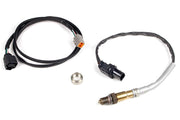
What the MAP sensor does
A manifold absolute pressure (MAP) sensor reads the pressure inside the intake manifold, from deep vacuum at idle up to full boost. Because that pressure tracks how much air the engine is drawing in, it's the most common load input for fuel and ignition tables on a Haltech. If the MAP reading is wrong, everything built on top of it is wrong too.
It's a powered sensor with three wires: a 5V supply from the ECU, a signal back to the ECU, and a signal ground. The signal voltage rises as manifold pressure rises.
Onboard or external?
Elite ECUs have a pressure sensor built in, rated at 3.0 bar absolute. You connect it to the manifold with a vacuum hose, and there's no wiring to do. On the Wiring tab, Input Type picks between the two options:
| Input Type | When to use it |
|---|---|
| On-board Pressure Sensor (default) | Naturally aspirated engines and boost levels comfortably inside a 3 bar range, roughly up to about 29 psi (2 bar) of boost at sea level |
| Analogue Voltage | An external sensor. Needed for more boost than the internal sensor can read, or when a short hose run matters |
Absolute pressure includes the atmosphere, so a 3 bar sensor tops out around 2 bar (about 29 psi) of boost at sea level. If you plan to run more than that, fit an external sensor with headroom, such as the 3 bar GM MAP sensor for milder builds or the 5 bar TI MAP sensor for serious boost. We also prefer an external sensor mounted close to the plenum on engines with long hose runs, since a long hose slows the response.
Wiring an external sensor
Pick the input under Connections. The default is AVI-9.
- AVI (analog voltage input): the right choice whenever one is free. Set the pull-up to Disabled. The 1k pull-up option is for two-wire temperature sensors, which have no supply of their own. A MAP sensor is powered, so a pull-up would distort its reading.
- SPI: can stand in if you've run out of AVIs. Set Sensor Type to Hall Effect, which is what you use for any analog signal on an SPI, and again leave the 10k pull-up disabled.
If the sensor is shared with a factory ECU, as on a piggyback install, the other ECU already provides whatever bias the circuit needs, which is one more reason to leave the Haltech pull-up off. A Delphi 3-pin connector is available if your external pressure sensor uses that plug.
Calibration
When Input Type is Analogue Voltage, the Calibration tab appears. ESP ships with calibrations for many common sensors, and you load them with the open-folder icon. If your sensor isn't listed, build a custom calibration from the manufacturer's voltage-to-pressure data and save it with the disk icon so you can reuse it. A quick sanity check after loading: with the engine off, the MAP reading should match barometric pressure, around 101 kPa (14.7 psi) at sea level.
Display settings
The Display tab only changes how gauges look, not what the sensor reads. Display Minimum and Display Maximum set the gauge range, and Warning Maximum sets the pressure where any MAP gauge starts flashing red. We set the warning just above the highest boost target, so a boost control problem jumps out at you on the laptop.
Diagnostics and engine protection
The Diagnostics tab lets the ECU flag wiring faults and unsafe pressure. Each check is off by default. If Engine Protection is active, you can also assign a DTC severity to each one so the ECU reacts, not just records.
| Check | Fault code | What it catches | Our advice |
|---|---|---|---|
| Raw Min | P0107 | Signal voltage below your limit (external sensor only) | Set just below the lowest voltage you ever see in normal running. Catches a broken wire or lost 5V |
| Raw Max | P0108 | Signal voltage above your limit (external sensor only) | Set just above the highest normal voltage. Catches a short to supply |
| Operating Min | P0105 | Pressure lower than it should ever be | Useful to catch a sensor that reads implausibly low |
| Operating Max | P0106 | Pressure above your limit | Set above your boost target as an overboost warning, alongside proper boost cut |
Troubleshooting
| Symptom | Usually |
|---|---|
| Reading stuck at full scale or zero | Lost 5V or ground, signal wire open, or pull-up left enabled |
| Engine-off reading far from barometric | Wrong calibration loaded |
| Boost reads lower than a mechanical gauge | Hose leak, or sensor range too small and maxed out |
| Noisy, jumpy reading at idle | Hose taken from a single runner instead of the plenum, or a long hose run |
For more on how the sensors fit together, see What sensors do I need?, and for the Nexus version of this setup see Manifold Pressure Sensor.
MAP sensor FAQ
Can I use the internal sensor on a turbo car?
Yes, as long as your boost stays well inside its range. Once you're getting close to the top, move to an external sensor so you're not tuning at the edge of what it can measure.
Should the pull-up ever be on for a MAP sensor?
No. MAP sensors drive their own signal from the 5V supply, so the pull-up stays disabled on both AVI and SPI inputs.