The short answer
To start and run an engine properly, a Haltech ECU needs to know two things: where the engine is in its cycle, and how much air is going into each cylinder. Six sensors answer those questions.
| Sensor | What it tells the ECU | What goes wrong without it |
|---|---|---|
| Trigger (reference) | Engine speed, and often crank angle | No RPM signal, so no fuel or spark |
| Home (sync) | Which stroke each cylinder is on | No sequential injection or coil-on-plug timing |
| MAP | Intake manifold pressure, the main load reading | The ECU can't tell light load from full load |
| Air temperature | How hot the incoming air is | Air density is guessed, so fueling drifts with weather |
| Coolant temperature | Engine temperature | Cold start and warm-up can't be tuned |
| Throttle position | Throttle blade angle | No accel enrichment or decel fuel cut |
What each essential sensor does
Trigger and home
These two work as a pair. The trigger sensor, usually reading a toothed wheel on the crank, gives the ECU engine speed and, on many setups, the crankshaft's angle. But a crank sensor alone can't tell the difference between the compression stroke and the exhaust stroke, because the crank turns twice per engine cycle. The home sensor, usually on a cam, fills in that gap so the ECU knows exactly which cylinder is where. That's what allows fully sequential injection and individual coil control. Our engine trigger systems explained article goes further.
MAP sensor
The manifold absolute pressure sensor measures pressure in the intake manifold. It can be screwed straight into the manifold or mounted remotely and fed by a vacuum line. It's the ECU's main load input, and it does double duty on a boosted engine. The boost control function uses it to chase a requested boost level, and it can shut things down if boost runs away because of a stuck wastegate or a blown-off hose. Make sure the sensor's range covers your maximum boost. A 3 bar GM MAP sensor or a 5 bar TI MAP sensor are common choices.
Air and coolant temperature
The air temp sensor normally sits near the throttle body, either just ahead of it or just after it. The coolant temp sensor reads the cooling system, which is the best simple stand-in for engine temperature.
Together with MAP, these let the ECU estimate the charge air temperature, meaning how hot the air really is once it reaches the cylinder. Pressure plus temperature gives the ECU the mass of air per cylinder, and from that it calculates the mass of fuel needed to hit your target air-fuel ratio.
Both sensors also carry their own correction tables. You can add fuel or change timing based on air or coolant temperature, which is how we tune cold starts, hot restarts and safety margins for a hot day.
Throttle position
The TPS reports the throttle blade angle. The ECU uses how quickly it changes to add fuel on a sudden stab (the EFI version of a carburetor's accelerator pump) and to cut fuel on deceleration, which helps economy.
Optional sensors worth considering
Once the engine runs, extra sensors let you add mapping features, protect the engine, log more data and feed a dash. The ones we fit most often:
| Sensor | Why we'd add it |
|---|---|
| Wideband O2 | Real air-fuel ratio for tuning and closed loop fueling. Close to essential for anyone tuning |
| Ethanol content | Automatic fuel and timing changes for flex fuel |
| Fuel pressure | Catches a failing pump or regulator before it leans the engine out |
| Fuel flow | Accurate fuel usage for endurance and economy |
| Oil pressure and oil temperature | Engine protection, and cheap insurance |
| Coolant pressure | Early warning of head gasket or cooling problems |
| Exhaust gas temperature | Per-cylinder balance and turbo protection |
| Wheel, driveshaft and turbine speed | Traction control, torque management and transmission functions |
| Suspension travel | Chassis data logging |
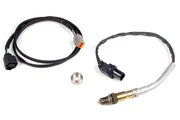
Related hardware includes a WB1 wideband kit, a flex fuel composition sensor and thermocouple amplifiers such as the TCA4 for EGT. See wideband O2 sensors explained if you're choosing one.
Sensor FAQ
Can I run without a cam (home) sensor?
Some engines can run batch or wasted-spark without one, but you lose sequential injection and true coil-on-plug timing. We fit one whenever the engine allows it.
Can I reuse my factory sensors?
Usually, yes. Most factory trigger, MAP and temperature sensors can be calibrated in the Haltech software. If you're not sure about yours, ask us.