The L series at a glance
The L family is Honda's small-displacement inline four. Every version fires 1-3-4-2. Displacement depends on the code:
| Family | Nominal size | Swept volume |
|---|---|---|
| L12 | 1.2 liters | 1246 cc (73.1 ci) |
| L13 | 1.3 liters | 1339 cc (81.7 ci) |
| L15 | 1.5 liters | 1496 cc (91.4 ci) |
You'll find them in the Fit/Jazz, City, Civic, Brio, HR-V and CR-V, among others.
Which L engines can run a Haltech?
Honda built a lot of L variants, and some use technology Haltech doesn't support. Check your engine code before you buy anything.
Not supported
- i-DSI engines: these fire two spark plugs per cylinder, slightly staggered, a bit like a rotary's leading and trailing plugs. Honda did it for economy and emissions, and it isn't supported.
- Turbocharged L15s (L15BF, L15B7, L15B9, L15BG, L15E and L15C): all direct injected, which Haltech doesn't support on these engines.
Port-injected variants that are covered
| Engine | Cam layout | Valve timing | Compression |
|---|---|---|---|
| L12B | SOHC | VTEC on the intake lobes only | 10.2:1 |
| L13A | SOHC | i-VTEC, continuously variable | 10.5:1 |
| L13B | DOHC | i-VTEC, continuously variable intake cam | 13.5:1 |
| L13Z1 | SOHC | i-VTEC, continuously variable | 10.5:1 |
| L15A1 | SOHC | VTEC on the intake lobes only | 10.4:1 |
| L15A7 | SOHC | i-VTEC, continuously variable, higher output | 10.4:1 |
| L15B1 | DOHC | i-VTEC, continuously variable intake cam | Not listed |
| L15Z1 | SOHC | i-VTEC, continuously variable | 10.3:1 |
| L15Z2 / Z5 / Z6 | SOHC | i-VTEC, continuously variable | 10.4:1 |
The dash, ABS and body control on these cars talk over CAN, and Haltech doesn't support that factory network. Vehicle speed also comes in over CAN on this engine, so plan how you'll handle the gauge cluster and speed signal before the swap.
Crank and cam sensors
Both sensors are Hall effect. The crank wheel is a 60-2 pattern (60 tooth positions with two missing), and the cam wheel has three teeth: two large and one small. The cam sensor sits in the head at the transmission end.
Crank sensor to Haltech Trigger 4-core
| Haltech wire | Sensor pin | Job |
|---|---|---|
| Red | 1 | Switched 12 V supply |
| Yellow (Trigger +) | 2 | Crank signal |
| Blue | 3 | Signal ground |
Cam sensor to Haltech Home 4-core
| Haltech wire | Sensor pin | Job |
|---|---|---|
| Yellow (Home +) | 1 | Cam signal |
| Blue | 2 | Signal ground |
| Red | 3 | 12 V supply |
Note the pinouts aren't in the same order on the two sensors. Getting power and ground swapped on a Hall sensor is one of the most common reasons we see for no RPM while cranking. See our Hall sensor pinout guide if you're working with a different sensor.
Ignition coils
The L runs coil-on-plug direct fire, and each coil has its igniter built in, so they wire straight to the ECU's ignition outputs with no separate igniter box.
| Coil pin | Connects to |
|---|---|
| 1 | That cylinder's Haltech ignition output |
| 2 | Ground at the cylinder head |
| 3 | Switched 12 V |
Set dwell to suit these coils. If you'd like the dwell figures we use, ask us.
Throttle: drive by wire or cable
Most L engines use a single drive-by-wire throttle body, which also handles idle speed, so there's no separate idle valve.
DBW throttle body
| Function | Throttle pin | Haltech connection |
|---|---|---|
| Position sensor 1 | 1 | AVI 2, Orange/Black |
| Position sensor 2 | 3 | AVI 3, Orange/Red |
| 5 V supply | 2 | 5V+, Orange |
| Signal ground | 4 | Signal Ground, Black/White |
| Motor + | 6 | DBW 1, Brown/Black |
| Motor - | 5 | DBW 2, Brown/Red |
Accelerator pedal
The pedal has two independent sensors, each with its own supply and ground.
| Function | Pedal pin | Haltech connection |
|---|---|---|
| Pedal signal 1 | 3 | AVI 4, Orange/Yellow |
| Pedal signal 2 | 6 | AVI 5, Orange/Green |
| 5 V supplies | 2 and 5 | 5V+, Orange |
| Signal grounds | 1 and 4 | Signal Ground, Black/White |
Cable throttle versions
Engines with a cable throttle have a simple three-wire TPS: pin 1 to Signal Ground (Black/White), pin 2 is the signal to a spare AVI (AVI 10, White), and pin 3 to 5V+ (Orange).
Other sensors
MAP sensor
The factory MAP sensor lives on the intake plenum. Pin 1 takes 5V+ (Orange), pin 2 is the signal to a spare AVI (AVI 9, Yellow) and pin 3 goes to Signal Ground (Black/White). You can skip it and use the ECU's internal MAP sensor instead. If you're adding boost, use an external sensor rated for it on a spare AVI; see our MAP sensor guide.
Coolant and intake air temperature
Both are two-wire thermistors that don't care about polarity. One pin goes to a spare AVI, the other to signal ground. Pick an AVI with a switchable pull up; if yours doesn't have one, add a 1k ohm resistor from the signal to 5 V. The air temp sensor is in the intake duct.
Knock sensor
The factory sensor is an older resonant type. Those can be unreliable and misleading once an engine is modified, so we don't trust them for knock control. Swap to a flat-response donut sensor like the Haltech HT-011100.
Oxygen sensors
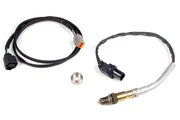
The stock O2 sensors are narrowband. They're fine for holding lambda 1.0 at light load, but useless for tuning under power. We strongly recommend a Haltech WB1 wideband kit, putting its LSU 4.9 sensor where the pre-cat sensor was. They come out with a 22 mm wrench or O2 socket.
Variable valve timing
- i-VTEC engines with a continuously variable intake cam are handled by the cam control function (called Variable Cams on the Elite).
- VTEC engines with on/off cam switching use the switched cam control function.
Injectors
Factory injectors flow about 190 cc/min at 100% duty. That's small, so expect to upgrade for any real power increase. If your fuel system uses a fixed regulator that isn't referenced to manifold pressure (common on returnless systems), map injector flow against manifold pressure so fueling stays accurate as vacuum and boost change.
You'll also need correct dead times. Dead time covers the delay while the injector's solenoid energizes and opens, the time it takes to close, and the partial-flow moments in between. Wrong dead times show up mostly at idle and light load, where pulse widths are short.
L series FAQ
Can I run my turbo L15 on a Haltech?
Not the factory turbo versions. They're direct injected, which isn't supported. A port-injected L15 with an aftermarket turbo is a different story.
Will my dash and speedo still work?
The factory cluster, ABS and body modules use CAN that Haltech doesn't support, and vehicle speed arrives over that bus too. Plan a solution for those before you pull the factory ECU.
Do I need the factory O2 sensors?
No. Replace the pre-cat sensor with a wideband and you'll get far better information for tuning.
Want wiring diagrams or the factory ECU pinout for your exact engine? Ask us and we'll help, or see our F20C guide and R18 guide for other Honda engines.