Why log gearbox oil temperature?
Automatics make heat in the torque converter, and manual gearboxes and transfer cases heat up hard on track. Fluid that runs too hot breaks down, and the damage usually shows up long after the day that caused it. A sensor on the Elite gives you the reading in your logs, a warning in ESP, and a signal your engine protection strategy can act on.
Most temperature sensors have just two wires: a signal wire to an analog voltage input (AVI) on the ECU and a signal ground.
Wiring tab
Input Type
Choose based on how your sensor's data is supplied:
| Input Type | Pick it when | Needs |
|---|---|---|
| Analogue Voltage | The sensor's calibration is given as voltage against temperature | An AVI |
| Analogue Resistance | The calibration is given as resistance against temperature (most thermistor sensors) | An AVI |
| Thermocouple Type K | You're measuring with a K-type thermocouple | A thermocouple amplifier such as the TCA2 or TCA4 |
| CAN Input | The temperature already exists on the vehicle CAN bus, for example from a factory transmission controller | Vehicle CAN set up |
The CAN option is the one we use on cars like the ZF six-speed Falcon, where the transmission controller already reads the fluid temperature. See vehicle CAN support.
Input and pull-up
Assign the AVI you've wired the sensor to. Then decide on the Pull Up:
- Enabled for a sensor used only by the Haltech. A thermistor needs a pull-up to make a readable voltage, so this is the normal setting.
- Disabled when the sensor is shared with another controller, such as a factory ECU or TCU in a piggyback-style install. That controller already provides the pull-up, and adding a second one skews the reading for both.
Calibration tab
This tab only appears for the two analog input types. It's where you load a calibration file (the yellow folder icon) or save your own (the blue disk icon). ESP ships with a set of calibrations, and the default is the Haltech 150°C (302°F) oil temperature sensor. If your sensor isn't listed, build a custom calibration from the manufacturer's resistance or voltage table.
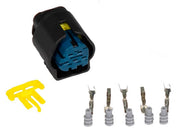
If you still need a sensor, the Haltech high range oil temperature sensor is one option. Whatever you fit, make sure the calibration you load matches that exact sensor, and ask us if you're unsure which connector it needs.
Display tab
- Warning Minimum: below this, gearbox oil temperature items in ESP flash red to show the fluid is cold.
- Warning Maximum: above this, they flash red to show it's too hot.
These only affect how ESP displays the value. They don't protect anything on their own.
Diagnostics tab
These settings catch wiring faults, and can feed engine protection if you want the ECU to react.
| Setting | What it does | Our advice |
|---|---|---|
| Raw Min | Sets DTC P0712 if the input voltage drops below your value | Enable it. A voltage near 0V usually means the signal is shorted to ground |
| Raw Max | Sets DTC P0713 if the input voltage rises above your value | Enable it. With a pull-up, an open circuit sits near 5V |
| DTC Severity | With Engine Protection active, chooses how seriously each fault is treated | Match it to what the car does. A race car may want a stronger response than a street car |
Both Raw limits are disabled by default. Set them just outside the voltages the sensor produces across its real working range, so a genuine reading never trips them. The DTC index lists what each code means.
Troubleshooting
| Symptom | Usually |
|---|---|
| Reads extremely cold all the time | Open circuit or unplugged sensor with the pull-up on |
| Reads extremely hot all the time | Signal shorted to ground |
| Reads plausible but wrong | Wrong calibration file, or pull-up enabled on a shared sensor |
| No value with CAN input | Vehicle CAN not configured, or the car doesn't broadcast that temperature |
The same approach applies to the differential oil temperature sensor and the engine oil temperature sensor.