Why monitor diff oil temperature?
The differential works hard on a car that launches repeatedly, runs long road-course sessions or tows. Gear oil thins as it heats, and once it's past its comfortable range, the ring and pinion and bearings wear fast. A temperature sensor in the diff lets the Elite log it, flash a warning in ESP and, through protection settings, flag a fault. It's also how you find out whether that diff cooler is actually doing anything.
You'll find the function in ESP under Main Setup, listed as Differential Oil Temperature. Its settings are spread across four tabs: Wiring, Calibration, Display and Diagnostics.
Choosing the input type
The first decision on the Wiring tab is what kind of sensor you have. Pick based on the data the sensor maker supplies.
| Input type | Pick it when | Wires to |
|---|---|---|
| Analogue Voltage | The calibration data is given as voltage vs temperature | An AVI (or an SPI if you're out of AVIs) |
| Analogue Resistance | The calibration data is given as resistance vs temperature, typical for two-wire thermistor sensors | An AVI |
| Thermocouple Type K | You're using a K-type thermocouple through a Haltech CAN thermocouple amplifier | A TCA input, over CAN |
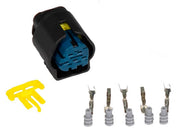
For most diffs, a regular thermistor sensor such as the Haltech high-range oil temperature sensor is the simplest choice, with the matching plug and pins if you're making your own wiring. A thermocouple makes sense if you already run a TCA2 or TCA4 for EGTs and have a spare channel. To use one, enable the TCA under Devices in Main Setup first, then pick the TCA input in this function.
Wiring it to an AVI or SPI
An AVI is the preferred home for this sensor. If every AVI is spoken for, an SPI will do the job, with a couple of differences.
| Setting | What it does | Our advice |
|---|---|---|
| AVI pull up | Switches in a 1k resistor to 5V | On for a two-wire sensor, off for a sensor with its own supply |
| SPI sensor type | Tells the SPI how to read the signal | Set to Hall Effect whenever the SPI is reading an analog sensor |
| SPI pull up | Switches in a weak 10k resistor to 5V | Same rule as the AVI: on for two-wire sensors |
The pull-up is what makes a two-wire thermistor work. The resistor and the sensor form a voltage divider, and the ECU reads the voltage in the middle. If the sensor is shared with another ECU, as in a piggyback setup with the factory computer, that other ECU is usually already supplying the pull-up. In that case turn the Haltech's off, or the two will fight and the reading will be wrong.
The pre-installed temperature calibrations are meant for use on an AVI. On an SPI, with its weaker 10k pull-up, the same sensor produces different voltages, so a stock calibration will need adjusting before it reads correctly. Check the reading against a known temperature before trusting it.
Calibration
The Calibration tab only appears for the two analog input types. It's where you tell the ECU how to turn voltage or resistance into temperature. By default it's set up for Haltech's 150°C (302°F) oil temperature sensor. ESP ships with a list of other calibrations; load one with the yellow folder (Open) icon. If your sensor isn't listed, build a custom calibration from the maker's data and save it with the blue disk icon so you can reuse it on the next car.
Display warnings
On the Display tab, set Warning Minimum and Warning Maximum. When the reading goes outside that window, diff oil temperature gauges in ESP flash red. The high warning is the one that matters. We set it with the gear oil and diff manufacturer's guidance in mind, low enough to give you time to back off before damage starts. The low warning is handy on a race car as a reminder the diff hasn't warmed up yet.
Diagnostics: catching wiring faults
The Diagnostics tab is about spotting a broken sensor or wire, not a hot diff. It works with Analogue Voltage input only.
- Raw Min: if enabled, a voltage below this sets fault code
P1900. That usually points to a short to ground. - Raw Max: if enabled, a voltage above this sets
P1901. On a pulled-up input, an unplugged sensor or broken wire reads high.
Both are disabled by default. If you're running engine protection, you can give each code a DTC severity level. We set the limits just outside the voltages the sensor produces across its real working range, so a genuine fault trips it but a cold morning doesn't.
Troubleshooting
| Symptom | Usually |
|---|---|
| Reads extremely cold all the time | Sensor unplugged or broken wire with the pull-up on, or wrong calibration |
| Reads extremely hot all the time | Signal shorted to ground |
| Reads, but far from reality | Wrong calibration, pull-up setting wrong, or a stock calibration used on an SPI |
| Reading changes when another sensor changes | Poor signal ground or a shared ground issue |
Setting up a gearbox sensor as well? It's configured the same way; see gearbox oil temperature sensor. For the channel side of this function, see differential oil temperature.