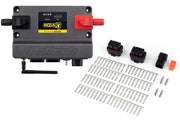
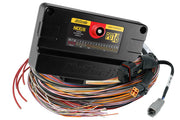
Why the ECU should control the pump
The biggest reason is safety. When the ECU controls the pump, it shuts the pump off whenever the engine isn't turning. If the car is in a crash and the engine stalls, the pump stops too, instead of pushing fuel out of a damaged line. It also means the pump primes the system when you switch on, then goes quiet until you crank.
The Nexus Fuel Pump function covers the main pump and an optional auxiliary pump, each with its own output and settings.
Options
- Pump Mode: choose how the pump is driven. It can be Digital (hard-wired to an ECU output) or CAN controlled, and either Switched (simple on and off) or Duty Cycle (variable speed using PWM).
- Pump Override Switch Enable: adds an input that forces the pump on while the switch is on. It's handy for bleeding the system or checking fuel pressure without cranking.
Under Connections, assign an output for every pump you've enabled and an input for every override switch.
Primary pump settings
| Setting | What it does | Our advice |
|---|---|---|
| Prime Time | How long (in ms) the pump runs at key-on before shutting off if the engine isn't turning | Long enough to bring the rail up to pressure. Watch a fuel pressure gauge or sensor at key-on to confirm. |
| PWM Signal Frequency | The switching frequency used in Duty Cycle mode | Use what the pump controller or pump manufacturer specifies |
| Override Duty Cycle | Duty used when the override switch is on (Duty Cycle mode only) | Enough to reach normal fuel pressure |
Running a second pump
A car built for big power only needs all that fuel flow some of the time. Running two pumps constantly, or one huge pump, makes noise and heats the fuel as it recirculates through the regulator. Hot fuel is less dense and more prone to vapor, so it's better to keep the second pump off until it's needed.
Plumb the auxiliary pump in parallel with the primary, and fit a check valve so fuel can't be pushed backward through whichever pump is off.
Aux pump settings
| Setting | What it does |
|---|---|
| Trigger Type | Switch on by Load and RPM thresholds, or by Estimated Fuel Flow |
| Estimated Fuel Flow | The fuel flow at which the aux pump turns on (flow trigger only) |
| RPM Threshold | The RPM at which the aux pump turns on |
| Load Threshold | The load at which the aux pump turns on |
| PWM Signal Frequency | Switching frequency, only when the aux pump runs in Duty Cycle mode |
| Time Hysteresis | The minimum time between one switch on and the next switch off, or the reverse |
| Override Duty Cycle | Aux pump duty while the override switch is on (Duty Cycle mode only) |
We prefer the Estimated Fuel Flow trigger where it fits, because it responds to what the engine is actually using rather than a guess based on RPM and load. Set the threshold so the second pump is running well before the primary runs out of capacity, not right at the edge. Time Hysteresis stops the pump from chattering on and off when you sit near the threshold.
Worked example
Picture a street car with a turbo that cruises on a fraction of one pump's capacity. With the flow trigger, the aux pump stays off around town, and the fuel stays cooler and the car quieter. On a pull, fuel flow crosses the threshold and the second pump joins in early, so pressure holds steady through the top end. Back off and it drops out again, but only after the hysteresis time, so a quick lift between gears doesn't cycle it.
Fuel Pump Table
In Duty Cycle mode, each pump gets its own Fuel Pump Table, which sets the output duty. That lets you slow the pump down at idle and cruise and bring it up to full speed as demand rises. The table only appears when the pump is set to Duty Cycle. Keep an eye on fuel pressure in your logs whenever you reduce duty: pressure should stay steady at every point in the table, including sudden throttle openings.
Troubleshooting
| Symptom | Usually |
|---|---|
| Pump doesn't prime at key-on | Output not assigned, relay wiring fault, or Prime Time set to zero |
| Pressure drops at high load | Aux pump threshold too late, duty too low in the table, or pumps too small |
| Aux pump clicks on and off | Threshold sits right where the car runs. Increase Time Hysteresis or move the threshold |
| Fuel pressure drops when one pump is off | Missing or failed check valve |
A fuel pressure sensor makes all of this far easier to verify, and the engine control relay article covers powering the pump circuit. For more on regulators, read why you need a fuel pressure regulator. Running an Elite instead? See our Elite fuel pump article.