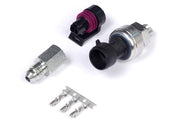
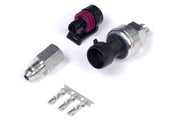
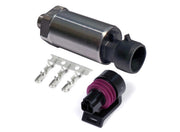
Why fit a fuel pressure sensor?
Injector flow depends on the pressure difference across the injector. If fuel pressure sags because a pump is tired, a filter is clogging or the regulator is struggling, every injector flows less than the tune expects and the engine goes lean, usually at the worst moment. With a sensor fitted, the Elite can:
- Log it, so a problem shows up in the data before it shows up as a damaged piston.
- Tune with it, correcting injection for the actual pressure differential instead of assuming it's constant.
- Protect with it, flagging a fault or triggering Engine Protection when pressure falls away under load.
Haltech's 150 psi TI sensor is what ESP is calibrated for out of the box. For very high pressure systems there's a 250 psi version, and the 150 psi motorsport sensor adds a stainless steel diaphragm.
Wiring tab
Assign the sensor under Fuel Pressure Input. The preferred choice is an AVI (analog voltage input). If you've run out of AVIs, an SPI can do the job.
| Input | Settings | Our advice |
|---|---|---|
| AVI (preferred) | Pull up: switches in a 1k resistor to 5V | Disabled for a normal three-wire pressure sensor, since it powers itself from the 5V supply |
| SPI (if no AVI is free) | Sensor Type, plus a weaker 10k pull-up to 5V | Set Sensor Type to Hall Effect for analog sensors like this one, and leave the pull-up disabled |
The pull-up exists for two-wire sensors, like most temperature sensors, that need the ECU to supply a reference voltage. A powered pressure sensor doesn't. The same goes for any sensor shared with another ECU, such as in a piggyback setup, since the other ECU usually provides the pull-up already.
Calibration tab
ESP ships with several pressure sensor calibrations and defaults to the Haltech 150 psi sensor. Use the yellow folder icon to load a different calibration file, or the blue disk icon to save one you've entered. For another brand of sensor, build a custom calibration from the maker's voltage-to-pressure data.
A quick check we always do: with the fuel system fully depressurized, the reading should sit at the sensor's zero point (atmospheric for an absolute sensor). Prime the pump and it should rise to your regulator pressure. If not, the calibration or the wiring is wrong.
Display tab
Warning Minimum and Warning Maximum make any fuel pressure gauge in ESP flash red outside your chosen range. Set them just outside normal operating pressure so a problem catches your eye while you're tuning.
Diagnostics tab
All three checks are off by default.
| Check | Code | Catches |
|---|---|---|
| Raw Min | P0192 | Sensor voltage below your limit, usually an open circuit or signal shorted to ground |
| Raw Max | P0193 | Sensor voltage above your limit, usually a short to 5V or a missing ground |
| Operating | P0191 | Real fuel pressure too low for the conditions, the one that saves engines |
How the Operating check decides
This check compares measured pressure against what the Elite expects, based on the Base Fuel Pressure you entered in the fuel setup. The code only sets when every condition you've enabled is true at once:
- Pressure is below expected by more than the Deadband Value.
- The Precondition is met. You choose MAP, TPS or Both. With MAP, manifold pressure must be above Minimum MAP. With TPS, throttle must be above Minimum TPS. With Both, both limits apply.
Finally, DTC Severity decides what happens. None just logs the code, while Level 1, 2 or 3 hand it to Engine Protection, if that's enabled.
Worked example
On a turbo car, we care most about pressure holding up on boost. We'd use MAP as the precondition, with Minimum MAP set a little above atmospheric so the check only runs under boost. The deadband is set wide enough to ignore the small dip you see when the throttle snaps open, but tight enough to catch a pump that's really falling behind. Then we pick a severity that pulls power rather than just logging. Always confirm the settings in logs from a few hard pulls before trusting them.
A deadband that's too small will trip on normal pressure ripple and throw false engine protection events. Start generous, look at real logs, then tighten.
Fuel pressure sensor FAQ
Where should the sensor go?
Somewhere that sees rail pressure, usually on the fuel rail or the regulator's inlet side, so it reads what the injectors actually see.
Can one sensor do both logging and protection?
Yes. One sensor feeds logging, injector pressure differential tuning and the diagnostic checks at the same time.
More detail on diagnosing fuel supply issues is in our fuel pressure diagnosis guide. If you run ethanol, the flex fuel sensor setup is the natural next step.