Why bring fuel level into the ECU
Once the ECU knows fuel level, you can log it next to everything else and send it to a dash such as the Haltech iC-7. On a track car that means a low fuel warning in front of the driver, and in the logs it helps explain a fuel pressure dip in a long corner when the tank is low.
Wiring: use a signal conditioner
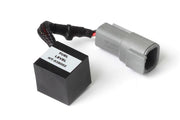
Fuel senders are float-driven resistors, and the reading jumps around as fuel sloshes in the tank. Wiring a sender directly to the ECU is not recommended for that reason. Instead, run it through the Fuel Level Sender Signal Conditioner (HT-038002), then take the conditioner's output to any free analog input. Follow the conditioner's own documentation for its connections and setup.
Setting it up in NSP
| Node | What you set | Our advice |
|---|---|---|
| Fuel Level | The calibration, loaded with Load from File or entered by hand. Save to File keeps a copy | Build the calibration from the actual tank (see below) |
| Display | Warning Minimum, the level where gauges and bars go into their low warning, and Display Maximum, where they end | Set the warning with enough fuel left to finish a session or reach a gas station |
| Diagnostics | High and low voltage DTCs, each with a severity that maps to an Engine Protection level | Enable them so a broken sender wire shows as a fault, not a full or empty tank |
| Wiring | The analog input the conditioner's output lands on | Any available AVI |
Calibrating to your tank
Every tank and sender combination is different, so a real calibration beats a guess. The simple way: start with the tank nearly empty, note the voltage, then add a known amount of fuel at a time and note the voltage at each step until it's full. Those pairs become your table. Our fuel level sensor calibration article covers it in more detail, and Subaru fuel level sensors covers a common OEM dual-sender setup.
Troubleshooting
| Symptom | Usually |
|---|---|
| Reading jumps around under cornering or braking | Sender wired directly without the conditioner |
| Always reads full or empty | Open or shorted wire; check the voltage DTCs |
| Accurate at one end only | Calibration built from too few points |