How digital sensors work
A Hall effect sensor has a small circuit built inside it. It switches its output as a trigger tooth or magnet passes, so what comes out is a clean square wave: fully on or fully off, with sharp edges. Optical sensors do the same job with a light beam and a slotted disc, and the ECU treats them exactly the same way.
Because of those internal electronics, a digital sensor needs power and ground as well as a signal wire, so expect at least three wires. That's one of the quickest ways to tell one from a two-wire reluctor. If you're not sure which wire is which, see determining Hall effect sensor pinouts.
Why we prefer them
A reluctor sensor produces an AC voltage whose size and shape change with engine speed, so the ECU has to condition it before it can find the edges. A Hall sensor's output is already digital, so there's nothing for the ECU to clean up. In practice that means:
- A consistent signal from cranking speed right up to redline.
- No arming thresholds to set as the signal voltage changes with RPM.
- Less work for the ECU and fewer ways for the trigger to go wrong.
If you're choosing sensors for a custom trigger, pick a Hall effect every time you can. For the full comparison, read Hall effect or reluctor?
Why you need a cam signal
A crank sensor tells the ECU where the crank is, but the crank turns twice per engine cycle. Top dead center on cylinder 1 looks the same whether it's the compression stroke or the exhaust stroke. For batch fire and wasted spark that doesn't matter. For sequential injection or direct fire ignition, it does: the ECU has to know which cylinder is on compression.
The answer is a sensor on the camshaft, which turns once per cycle. It sends a pulse as the engine approaches cylinder 1 TDC on compression, and from there the ECU can track the whole firing order. See crank and cam trigger wiring for how the two sensors connect to the Elite.
Haltech Hall sensors
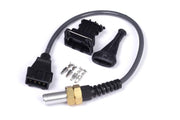
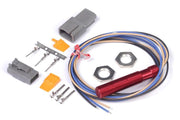
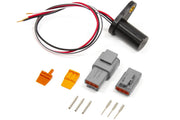
- Red single channel Hall effect sensor
- S3 black dual channel Hall effect sensor, with two signal outputs in one body
- GT101 style high frequency Hall effect sensor
Need the signal diagrams? Ask us and we'll send them over with advice for your build.