Why monitor transmission temperature?
Heat is what kills transmissions. Towing, drag launches, torque converter slip and long track sessions can all push fluid temperature up fast. Once it's logged by the ECU, you can see how hot it really gets, show a warning on the dash, and use it for driveline protection.
The sensor and wiring
Temperature sensors are almost always two-wire thermistors. One wire goes to an analog voltage input (AVI) on the ECU, the other to signal ground. Any free AVI works. In the Wiring node, assign the input and enable the pull-up. That connects an internal 1k ohm resistor from the input to 5V, which is what lets the ECU read a two-wire sensor's changing resistance.
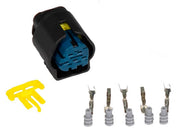
The Haltech high-range oil temperature sensor suits transmission fluid, and the matching Bosch-style plug and pins make the connection tidy. If you're short on AVIs, see using an SPI for a temperature sensor.
Configuration and calibration
The main node is where the calibration lives. If you bought a Haltech sensor, click Load from File and pick its calibration. For another sensor, enter the resistance or voltage points from the manufacturer's data by hand, then use Save to File so you can reuse it. A quick check: with the car cold, transmission temperature should read close to coolant and air temperature.
Display and warnings
The Display node sets how the channel appears on number displays, gauges and bars. You can set a lower and an upper warning threshold, and anything showing the channel changes to its warning state past those points. We set the upper warning where the fluid manufacturer says temperature starts to hurt the fluid.
Diagnostics and protection
The Diagnostics node gives you four checks you can turn on:
| Check | What it catches |
|---|---|
| Low voltage | Signal shorted to ground |
| High voltage | Sensor unplugged or wire broken |
| Minimum temperature | Implausibly low reading |
| Maximum temperature | Fluid getting dangerously hot |
Each can be given a DTC severity, which links it to an Engine Protection level. For example, a high temperature could trigger a warning light first and a power reduction if it keeps climbing.
Put the sensor where fluid actually flows, such as the cooler return line or pan, not a dead spot. A sensor in still fluid will read low and give you false confidence.
Setting up a full controller? See Transmission Control.