What a trans-brake actually does
A trans-brake is a solenoid in the valve body of a drag automatic. When it's energized, the transmission applies first gear and reverse at the same moment. Two gears fighting each other means the output shaft can't turn, so the engine can be held against the converter at high rpm without the car moving. Let go of the button, the solenoid drops out, reverse releases and the car leaves in first.
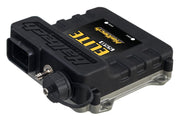
The Elite ECU can take over the whole job: reading the driver's button, switching the solenoid, holding a separate rpm limit while the brake is on, and adding a small, controlled delay on release.
Why bump and creep exist
Getting a car to full launch power takes time, especially a turbo car that has to build boost against the brake. If you pre-stage, then wait to build power, then roll into stage, you've lost the ability to stage on a loaded engine. Bump and creep solve that by briefly pulsing the trans-brake solenoid on and off. Each pulse lets the output shaft turn a tiny amount, so the car inches forward while the engine stays loaded.
- Bump: one press gives a pulse of a fixed length that you set in the software. Each press moves the car about the same distance, which makes it repeatable.
- Creep: the ECU pulses the solenoid for as long as the driver holds the button. The driver decides how far to roll.
A typical routine is to roll into the first (pre-stage) beam, bring the engine up on the brake, then bump or creep into the second (stage) beam.
Wiring tab: choosing the mode
| Option | Choices | When we use each |
|---|---|---|
| Trans-Brake Control | Not Used, Input Only, Input and Output | Input Only when the button already drives the solenoid directly and you only want the ECU to know the brake is on (for its limiter and logging). Input and Output when the ECU should switch the solenoid itself. |
| Bump Box Function | Not Used, Bump, Creep | Pick the one the driver prefers. Only one of Bump or Creep can be active. |
Connections
Trans-brake input and bump/creep input
Both buttons are switch inputs, and either an AVI (analog voltage input) or an SPI (synchronized pulsed input) will read them.
On an SPI, set these three:
- Edge Select: Falling if pressing the button pulls the wire to ground, Rising if pressing it applies voltage.
- Sensor Type: Hall Effect. That's the right choice for any switch.
- Pullup: turn it on when the switch only grounds the wire, so the input has a voltage to see when the button is released.
On an AVI, you give the ECU two thresholds, a Switch On Voltage and a Switch Off Voltage. Leave a healthy gap between them and keep them clear of the voltages the switch really sits at, so noise and charging system ripple can't make the input chatter.
Two cases worth thinking through:
- A button that pulls a 5 V line to ground when pressed. Set On to 0.5 V and Off to 4.5 V. The ECU sees the button pressed once the line drops under 0.5 V and released once it climbs back over 4.5 V.
- A switch that feeds 12 V when on and floats around 2.5 V when off. Here On is the higher number: 4.5 V for on and 3.0 V for off, so pressed means above 4.5 V and released means back under 3.0 V.
Trans-brake output and bump/creep output
Assign each to a free output, normally a DPO (digital pulsed output) or a stepper output. Each has an Active State:
- Low (the default): the ECU grounds the wire when the function is on. This is what you want for a relay whose coil has 12 V on the other side.
- High: inverts it, so the wire is grounded when the function is off and released when it's on.
A trans-brake solenoid draws far more current than an ECU output can supply. Use the output to switch a relay, and if you're using bump or creep, make it a solid state relay. A mechanical relay isn't built to be pulsed rapidly and will wear out or stick.
Settings tab
| Setting | What it does | Our advice |
|---|---|---|
| RPM Limiter Method | How the trans-brake rev limit cuts power: None, Fuel or Ignition | Ignition cut is the usual choice. Fuel cut leans the engine out while it's loaded, which is rarely what you want. |
| RPM Limit | The rev ceiling while the trans-brake function is on | Set it where the car leaves best, found from logs and time slips, not guessed. Start conservative. |
| Delay | The time between the driver releasing the input and the ECU releasing the solenoid | Small and consistent. It's a tuning tool, not a way to fix a slow driver. |
| Bump/Creep Frequency | How fast the solenoid is pulsed when the bump/creep button is used | Adjust until each bump moves the car a small, predictable amount. |
| Bump Time | How long a single bump pulses the output | Short. You can always bump twice, but you can't un-roll through the beams. |
Trans-Brake Enable Condition
This is a gate that has to be true before the trans-brake function will run. You pick any ECU channel (Select), a comparison (Maths: equal to, not equal to, greater than, less than, or the greater/less than or equal versions) and a Value. Useful examples are requiring a line lock or arm switch to be on, or requiring vehicle speed to be close to zero so a stray button press on the return road does nothing.
A worked example
Say a turbo car with a Powerglide uses a steering wheel button that grounds an SPI when pressed, plus a second button for bumping.
- Trans-Brake Control set to Input and Output, Bump Box Function set to Bump.
- Both inputs on SPIs with Edge Select Falling, Sensor Type Hall Effect and Pullup on.
- The trans-brake output drives a solid state relay (because bump will pulse it), Active State Low.
- RPM Limiter Method set to Ignition, with a conservative RPM Limit to start.
- An enable condition on vehicle speed so it only works when the car is nearly stopped.
On the first test hits, log engine rpm, boost, the trans-brake input, the output state and vehicle speed together, then raise the limit in small steps.
Troubleshooting
| Symptom | Usually |
|---|---|
| Input never shows as on | Wrong Edge Select, pullup off on a ground-switching button, or AVI thresholds on the wrong side of each other |
| Input flickers on and off | AVI On and Off voltages too close together, or a poor ground at the switch |
| Brake holds but the ECU limiter doesn't engage | Enable condition not met, or Trans-Brake Control left on Not Used |
| Bump does nothing or relay buzzes and fails | Mechanical relay in the circuit instead of a solid state one |
| Car rolls too far on each bump | Bump Time too long or frequency needs adjusting |
Related setup
Most trans-brake cars also use launch control, boost control and often anti-lag to build boost on the brake. The race timer is handy for anything that should happen at a set time after the brake releases. On a Nexus ECU, see the NSP version of this page: trans-brake.
Trans-brake FAQ
Can I use the Elite trans-brake with my existing button box?
Yes. Choose Input Only if your box already switches the solenoid and you just want the ECU's rev limiter and logging, or rewire so the ECU controls the solenoid through a relay with Input and Output.
Should the trans-brake limiter use fuel or ignition cut?
Ignition is the common choice and what we use. It keeps fueling normal so the engine isn't leaned out while it's working hard.
What's the difference between bump and creep?
Bump moves the car a fixed amount per press. Creep keeps moving it for as long as the button is held. Bump is more repeatable, creep gives the driver more direct control.