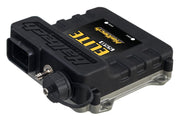
Two jobs, one function
A torque converter slips by design. That slip gives an automatic its smooth take-off and torque multiplication, but at highway cruise it just wastes fuel and heats the transmission fluid. The Elite's Torque Converter Control function covers two different needs:
- Lockup ties the engine and transmission input shaft together at the same speed once you're cruising. That improves economy and stops the converter slipping and cooking the fluid.
- Dump valve control is for drag racing. By reducing the converter's charge pressure on the start line, the engine can "come up on the converter" and reach launch RPM and boost more easily, then pressure is brought back for the run.
You can use either one or both. Both are enabled from the Wiring tab.
Wiring tab
| Setting | What it does | Our advice |
|---|---|---|
| Lock Enable | Turns on lockup control | Needs working vehicle speed sensors and a TPS |
| Dump Valve Enable | Turns on dump valve control | Drag cars with a dump valve fitted only |
| Torque Converter Multiplier Method | Sets how the ECU gets the converter's torque multiplication value for its calculations | Match it to the data you actually have for your converter |
| Lockup Feedback Mode | Lets the ECU monitor whether lockup has actually happened | Use it if your transmission gives a lockup status signal |
| Lock Request from ECU | The output that commands lockup | Usually a DPO or a stepper output |
| Lockup Feedback | Used when feedback is set to Digital - Switched | Pick a spare DPO or stepper output, as ESP lists them |
| Dump Valve Output | The output that drives the dump valve solenoid | Usually a DPO or a stepper output |
Vehicle speed is central to lockup, so set up and calibrate your vehicle speed sensors first.
Lockup conditions
Lockup should only happen when the car is truly cruising. Locking up at low speed or under heavy throttle makes the car shudder or bog. ESP gives you three conditions:
- Minimum Road Speed: lockup is only allowed above this speed.
- Throttle Position: the maximum throttle opening. Above it, lockup releases so the converter can multiply torque when you step on it.
- Minimum Coolant Temperature: lockup waits until the engine is warm enough to pull cleanly at low RPM.
Our starting point is conservative: a road speed well into normal cruising, a modest throttle limit, and a coolant temperature close to normal operating temperature. Then drive it and watch logs of engine RPM against driveshaft or vehicle speed to confirm lockup is clean and releases when it should.
Dump valve setup
The only setting on the Dump Valve tab is the Frequency of the PWM signal to the solenoid. Match it to what the valve's maker recommends.
The real tuning happens in the Torque Converter Dump Duty Cycle table, found under ECU Navigator, Torque Converter. That table sets how much charge pressure is dumped. Common axis choices are:
- Race time, to bring pressure back at a set time after launch.
- Engine RPM, to control pressure as the engine comes up to stall.
- Road speed, to restore pressure once the car is moving.
A typical drag strategy
- On the line, command enough dump so the engine can reach launch RPM and boost against the brakes.
- At the start of the run, either restore full charge pressure right away or ramp it back in over time.
- Log driveshaft speed and engine RPM together and adjust the ramp so the converter doesn't flash too high or bog.
Using race time as the axis needs the race timer running. It pairs well with anti-lag and boost control for building boost on the line.
Troubleshooting
| Symptom | Usually |
|---|---|
| Converter never locks | No valid vehicle speed or TPS, conditions set too tight, or the wrong output selected |
| Shudder when it locks | Minimum road speed too low or the engine still cold |
| Lockup won't release under throttle | Throttle position limit set too high |
| Engine won't come up on the converter | Dump duty too low on the line, or the valve's frequency doesn't match the solenoid |
FAQ
Do I need the dump valve on a street car?
No. Lockup alone is what a street car needs. The dump valve is a drag racing tool.
Is a Nexus set up the same way?
The ideas are the same, but menus differ. Nexus owners should see our torque converter article instead. Want help planning a converter strategy? Book a free 30-minute consultation.